
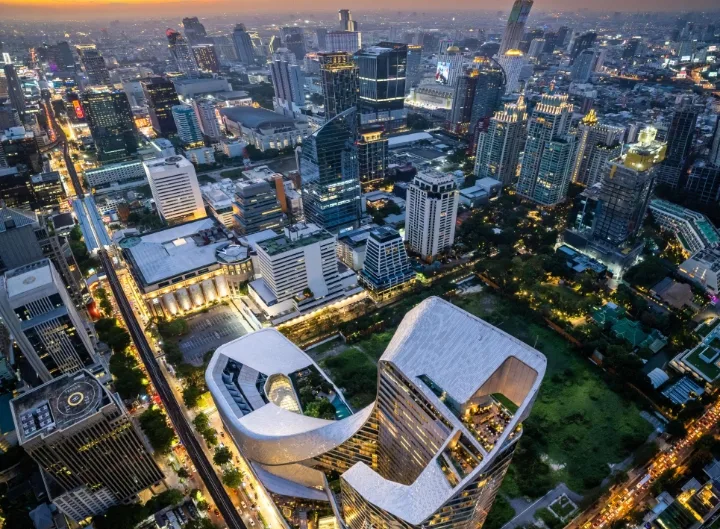
ASIATODAY.ID, BANGKOK — The World Bank Group has approved a US$200 million project to help Thailand accelerate the development of low-carbon cities through a financing platform that combines private investment, energy-efficiency projects, renewable energy, and carbon market mechanisms.
The Low Carbon Cities and Carbon Market Development Project (LCC) is designed to remove one of the biggest barriers to public-sector decarbonization by enabling government agencies to upgrade buildings and infrastructure without bearing the full upfront investment costs.
Under the model, qualified energy service companies (ESCOs) will finance and implement energy-efficiency and renewable-energy projects, while participating public institutions repay the investment over time using the savings generated from lower energy consumption.
The World Bank said the approach is expected to attract private capital, reduce public-sector energy costs, and create a scalable financing model that can be replicated across Thailand.
“Thailand is building more than individual clean-energy projects—it is creating a system that can turn many small and fragmented investments into a pipeline that can be financed and expanded nationwide,” said Melinda Good, World Bank Division Director for Thailand and Myanmar.
The project is expected to generate at least 1,800 job-years during implementation, supporting employment in renewable-energy installation, operations and maintenance, energy services, digital carbon monitoring, and emissions verification.
The Export-Import Bank of Thailand (EXIM Thailand) will finance qualified ESCOs undertaking projects for participating public agencies, initially including the Bangkok Metropolitan Administration and the Industrial Estate Authority of Thailand.
Meanwhile, Krungthai Bank will aggregate carbon credits generated by participating projects and connect them with carbon markets, creating additional revenue streams to support future low-carbon investments.
The initiative is supported by several key Thai institutions, including the Public Debt Management Office, the Department of Climate Change and Environment, the Bank of Thailand, the Securities and Exchange Commission, the Stock Exchange of Thailand, the Thailand Greenhouse Gas Management Organization, the Comptroller General’s Department, and the Bureau of the Budget.
Initial investments will focus on rooftop solar installations and energy-efficiency upgrades at public buildings, healthcare facilities, schools, district offices, industrial estates, and public street lighting.
According to the World Bank, the program is expected to install up to 180 megawatts of renewable-energy capacity and deliver approximately 448 gigawatt-hours of annual electricity savings, lowering operating costs while reducing greenhouse gas emissions.
The project also establishes a standardized financing and carbon-credit framework that could be replicated by cities and government agencies across Thailand as the country advances its carbon-neutrality and net-zero emissions targets.
The approval comes ahead of the 2026 IMF–World Bank Group Annual Meetings, scheduled to take place in Bangkok this October, where climate finance and sustainable development are expected to feature prominently on the agenda. (AT Network)
Follow Us at Google News, Instagram, WA Channel, and LinkedIn