
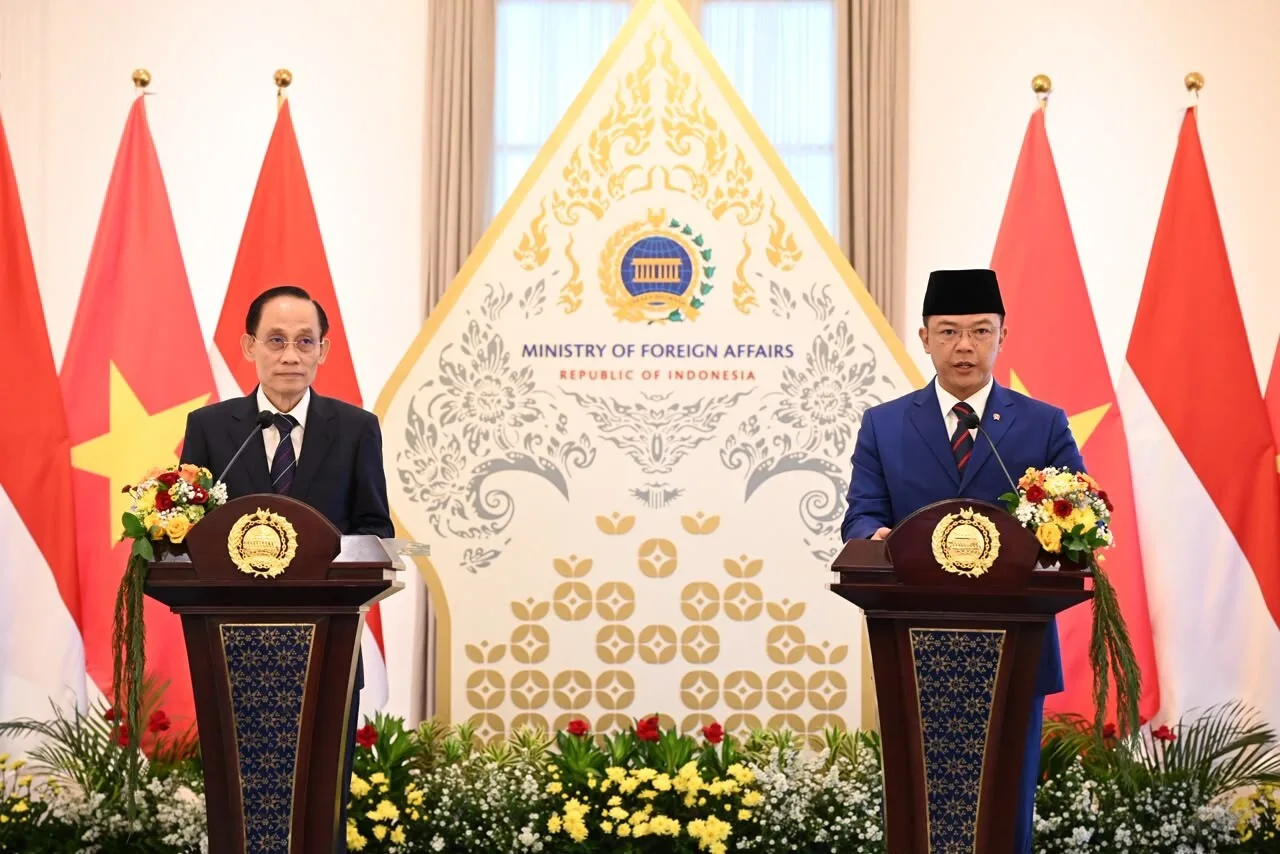
ASIATODAY.ID, JAKARTA — Indonesia and Viet Nam have entered a new phase of strategic cooperation after signing the 2026–2030 Plan of Action for the Implementation of the Comprehensive Strategic Partnership, a five-year roadmap designed to accelerate collaboration across economic, technological, security, and regional priorities.
The agreement was signed by Indonesian Foreign Minister Sugiono and Foreign Minister of the Socialist Republic of Viet Nam Le Hoai Trung during the 6th Indonesia–Viet Nam Joint Commission for Bilateral Cooperation (JCBC) held at the Pancasila Building, Ministry of Foreign Affairs of Indonesia, Jakarta, on July 14, 2026.
The action plan serves as a strategic guideline for implementing the Comprehensive Strategic Partnership agreed by both countries in 2025, translating the upgraded relationship into concrete programs that generate tangible benefits for the people of Indonesia and Viet Nam.
“By leveraging our complementary strengths, we will foster innovation, deepen cooperation, and advance shared prosperity for the benefit of both our nations,” Foreign Minister Sugiono said during the joint press conference.
Expanding Strategic Economic Cooperation
Under the new roadmap, Indonesia and Viet Nam agreed to strengthen cooperation across a wide range of strategic sectors, including: food security and agriculture; high-technology industries; digital economy; energy cooperation; healthcare; halal industry; science and technology; education and human resource development.
Economic cooperation remains one of the key pillars of the partnership. Both countries reaffirmed their commitment to achieving a bilateral trade target of US$18 billion by 2028.
To support this goal, Indonesia and Viet Nam will enhance trade and investment cooperation, including through the revitalization of the Joint Committee on Economic, Scientific and Technical Cooperation (JC-ESTC) as a platform to accelerate economic engagement.
Strengthening Maritime and Security Partnership
In the political and security fields, the two countries agreed to deepen coordination on strategic issues, including defense cooperation, maritime security, border matters, combating illegal, unreported and unregulated (IUU) fishing, and addressing transnational crimes.
As maritime nations with strategic positions in Southeast Asia, Indonesia and Viet Nam share common interests in maintaining a secure, open, and stable regional environment.
ASEAN Unity at the Center of Regional Stability
Beyond bilateral cooperation, the two foreign ministers exchanged views on regional and global developments, reaffirming the importance of maintaining ASEAN unity and centrality in responding to growing geopolitical challenges.
Indonesia and Viet Nam emphasized the need to strengthen ASEAN’s role in preserving peace, stability, and prosperity in Southeast Asia and the wider Indo-Pacific region.
Both countries also reiterated support for the ASEAN Five-Point Consensus as the main framework for addressing the situation in Myanmar.
The meeting also discussed developments in the Middle East and their potential implications for regional stability, international trade, energy security, and food resilience.
A New Era of Indonesia–Viet Nam Partnership
Closing the meeting, both sides reaffirmed their commitment to ensuring that the Comprehensive Strategic Partnership delivers practical outcomes and creates greater opportunities for cooperation.
Indonesia and Viet Nam established diplomatic relations on 30 December 1955. In 2025, the two countries elevated their ties to a Comprehensive Strategic Partnership, reflecting the growing importance of cooperation between two of ASEAN’s most dynamic economies.
Through the implementation of the 2026–2030 roadmap, Jakarta and Hanoi aim to build a stronger partnership based on innovation, economic resilience, regional connectivity, and shared prosperity.
The strengthened Indonesia–Viet Nam partnership is expected to become an important contribution to ASEAN’s efforts to maintain peace, stability, and sustainable growth across the Indo-Pacific. (AT Network)
Follow Us at Google News, Instagram, WA Channel, and LinkedIn