
ASIATODAY.ID, JAKARTA — Indonesia and Chile are moving to elevate their economic partnership as both countries seek to transform a growing trade relationship into a broader platform for investment, business cooperation, and market expansion.
The two countries see significant room to expand economic ties despite positive trade momentum. Bilateral trade reached US$535.5 million in 2025, with Indonesia recording a substantial trade surplus, reflecting strong export performance while highlighting untapped opportunities in the Chilean market.
The issue was discussed during a meeting between Indonesian Trade Minister Budi Santoso and Chilean Foreign Minister José Francisco Pérez Mackenna at the Ministry of Trade in Jakarta on Monday, July 20, 2026.
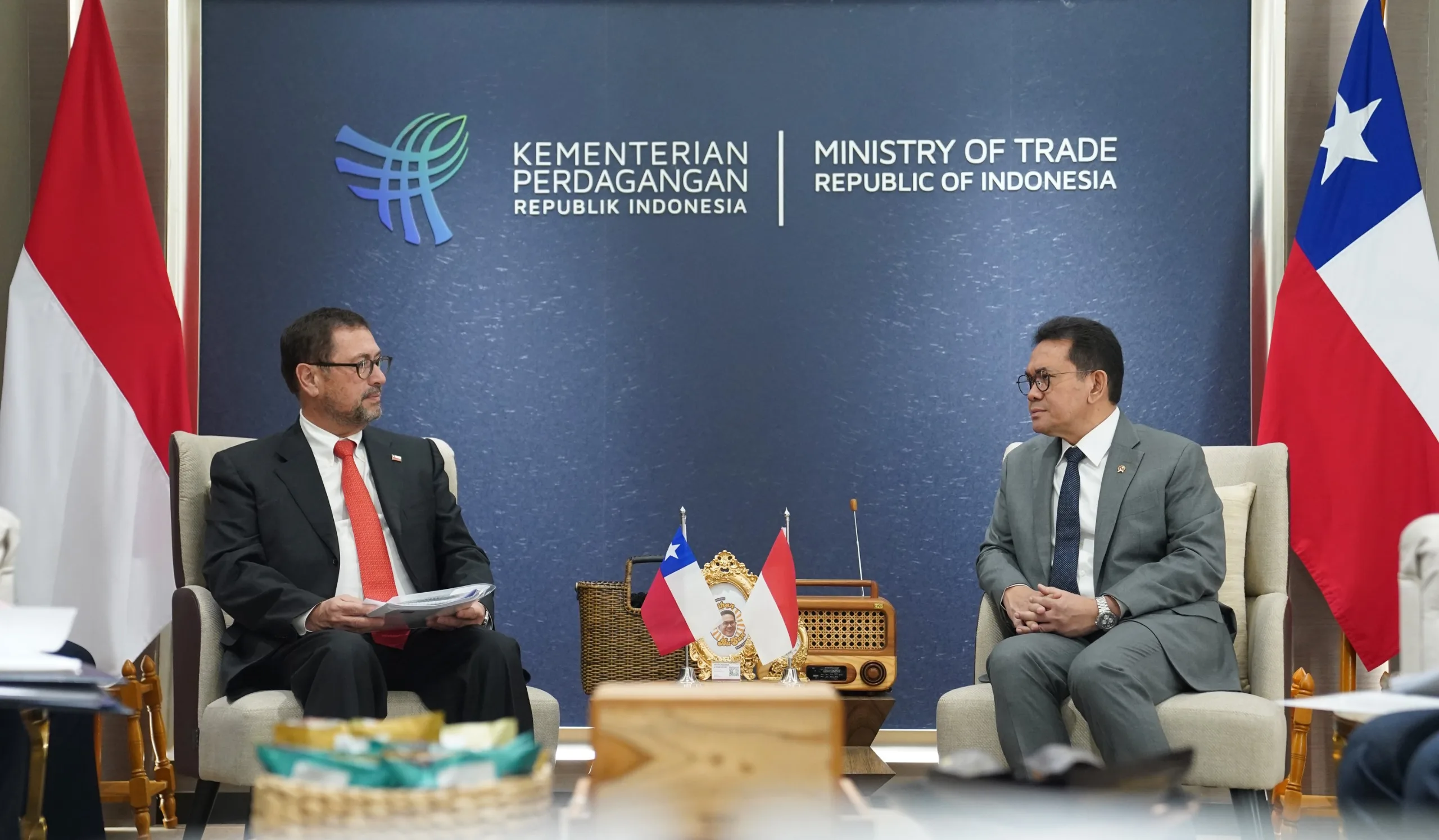
Santoso emphasized that Indonesia is committed to maximizing the benefits of the Indonesia–Chile Comprehensive Economic Partnership Agreement (IC-CEPA) as a strategic framework to strengthen trade and investment cooperation.
“Indonesia appreciates the continued progress in trade relations with Chile. The next step is to optimize IC-CEPA to increase trade value while expanding market access for businesses in both countries,” Santoso said.
IC-CEPA has become a key pillar of bilateral economic engagement. The agreement on trade in goods was implemented in 2019, followed by the services chapter in 2025. Both countries also launched negotiations on an investment chapter in 2024, with discussions continuing as part of efforts to build a more comprehensive economic partnership.
Indonesia aims for the investment negotiations to deliver a balanced, long-term framework that provides greater certainty for investors and encourages stronger cross-border investment flows.
Trade Surplus Opens New Growth Opportunities
Indonesia’s trade relationship with Chile has continued to show positive performance.
In 2025, total bilateral trade reached US$535.5 million, consisting of US$441.5 million in Indonesian exports and US$94 million in imports from Chile. The figures resulted in a trade surplus of US$347.5 million for Indonesia.
During January–May 2026, bilateral trade totaled US$226.2 million, with Indonesian exports reaching US$179.1 million and imports from Chile standing at US$47.1 million, generating a surplus of US$132.1 million.
Indonesia’s major exports to Chile include motor vehicles, mineral and chemical fertilizers, and footwear. Meanwhile, Chile’s main exports to Indonesia include frozen fish, chemical wood pulp, fertilizers, starch products, and wine.
However, both governments acknowledge that current trade volumes remain below the potential of the two economies.
Building Stronger Business and Investment Links
To accelerate trade expansion, Indonesia has encouraged stronger private-sector engagement between the two countries.
Santoso proposed the establishment of a bilateral Business Council to connect investors, exporters, and importers from Indonesia and Chile. The initiative is expected to strengthen business-to-business (B2B) cooperation and create more direct commercial opportunities.
Beyond trade in goods, Chile identified several promising areas for future collaboration, including technical education, pharmaceuticals, and green technology.
The meeting also highlighted growing cooperation in global and regional economic frameworks. Chile reaffirmed its support for Indonesia’s accession to the Comprehensive and Progressive Agreement for Trans-Pacific Partnership (CPTPP) and the Organisation for Economic Co-operation and Development (OECD).
Meanwhile, Chile expressed hope for Indonesia’s support for its accession to the Regional Comprehensive Economic Partnership (RCEP), strengthening both countries’ commitment to deeper regional economic integration.
With IC-CEPA entering a new phase and investment negotiations gaining momentum, Indonesia and Chile are positioning their partnership for broader trade, investment, and economic cooperation, strengthening connectivity between Southeast Asia and Latin America. (AT Network)
Follow Us at Google News, Instagram and LinkedIn