
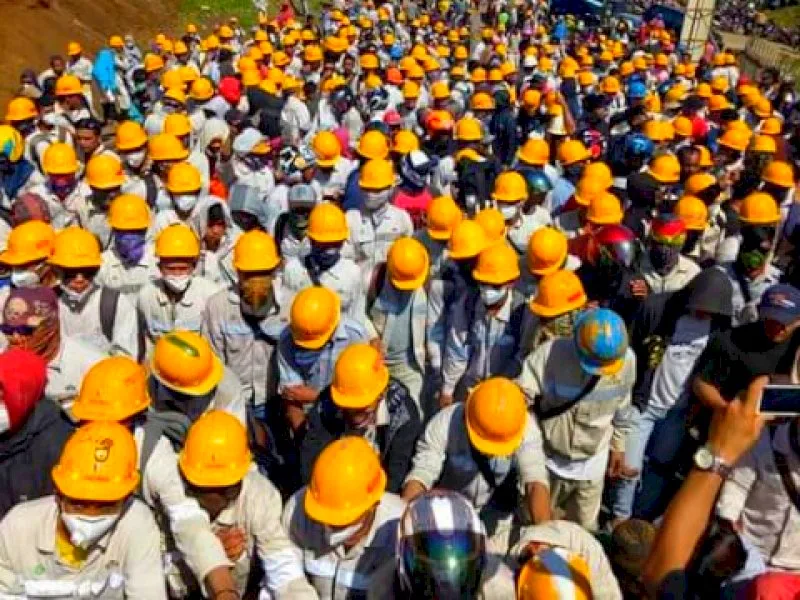
ASIATODAY.ID, JAKARTA – Indonesia’s nickel industry is entering a new phase of industrial expansion as the Indonesia Morowali Industrial Park (IMIP) attracts US$41.48 billion in investment, equivalent to around IDR696.9 trillion, while creating nearly 100,000 employment opportunities in Central Sulawesi.
The rapid growth of IMIP has transformed Morowali into one of Indonesia’s most important nickel-based industrial centers, reflecting the country’s strategy to move beyond raw commodity exports and build a stronger downstream manufacturing ecosystem.
According to PT Indonesia Morowali Industrial Park (IMIP), the expansion of investment has been supported by the development of production facilities, industrial infrastructure, and supporting businesses, resulting in a significant increase in workforce absorption.
The development comes amid growing global demand for critical minerals and increasing competition among countries to secure industrial supply chains, particularly for sectors linked to advanced manufacturing and clean energy technologies.
Investment Expansion Drives Employment Growth
The rise of IMIP has created one of the largest industrial employment hubs in eastern Indonesia.
IMIP data shows that the number of workers in the industrial area has increased significantly over recent years:
– 35,592 workers in 2020
– 74,350 workers in 2023
– 83,000 workers in 2024
– 89,849 workers by January 2026
– 97,427 active workers as of July 2026
Beyond direct employees, approximately 20,000 outsourced workers are engaged through contractors and supporting service providers operating within the industrial ecosystem.
The workforce includes 89,335 male workers and 8,092 female workers, demonstrating the scale of employment generated by the expansion of the nickel-based industrial sector.
“Industrial growth in Morowali, particularly in IMIP, has significantly contributed to employment development in Central Sulawesi,” said Emilia Bassar, Communication Director of PT IMIP, in an official statement.
Nickel Industry Becomes Regional Economic Engine
The expansion of IMIP has become an important driver of economic transformation in Central Sulawesi.
The industrial park currently hosts 52 companies involved in nickel processing, stainless steel production, carbon steel manufacturing, and related supporting industries.
The growth of industrial activity has contributed to rising formal employment in the province. Data from Indonesia’s Statistics Agency (BPS) shows that formal workers in Central Sulawesi increased from 477,200 people in August 2023 to 525,800 people in August 2025.
The manufacturing sector has also emerged as a key contributor to regional economic growth. In the first quarter of 2026, the processing industry expanded by 15.09 percent, becoming one of the fastest-growing sectors in Central Sulawesi.
Investment Creates Wider Economic Impact
The impact of IMIP extends beyond the industrial area, supporting the growth of local businesses and economic activities around Morowali.
Research by IMIP’s Survey and Research Department showed that micro, small, and medium enterprises (MSMEs) in Bahodopi District increased from 4,697 units in 2021 to 7,643 units in March 2025.
Although the number adjusted to 7,190 units in April 2026, employment absorption among existing businesses increased to 17,080 workers, indicating stronger business capacity and wider economic participation in communities surrounding the industrial zone.
Building Indonesia’s Industrial Workforce
As the nickel industry expands, developing skilled workers has become a key priority to support long-term competitiveness.
IMIP has established partnerships with vocational institutions and universities, including the Politeknik Industri Logam Morowali (PILM), Akademi Teknik Industri Makassar, Universitas Hasanuddin, and Universitas Tadulako.
The cooperation includes scholarships, industrial internships, competency certification, and industry-based learning programs designed to prepare Indonesian workers for modern manufacturing industries.
Morowali’s Role in Indonesia’s Industrial Transformation
The growth of IMIP represents a significant shift in Indonesia’s economic development model — from exporting raw resources toward building domestic industrial capacity and value-added manufacturing.
The transformation of Morowali has been supported by the participation of global industrial investors, including Tsingshan Holding Group, one of the world’s largest stainless steel and nickel producers and one of the key investors behind the development of the IMIP ecosystem.
Through its subsidiaries and partnerships within the industrial park, including PT Indonesia Tsingshan Stainless Steel (ITSS) and PT Tsingshan Steel Indonesia (TSI), Tsingshan has played a role in developing integrated processing facilities for nickel-based products and stainless steel manufacturing.
The involvement of global companies in IMIP reflects Indonesia’s growing importance in the global critical minerals and manufacturing landscape, as countries and industries seek more resilient supply chains for strategic materials.
At the same time, the development of Morowali illustrates Indonesia’s broader industrial strategy: attracting international investment while creating domestic employment opportunities and strengthening local manufacturing capabilities.
With investment approaching US$42 billion and employment nearing 100,000 workers, IMIP has become one of the clearest examples of Indonesia’s industrial transformation.
The next challenge will be ensuring that continued industrial expansion delivers long-term economic benefits while meeting global expectations on sustainability, environmental responsibility, and inclusive workforce development. (AT Network)
Follow Us at Google News, Instagram and LinkedIn