
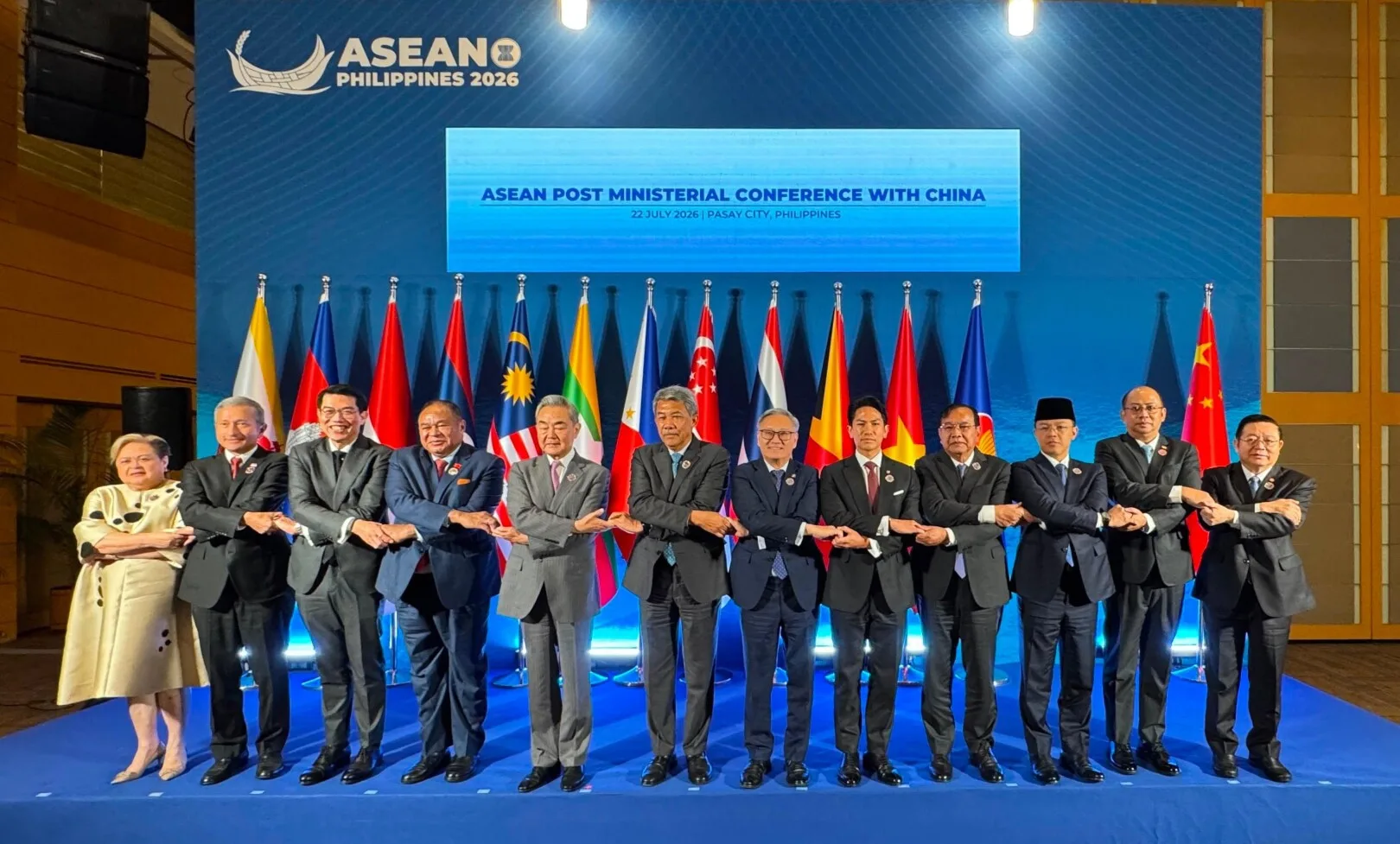
ASIATODAY.ID, MANILA — China has called for greater dialogue and cooperation with ASEAN to ensure that South China Sea tensions do not disrupt broader regional partnerships, as Southeast Asia continues to navigate complex geopolitical challenges.
Chinese Foreign Minister Wang Yi said maritime disputes should not become an obstacle to the long-standing relationship between China and ASEAN, emphasizing the importance of maintaining peace, stability and cooperation in the region.
“The South China Sea is a common home for countries in the region, and the issue should not become an obstacle to China-ASEAN relations,” Chinese Foreign Ministry spokesperson Lin Jian said, citing Wang Yi’s remarks during the China-ASEAN Foreign Ministers’ Meeting in Manila.
The statement came amid renewed tensions in the disputed waters following a confrontation between Chinese and Philippine maritime forces near Ren’ai Jiao, also known internationally as Second Thomas Shoal.
The incident prompted diplomatic protests from Manila and highlighted ongoing challenges surrounding overlapping maritime claims in one of the world’s most strategically important sea lanes.
Pushing Forward the Code of Conduct
Despite differences over maritime boundaries, China emphasized the need to accelerate negotiations on the Code of Conduct (COC) in the South China Sea, a regional framework designed to manage disputes and prevent escalation.
“China is ready to work with ASEAN countries to remove disruptions and accelerate consultations on the Code of Conduct,” Lin Jian said.
Beijing said regional countries have the ability and responsibility to manage differences while ensuring that peace, stability and cooperation remain the dominant theme in the South China Sea.
The call comes as ASEAN seeks to maintain its central role in regional affairs while balancing relationships with major powers, including China, the United States, Japan and India.
Trade Partnership Remains Strong
Beyond security issues, China highlighted the rapid expansion of economic cooperation with ASEAN.
Wang Yi pointed to the progress of the China-ASEAN Comprehensive Strategic Partnership, including the implementation of the upgraded China-ASEAN Free Trade Area 3.0 framework.
China and ASEAN have remained each other’s largest trading partners for six consecutive years, with economic cooperation expanding across trade, investment, infrastructure, digital transformation and supply chain connectivity.
The two sides are also strengthening cooperation in emerging sectors, including clean energy, green development, climate action, innovation and the blue economy.
Four Priorities for Future Cooperation
During the Manila meeting, Wang Yi outlined four priorities for the future of China-ASEAN relations.
First, maintaining a peaceful and open regional environment based on cooperation and inclusiveness.
Second, strengthening economic resilience and deeper integration through open cooperation.
Third, accelerating green and innovation-driven development, including renewable energy, climate solutions, green agriculture and the blue economy.
Fourth, ensuring that regional cooperation delivers practical benefits for communities across ASEAN and China.
The meeting also adopted a joint statement on addressing the impact of developments in the Middle East on the region and strengthening energy cooperation.
ASEAN Navigates a New Geopolitical Era
The South China Sea remains one of Asia’s most sensitive geopolitical issues, involving overlapping claims by China, the Philippines, Vietnam, Malaysia, Brunei and Taiwan.
However, the waters are also a vital artery for global trade, with trillions of dollars in goods passing through the region every year.
For ASEAN, maintaining stability in the South China Sea is critical not only for security but also for investment confidence, supply chain resilience and long-term economic growth.
As competition among major powers intensifies, ASEAN continues to promote dialogue and cooperation as the foundation for regional stability. (AT Network)
Follow Us at Google News, Instagram and LinkedIn