
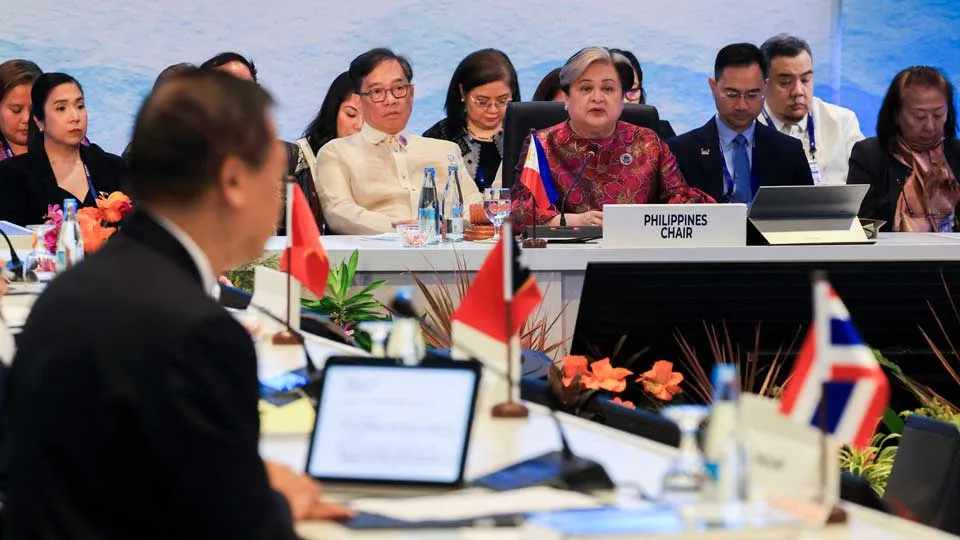
ASIATODAY.ID, MANILA — A diplomatic clash between China and the Philippines erupted during the ASEAN Foreign Ministers’ Meeting in Manila, as both sides exchanged strong protests over a recent maritime confrontation in the disputed South China Sea.
The confrontation highlighted growing tensions between the two countries, whose relations have deteriorated in recent years due to repeated disputes over competing maritime claims and encounters involving coast guard vessels.
Philippine Foreign Minister Maria Theresa Lazaro said Manila had reiterated its protest against what she described as “unacceptable actions” toward Philippine personnel during the latest incident.
Chinese Foreign Minister Wang Yi responded by delivering a counter-protest, accusing Philippine personnel of carrying out “provocative actions” and allegedly ramming a Chinese law enforcement vessel.
The exchange took place on the sidelines of the ASEAN ministerial meeting in Pasay, Manila, where regional foreign ministers gathered to discuss security and cooperation issues across Southeast Asia.
China and Philippines Trade Accusations
The dispute followed an incident on Monday (July 20), when the Philippines accused Chinese Coast Guard personnel of striking a Philippine Navy staff member on the head with a wooden stick during a confrontation at sea.
Beijing rejected the accusation, saying Philippine personnel were responsible for initiating the confrontation and had collided with a Chinese patrol vessel.
Both governments have presented different accounts of the incident, further intensifying tensions in one of Asia’s most contested maritime regions.
Wang Yi Warns Relations at a Crossroads
During his meeting with Lazaro, Wang Yi said China-Philippines relations had reached a critical point and urged Manila to make a “correct and rational choice” regarding the future direction of bilateral ties.
The Chinese foreign minister also accused certain groups within the Philippine military and police of deliberately creating tensions, damaging dialogue efforts, and acting under influence from external forces.
Manila has consistently maintained that its actions are aimed at protecting its sovereign rights and maritime interests under international law.
South China Sea Remains Asia’s Major Security Flashpoint
The South China Sea remains one of the world’s most strategically important waterways, carrying major global trade routes and containing significant natural resources.
China claims sovereignty over almost the entire South China Sea, while the Philippines and several other Southeast Asian countries maintain competing claims.
A 2016 international arbitration ruling rejected Beijing’s expansive maritime claims, but China has refused to recognize the decision.
Scarborough Shoal — known in China as Huangyan Dao — remains among the most sensitive disputed areas between Beijing and Manila.
The latest confrontation adds pressure on ASEAN as the regional bloc continues efforts to maintain peace and accelerate negotiations on a long-awaited Code of Conduct for the South China Sea.
Observers warn that repeated maritime incidents could further complicate ASEAN’s efforts to manage regional security challenges amid increasing strategic competition in the Indo-Pacific. (AT Network)
Follow Us at Google News, Instagram and LinkedIn