
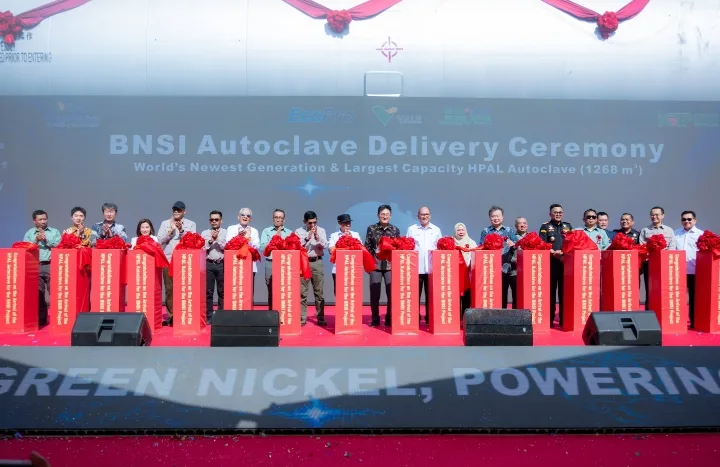
ASIATODAY.ID, MOROWALI — Indonesia’s push to strengthen its position in the global electric vehicle (EV) battery supply chain reached another milestone after PT Vale Indonesia Tbk received the first autoclave for its High Pressure Acid Leaching (HPAL) project in Morowali, marking a significant step toward large-scale production of battery-grade nickel materials.
The autoclave—one of the most critical components in HPAL technology—arrived at the Sambalagi processing facility in Central Sulawesi on Wednesday. Once operational, it will enable the processing of limonite ore into Mixed Hydroxide Precipitate (MHP), an essential intermediate material used in lithium-ion batteries for electric vehicles.
The milestone brings one of Indonesia’s flagship downstream nickel projects closer to commercial production as Southeast Asia’s largest economy accelerates efforts to capture more value from its vast mineral resources and establish itself as a strategic supplier in the global clean-energy economy.
The project is being developed by PT Bahodopi Nickel Smelting Indonesia (BNSI), a joint venture between PT Vale Indonesia, China’s GEM Co. Ltd., and South Korea’s EcoPro. Located within the Indonesia Green Industrial Park (IGIP) in Morowali, Central Sulawesi, the integrated development combines mining and advanced hydrometallurgical processing to support Indonesia’s long-term ambition of building a complete electric vehicle battery ecosystem.
Designated as a National Strategic Project (PSN), the development reflects Jakarta’s industrial policy of expanding domestic mineral processing, attracting technology-intensive investment, and strengthening the country’s position in global supply chains for critical minerals.
The HPAL facility is expected to process approximately 10.4 million tonnes of limonite ore annually from PT Vale’s Bahodopi mine, producing around 90,000 tonnes of contained nickel each year in the form of MHP. Construction is progressing across three production lines, with first mechanical completion targeted by the end of 2026.
“The arrival of the autoclave represents a major milestone for the Sambalagi HPAL Project,” PT Vale President Director and Chief Executive Officer Bernardus Irmanto said.
“As the core of the HPAL process, this equipment will transform Indonesia’s limonite resources into high-value battery materials that support the global electric mobility industry while reinforcing our commitment to sustainable downstream development.”
Low-carbon industrial development
The Sambalagi project has been designed to support Indonesia’s broader decarbonization agenda by integrating lower-carbon technologies into its operations.
The facility will utilize a Waste Heat Recovery Power Generation (WHRPG) system that converts excess industrial heat into electricity, improving energy efficiency while reducing emissions. Solar power generation is also planned as part of efforts to increase the use of renewable energy across the industrial complex.
In addition to the processing plant, the project includes supporting infrastructure such as logistics facilities, utilities, worker accommodation, and community amenities intended to support long-term industrial operations and regional development.
Government highlights sustainable downstream strategy
Minister of Investment and Downstream Industry and Head of Indonesia’s Investment Coordinating Board (BKPM), Rosan Perkasa Roeslani, described the project as an example of Indonesia’s next phase of industrial transformation, where downstream processing is expected to deliver higher economic value while meeting international sustainability standards.
He said the collaboration between Indonesian, Chinese, and South Korean partners demonstrates how cross-border investment can strengthen Indonesia’s resource sovereignty, create skilled jobs, encourage technology transfer, and accelerate industrial development.
“The Sambalagi HPAL project is more than an industrial investment. It is part of a broader effort to build an integrated downstream ecosystem that creates long-term value for Indonesia,” Rosan said.
During his visit to the Morowali site, Rosan also reviewed PT Vale’s environmental initiatives, including its nursery and land rehabilitation programs supporting post-mining restoration.
He praised the company’s implementation of Environmental, Social and Governance (ESG) principles, saying responsible mining practices would become increasingly important as global manufacturers seek reliable and sustainable sources of critical minerals.
Regional support
Central Sulawesi Vice Governor Reny Arniwaty Lamadjido welcomed the project’s progress, saying it demonstrates how downstream investment can create employment, expand opportunities for local businesses, and improve public facilities.
Morowali Regent Iksan Baharudin Abdul Rauf said the project would further strengthen the regency’s position as one of Indonesia’s leading centers for mineral processing while generating long-term economic benefits for local communities.
Strategic role in the global battery market
The arrival of the autoclave marks the beginning of the next phase of development, leading toward equipment installation, commissioning, and commercial production.
As governments and manufacturers race to secure supplies of critical minerals for electric vehicles and energy storage, projects such as Sambalagi are becoming increasingly important to Indonesia’s ambition of moving beyond raw material exports and establishing itself as a leading producer of value-added battery materials.
For PT Vale and its international partners, the Morowali development represents more than another nickel processing facility. It signals Indonesia’s growing role in the global energy transition, where sustainable production, advanced processing technology, and resilient supply chains are becoming decisive competitive advantages. (AT Network)
Follow Us at Google News, Instagram and LinkedIn