
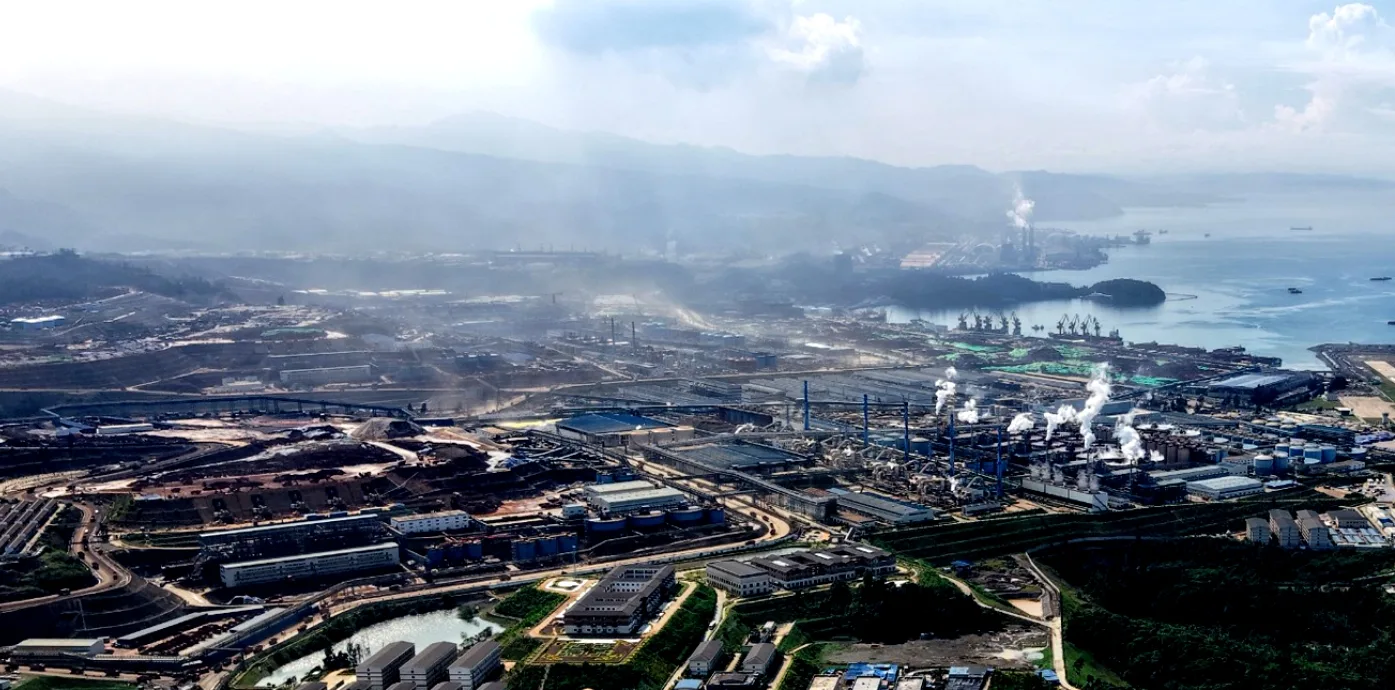
ASIATODAY.ID, NORTH MALUKU – PT Indonesia Weda Bay Industrial Park (IWIP) marked its 7th year of operation on August 30, 2025.
Established on the coasts of Central and North Weda, this nickel industrial hub has grown into the world’s largest integrated nickel downstreaming facility, with investments reaching IDR 240 trillion (US$15 billion).
But behind the government’s and corporations’ narrative of “progress” and “energy transition,” the Mining Advocacy Network (JATAM) describes IWIP as nothing more than a new face of “extractive colonialism.” Local communities, they argue, are being squeezed by land grabs, food insecurity, water pollution, and severe health threats.
JATAM: IWIP Represents Plunder and Conquest of Nature
In its official statement, JATAM stressed that IWIP’s massive expansion has destroyed farmland, displaced plantations, and polluted rivers that once provided clean water and food security for surrounding villages. Ironically, residents who previously had free access to water must now pay a high price for clean water.
“The entire IWIP operation is a manifestation of plundering people’s livelihoods. The state stands with corporations, not with its citizens,” JATAM declared.
Research by Nexus3 Foundation and Tadulako University revealed that workers and nearby residents have been exposed to mercury and arsenic at levels exceeding safety thresholds. Other studies reported increased levels of harmful pollutants, such as nitrogen dioxide (NO2) and sulfur dioxide (SO2), which have triggered acid rain with dangerously low pH levels in Halmahera.
Nickel Expansion Threatens Small Islands
IWIP does not operate in isolation. Its nickel ore is supplied by mines in Central and East Halmahera, as well as from small islands like Gebe, Fau, and Gag in Raja Ampat, West Papua. Mining activities have devastated rice fields, rivers, and marine ecosystems. Local fishers complain that nickel barges disrupt traditional fishing grounds, cutting into their daily catch.
Meanwhile, plans to quarry limestone in the Sagea karst area and the reliance on coal to fuel IWIP’s massive power plants add to the growing list of ecological risks in North Maluku.
IWIP Claims to Drive Downstreaming and Green Energy
On the corporate side, IWIP maintains that it is strengthening Indonesia’s nickel downstreaming sector. By early 2025, IWIP had attracted US$15 billion (IDR 240 trillion) in foreign and domestic investment from China, France, Australia, India, South Korea, Taiwan, and Indonesia.
According to IWIP Director Scott Ye, the company is advancing an additional US$8 billion investment in three national strategic sectors:
1. Nickel downstreaming and EV battery production (US$5 billion)
2. Renewable energy with 2 GW of solar power and 500 MW of wind power (US$2 billion)
3. Electrolytic aluminum smelter for EV structures, battery components, and clean energy infrastructure (US$1 billion)
“These projects not only strengthen Indonesia’s position in the global EV supply chain but also mark IWIP’s transformation into an industrial hub driven by technology, sustainability, and clean energy,” Ye said.
Progress or Crisis?
While hailed as a cornerstone of Indonesia’s industrialization and energy transition, IWIP also symbolizes the stark contradictions of extractive development.
JATAM estimates that 17,747 local residents live directly in IWIP’s shadow, facing pollution, the loss of farmland, and violations of their constitutional right to a clean and healthy environment.
On one hand, IWIP is celebrated as a driver of downstreaming and green technology. On the other, it stands as a stark reminder of the human and ecological costs of the global energy transition—a tale of billion-dollar investments alongside communities in Halmahera struggling for land, water, and clean air. (AT Network)
Follow Us at Google News and WA Channel