
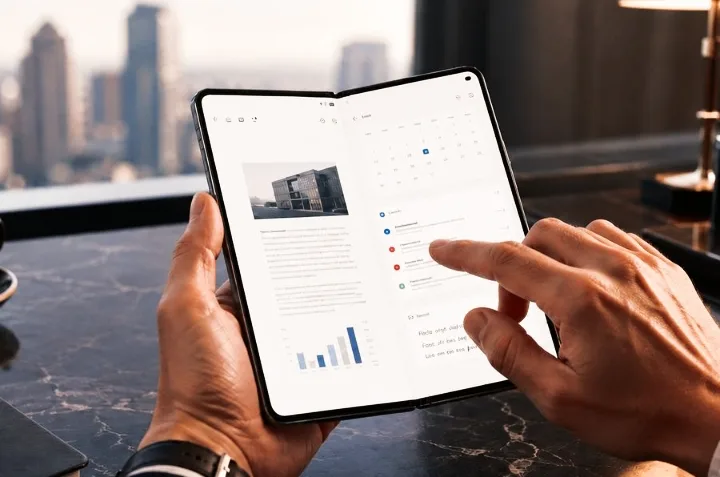
ASIATODAY.ID, JAKARTA — Artificial intelligence is rapidly evolving from an experimental technology into an everyday digital companion across Southeast Asia and Oceania, as consumers increasingly rely on AI-powered features through their smartphones.
New data released by Samsung Electronics shows that AI adoption among users of the Galaxy Z Fold7 and Galaxy Z Flip7 increased from 84% in August 2025 to 96% in June 2026, highlighting the growing role of AI in everyday activities ranging from information searches and productivity to content creation and photo editing.
The figures were announced following the launch of Samsung’s Galaxy Z8 Series at the Galaxy Unpacked event in London, where company executives discussed how mobile AI is entering a new phase centered on personalization and seamless integration rather than simply adding more features.
The report also showed that sales of Samsung’s seventh-generation Galaxy Z foldable smartphones increased nearly 15% compared with the previous generation across Southeast Asia and Oceania, suggesting that demand for premium foldable devices continues to strengthen as AI capabilities become an increasingly important purchasing consideration.
Among the most widely used Galaxy AI features are Circle to Search, Now Brief, and Photo Assist, reflecting consumers’ growing preference for AI tools that simplify daily tasks instead of requiring separate applications.
“The next phase of AI is no longer about adding more features, but about delivering experiences that are increasingly relevant for every user,” said CU Kim, President and CEO of Samsung Electronics Southeast Asia and Oceania.
According to Kim, AI will become increasingly personalized as Galaxy AI expands across Samsung’s broader ecosystem of smartphones, tablets, wearables and connected devices, allowing the technology to better understand user preferences and provide context-aware assistance.
Samsung also announced that Galaxy AI now supports 22 languages, including Indonesian, Thai, Vietnamese and Filipino, as part of its strategy to broaden AI accessibility across diverse markets in Asia.
Meanwhile, Won-Joon Choi, President and COO of Samsung Electronics’ Mobile eXperience (MX) Business and Head of the R&D Office, said the next generation of mobile AI will depend on intelligent systems capable of working naturally in the background without disrupting users.
Rather than relying on a single AI model, Samsung is developing Galaxy AI as an open platform capable of supporting multiple AI agents that can operate seamlessly across applications, services and device functions, giving users greater flexibility depending on their needs.
Powered by One UI 9, the latest Galaxy Z8 Series introduces deeper system-level integration that enables AI agents to interact across the smartphone ecosystem, enhancing productivity, creativity and everyday convenience.
The latest data also reflects a broader shift within the global smartphone industry, where manufacturers are increasingly positioning artificial intelligence as a defining feature of premium devices.
As competition moves beyond hardware specifications toward intelligent software experiences, AI is expected to become one of the key drivers of future smartphone upgrades, particularly in fast-growing digital markets such as Southeast Asia.
For Samsung, the growing adoption of Galaxy AI and continued demand for foldable devices underscore the company’s ambition to remain at the forefront of the next wave of mobile computing, where smartphones are evolving into personalized AI companions rather than simply communication devices. (AT Network)
Follow Us at Google News, Instagram and LinkedIn