
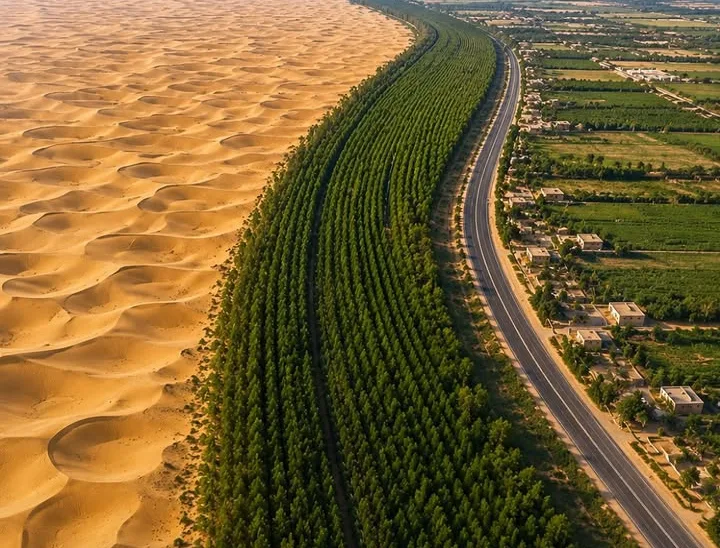
ASIATODAY.ID, BEIJING — As countries intensify efforts to meet global climate targets, China and Indonesia are advancing two of Asia’s most ambitious forest restoration programs through different but complementary strategies.
China’s Great Green Wall program is estimated to have planted around 66 billion trees over nearly five decades, according to a study highlighted by Live Science, while Indonesia is accelerating a nationwide campaign to plant 2 billion trees, placing mangrove restoration at the heart of its climate resilience strategy.
Together, the two initiatives demonstrate how nature-based solutions are becoming an increasingly important pillar of climate policy, helping countries reduce carbon emissions, restore degraded ecosystems and strengthen resilience against worsening climate impacts.
Launched in 1978, China’s Great Green Wall was designed to curb desertification across the country’s northern regions. Since then, it has grown into one of the world’s largest afforestation initiatives, transforming vast areas of degraded land into productive forest landscapes while increasing carbon sequestration and improving ecological conditions.
Research led by landscape ecologist Yuhang Luo compared planted forests with naturally regenerated forests using satellite observations of canopy density, leaf area and carbon uptake. The study found that plantation forests expanded leaf area 66 percent faster and recorded tree growth rates 4.6 percent higher, largely because they are dominated by younger, faster-growing trees.
The researchers also emphasized that while plantation forests can accelerate carbon absorption during their early stages of growth, natural forests remain irreplaceable for long-term carbon storage, biodiversity conservation and ecosystem resilience.
“Planted forests can be a powerful tool for short-term carbon removal, but natural forests remain essential for long-term carbon storage and ecological stability,” Luo said.
Among the program’s most notable achievements is Saihanba National Forest Park, where once-barren land has been transformed into one of the world’s largest planted forests, covering more than 76,000 hectares.
Indonesia Bets on Mangrove Restoration
While China has concentrated on expanding inland forest cover, Indonesia is prioritizing the restoration of mangrove ecosystems, widely regarded as among the world’s most effective blue carbon ecosystems because of their exceptional capacity to capture and store carbon while protecting vulnerable coastlines.
On July 3, Environment Minister Moh Jumhur Hidayat led a large-scale mangrove planting campaign in Brebes, Central Java, under the theme “Plant Today for Future Generations.” The initiative forms part of Indonesia’s national goal of planting 2 billion trees while strengthening the resilience of coastal communities.
According to the Ministry of Environment/Environmental Control Agency of Indonesia, approximately 770,000 hectares of mangrove habitat across the country still require restoration through collaboration among government institutions, local authorities, businesses, universities and community organizations.
“Mangrove planting is not simply about planting trees. It is about restoring ecosystems, protecting coastlines and safeguarding the future of communities that depend on healthy coastal environments,” Minister Jumhur said.
Healthy mangrove forests not only store significant amounts of carbon but also reduce coastal erosion, buffer tidal flooding and storm surges, support fisheries and preserve biodiversity, making them one of the most valuable natural assets for climate adaptation.
Different Strategies, Shared Climate Goals
Although China and Indonesia have adopted different restoration strategies, both countries are placing forests at the center of their climate policies.
China has prioritized large-scale afforestation to combat desertification and expand forest cover, while Indonesia is focusing on ecosystem restoration that integrates climate mitigation with biodiversity conservation and coastal protection.
Environmental experts increasingly agree that effective climate action requires both approaches: expanding forest cover where appropriate while protecting and restoring natural ecosystems that provide lasting ecological resilience.
As climate pressures continue to intensify, the experiences of China and Indonesia underscore a broader global lesson: the success of climate action will be measured not only by the number of trees planted, but also by the resilience, biodiversity and long-term health of the ecosystems those trees help sustain. Together, the two countries are reinforcing Asia’s growing leadership in advancing nature-based solutions to the global climate challenge. (AT Network)
Follow Us at Google News, WA Channel, and LinkedIn