
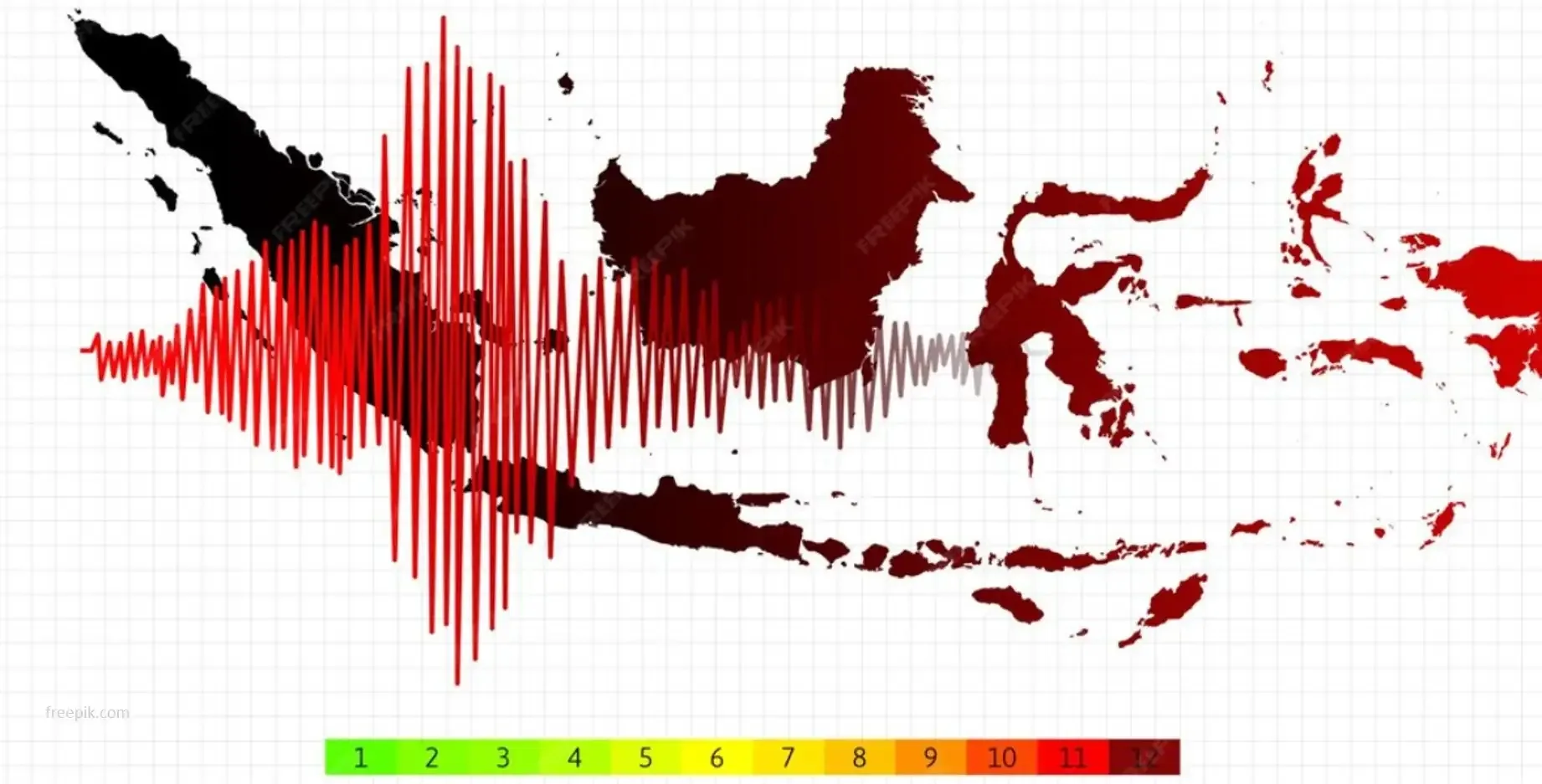
ASIATODAY.ID, JAKARTA – The threat of a megathrust earthquake has once again captured global scientific attention.
For Indonesia—located squarely along the Pacific Ring of Fire—the risk of a devastating seismic event is no longer hypothetical but a matter of time. This warning emerged during Geohazard Webinar #5, themed “Understanding Geohazard With GNSS”, hosted by BRIN’s Disaster Research Center on Tuesday, December 2, 2025.
Prof. Kosuke Heki of Hokkaido University emphasized that the seismic pattern observed in Japan’s Nankai Trough offers critical lessons for Indonesia.
“We now understand that magnitude-8 earthquakes occur more frequently than previously thought, roughly every 50–100 years,” he explained.
Although an exact timeline remains unpredictable, the buildup of tectonic stress in subduction zones can be monitored using long-term deformation measurements such as GNSS and seafloor geodesy.
Heki elaborated that interseismic coupling—even in the shallowest sections of the plate boundary—accumulates significant strain prior to a megathrust rupture.
He also highlighted the importance of detecting slow slip events (SSEs), subtle fault movements that often precede major earthquakes.
“These events have been repeatedly observed in the Nankai Trough and may trigger the next major trench earthquake,” he noted.
He stressed that Indonesia, with its long chain of active subduction zones stretching across Mentawai, Java, Bali, Lombok, and Maluku, is well positioned to adopt similar monitoring systems.
“I am currently working on this issue in Indonesia,” Heki added, affirming his support for advancing the country’s earthquake mitigation capabilities.
Jakarta’s Hidden Seismic Risk
Beyond megathrust scenarios, local faults also pose significant threats. Endra Gunawan, Associate Professor at ITB, presented new findings on the seismic potential of the Jakarta Fault.
Using GNSS slip-rate analysis, he identified crustal deformation of about three millimeters per year, with a locking depth of seven kilometers and a dip angle of 63 degrees southward.
“These findings open new possibilities for modeling seismic hazards in one of the world’s most densely populated urban regions,” Endra stated.
His research reinforces the message that deformation-based monitoring is essential for modern disaster preparedness.
BIG: National GNSS Integration Is Crucial
The third speaker, Muhammad Al Kautsar of the Geospatial Information Agency (BIG), underscored the role of integrated GNSS networks in monitoring geohazards across Indonesia.
“The dynamics of tectonic plate movement carry serious implications. Indonesia will continue to experience significant earthquakes and volcanic activity,” he warned.
He explained how BIG’s CORS network is being used to monitor micro-movements and daily deformation patterns that signal potential seismic activity.
In conclusion, the megathrust threat confronting Indonesia is real and increasingly urgent. With comprehensive GNSS monitoring, long-term deformation analysis, and integrated national geospatial data, Indonesia can strengthen its mitigation strategies before the next major disaster strikes. (AT Network)
Follow Us at Google News and WA Channel