
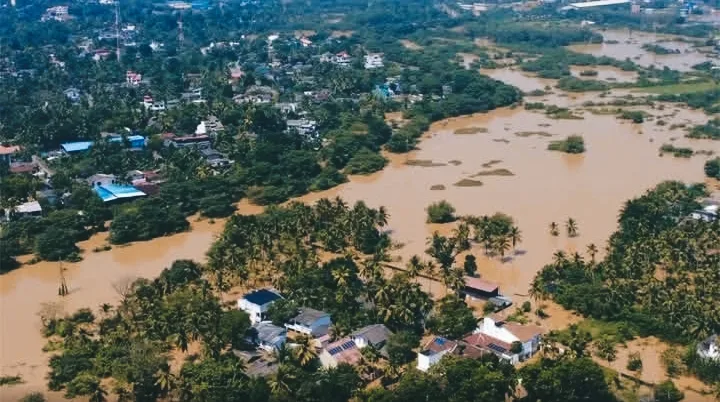
ASIATODAY.ID, COLOMBO — Nearly one month after Cyclone Ditwah battered Sri Lanka, the humanitarian crisis gripping the island nation shows little sign of easing.
More than one million people, including hundreds of thousands of children, remain in urgent need of assistance as floods, landslides, and renewed rainfall continue to deepen the impact of one of the country’s worst disasters in decades.
Cyclone Ditwah made landfall on Sri Lanka’s eastern coast on 28 November 2025, triggering widespread flooding and deadly landslides across all 25 districts.
While some displaced families have begun returning home, fresh downpours have caused new floods, road closures, and renewed displacement—particularly in the central districts of Kandy, Nuwara Eliya, and Polonnaruwa.
1.8 Million Affected, Children Most at Risk
United Nations assessments indicate that around 1.8 million people, or eight per cent of Sri Lanka’s population, have been directly affected. Of those, more than 1.2 million people require humanitarian assistance, including approximately 527,000 children.
A joint rapid needs assessment conducted by national authorities and humanitarian partners confirmed extensive damage across all nine provinces, severe disruption to essential services, and heightened risks for women, children, and persons with disabilities.
Food insecurity is worsening rapidly. Nearly one in three households is now food insecure, with many families resorting to coping strategies such as reducing the number and quality of daily meals.
Schools Damaged, Child Protection Under Threat
The UN Children’s Fund (UNICEF) reports critical gaps in child protection, education, nutrition, and water, sanitation and hygiene (WASH) services.
Thousands of children remain displaced in overcrowded shelters or with host families, where inadequate lighting, privacy, and sanitation significantly increase protection risks, including gender-based violence and exploitation.
The education sector has been severely disrupted. More than 1,300 schools and six universities have been damaged, while around 500 schools continue to operate as temporary shelters.
Authorities have begun relocating students to nearby functioning schools, but humanitarian agencies warn that temporary learning spaces are urgently needed to prevent prolonged interruptions to education.
Hundreds Dead, Hundreds of Thousands Still Displaced
The International Organization for Migration (IOM) estimates that more than 272,000 people remain displaced, most of them staying with host communities, while others are sheltering in schools, religious buildings, and community centres.
As of mid-December, authorities reported 643 deaths and 183 people still missing. An estimated 107,000 homes have been damaged or destroyed, making shelter one of the most urgent humanitarian needs.
Billions in Economic Losses
Cyclone Ditwah has also delivered a heavy blow to Sri Lanka’s economy. A rapid post-disaster assessment by the World Bank estimates total damage at US$4.1 billion, equivalent to four per cent of the country’s Gross Domestic Product (GDP).
Agriculture has been among the hardest-hit sectors, with losses exceeding US$800 million. More than 58,000 hectares of paddy fields have been flooded, threatening food production and the livelihoods of tens of thousands of smallholder farmers.
Funding Shortfalls Threaten Recovery
At the Government’s request, the United Nations and its humanitarian partners launched a Humanitarian Priorities Plan seeking US$35.3 million to support the most vulnerable communities.
However, funding remains critically low. UNICEF alone requires US$7.8 million to sustain its emergency response for children, yet less than half of that amount has been received or pledged so far.
Humanitarian agencies warn that without sustained international support, Sri Lanka’s recovery will be slow and uneven, leaving millions—especially children—at continued risk of hunger, disrupted education, and protection crises as the country struggles to recover from a disaster that is far from over. (AT Network)
Follow Us at Google News and WA Channel