
ASIATODAY.ID, TEHRAN – Global energy markets are on edge as tensions between Iran and the United States intensify.
Crude oil prices have jumped nearly 10 percent in three consecutive sessions, driven by Tehran’s threat to block the strategic Strait of Hormuz — a chokepoint that carries roughly one-fifth of the world’s oil supply.
A senior adviser to the Islamic Revolutionary Guard Corps (IRGC) warned that Iranian forces could set ablaze any tanker attempting to pass through the strait if a blockade is enforced.
He claimed oil prices could surge to $200 per barrel should the waterway effectively close.
Brent Nears $82, WTI Climbs
On Tuesday (March 3, 2026):
– Brent crude futures traded around $79.85 per barrel
– WTI futures stood at $73.15 per barrel
– Murban crude reached approximately $80.41 per barrel
Brent had briefly touched $82.37 per barrel a day earlier before easing slightly at market close.
The cumulative rally reflects escalating hostilities involving Iran and the US-backed bloc, including Israel.
Shipping Traffic Drops 80 Percent
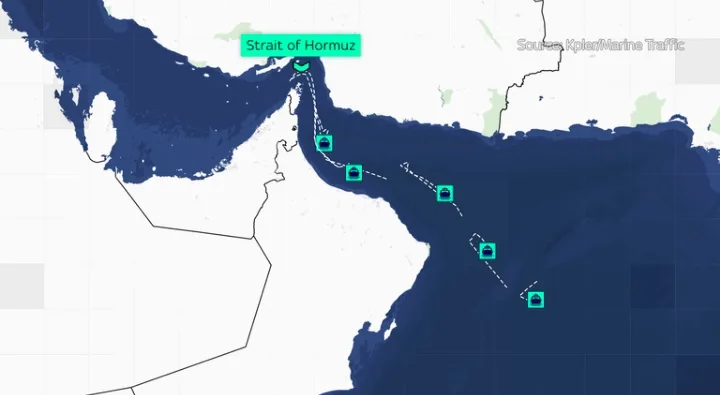
Maritime intelligence analysts report that traffic through the Strait of Hormuz has fallen by as much as 80 percent amid mounting security risks. Insurance premiums for vessels have surged to their highest levels in six years.
Many commercial operators are rerouting ships, adding longer transit times and significantly higher freight and insurance costs.
A functional closure of Hormuz would severely affect:
– Gulf oil exporters
– Major Asian importers such as China, India, Japan, and South Korea
– Europe, where nearly 30 percent of jet fuel supplies transit the strait
US Fuel Prices Climb Above $3 per Gallon
In the United States, the impact is already visible. The national average gasoline price has risen above $3 per gallon for the first time since November, while diesel approaches $3.80 per gallon.
US Secretary of State Marco Rubio said Washington has prepared phased measures to mitigate price shocks, coordinating with Energy Secretary Chris Wright and Treasury Secretary Scott Bessent.
However, market analysts warn that without a credible de-escalation pathway, volatility in global energy markets is likely to intensify.
A World Holding Its Breath
Technically, the Strait of Hormuz remains open — but operationally, it is increasingly constrained. A prolonged confrontation could not only drive oil toward the projected $200 per barrel mark, but also risk drawing Gulf states deeper into the conflict.
The central question now:
Is Iran’s threat a strategic pressure tactic — or the opening chapter of a full-scale energy crisis?
For global markets, the answer could redefine 2026. (AT Network)
Follow Us at Google News and WA Channel