
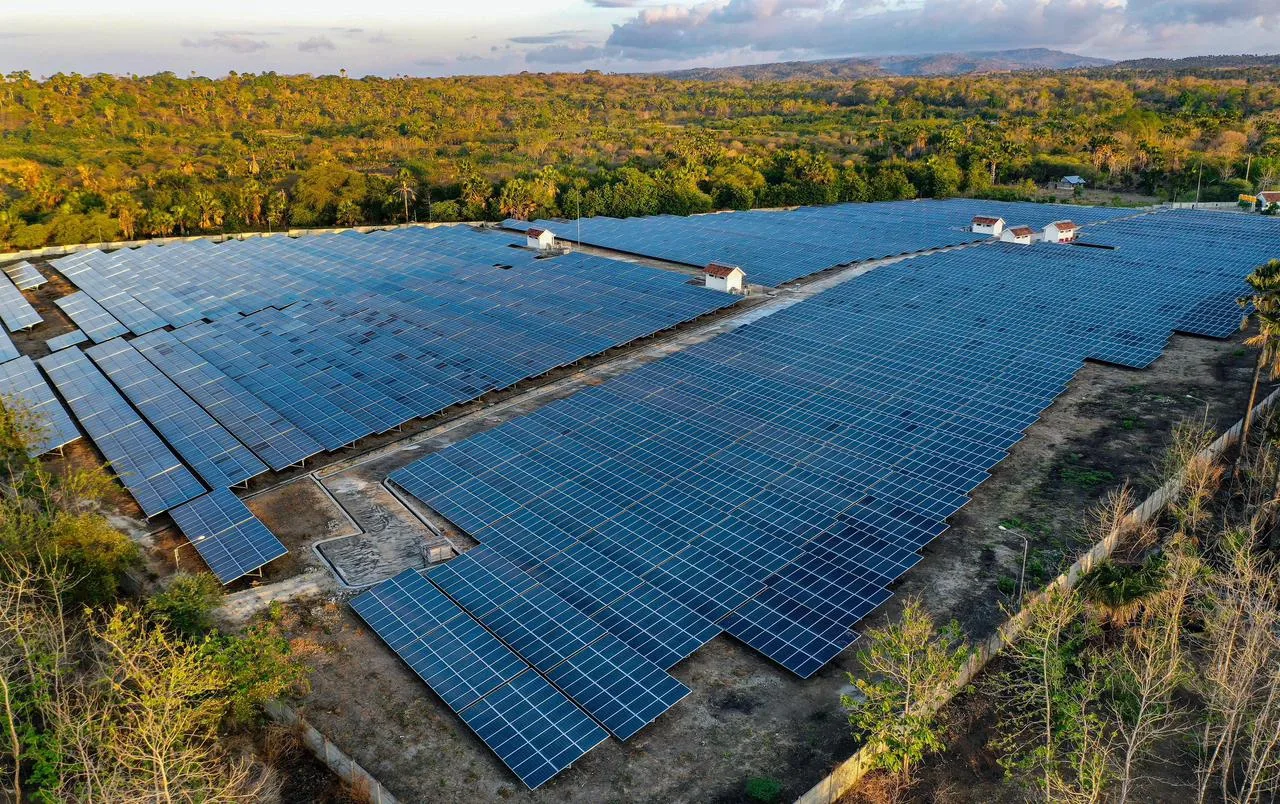
ASIATODAY.ID, JAKARTA — Indonesia is drawing on utility-scale solar development models from the United Arab Emirates, Saudi Arabia, and the United States as state-owned electricity company PLN accelerates a 100-gigawatt (GW) solar expansion, one of the largest renewable energy initiatives in Southeast Asia.
The program comes as countries across Asia step up investment in renewable energy to strengthen energy security, reduce dependence on imported fossil fuels, and meet long-term climate commitments. For Indonesia, the solar expansion is a key pillar of President Prabowo Subianto’s strategy to build a more resilient and self-reliant energy system while attracting long-term green investment.
PLN President Director Darmawan Prasodjo said the company has benchmarked large-scale solar developments in the UAE, Saudi Arabia, and California, where integrated planning, abundant land, and economies of scale have helped deliver some of the world’s most competitive solar electricity.
Indonesia faces a different geographical reality. Instead of vast desert landscapes, the archipelago plans to maximize state-owned land, floating solar installations on reservoirs, and solar development along toll-road corridors to expand renewable electricity generation without competing with residential, agricultural, or industrial land use.
To support the program, the government is preparing approximately 28,000 hectares of land in cooperation with the Ministry of Agrarian Affairs and Spatial Planning. PLN also plans to utilize around 10,000 hectares of reservoir surfaces for floating solar projects capable of generating an estimated 10.3 gigawatt-peak (GWp) of electricity.
According to PLN, greater access to low-cost government land is expected to improve project economics, making solar power increasingly competitive while replacing imported fossil fuels with domestically generated renewable energy.
Battery Storage to Strengthen the Grid
Large-scale Battery Energy Storage Systems (BESS) will play a central role in supporting the expansion by improving grid reliability and enabling higher penetration of intermittent renewable energy.
PLN’s first development phase targets 27.4 GWp of installed solar capacity integrated with 82.5 gigawatt-hours (GWh) of battery storage. Construction is scheduled to begin with approximately 4.6 GW in 2027, followed by 4.4 GW in 2028, before cumulative additional capacity reaches 19.1 GW by 2030.
From 2028 onward, the company also plans to develop 3.1 GW of floating solar projects integrated with battery storage on reservoirs while expanding BESS-supported solar installations across Java, Bali, and Madura to reduce reliance on diesel-fired electricity generation.
In Bali alone, PLN estimates its clean energy initiative could reduce diesel consumption by around 586,000 kiloliters through the deployment of 3,000 MWh of battery storage and 1,400 MWp of solar generation.
GIGA ONE Aims to Accelerate Renewable Investment
The broader expansion builds on the launch of Mentari Nusantara I, a 1.225 GW nationwide solar initiative introduced in May 2026 under an integrated procurement framework known as GIGA ONE.
The procurement model bundles multiple utility-scale renewable energy projects into a single strategic package, improving economies of scale, strengthening project bankability, streamlining procurement and construction, and providing greater certainty for domestic and international investors. PLN says the approach is designed to lower development costs and shorten project timelines—two critical factors in accelerating utility-scale renewable energy deployment.
The first portfolio will span Sumatra, Java, Kalimantan, Sulawesi, West Nusa Tenggara, and eastern Indonesia, with commercial operations targeted for 2029.
PLN plans to extend the GIGA ONE framework to future hydropower, wind power, and battery storage developments as part of a broader effort to build an integrated clean energy ecosystem while strengthening domestic manufacturing and increasing local content.
Indonesia’s 100 GW solar program underscores the country’s long-term strategy to diversify its energy mix, expand renewable electricity generation, and reduce reliance on imported fossil fuels. As investment in clean energy accelerates across Asia, the initiative is expected to play an important role in supporting Indonesia’s energy transition while creating new opportunities for infrastructure investment and regional industrial growth. (AT Network)
Follow Us at Google News, WA Channel, and LinkedIn