
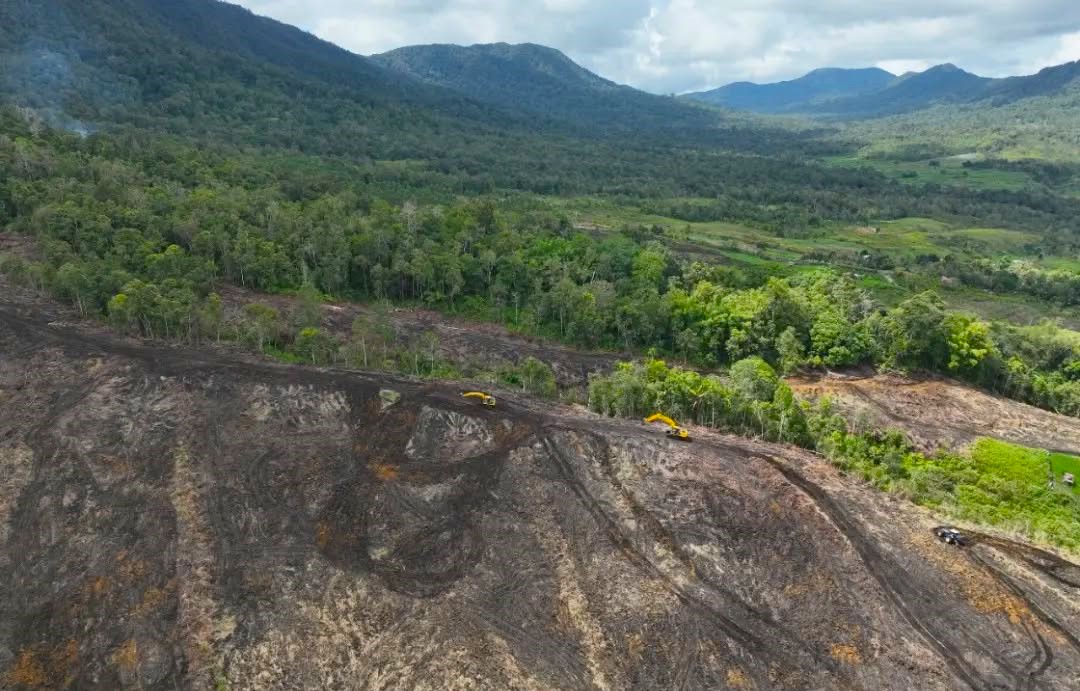
ASIATODAY.ID, JAKARTA – Indonesia has very abundant mineral resources, one of which is Tanah Hitam.
Black soil is black mineral soil, which contains high levels of organic matter in the top layer so that it plays an important role in food security and mitigating the impacts of climate change. This fertile and productive land is the center of world agricultural production and plays a role in capturing carbon from the air and storing high carbon stocks.
Soil degradation in the form of soil erosion, loss of soil carbon, nutrient imbalance, soil shallowing, compaction, soil acidification, and soil pollution are the main threats to the preservation of this soil. A multidimensional strategy also needs to be formulated to preserve black soil and ensure the functioning of the seven functions and environmental services of black soil.
Realizing the importance of black soil and food security, climate change, achieving Sustainable Development Goals (SDG), 17 countries, including Indonesia and the European Union, established the International Network of Black Soils under the coordination of FAO’s Global Soil Partnership. This network is used as a vehicle for exchanging research results, knowledge and experience in sustainable management of black soil.
To date, more than 30 countries have joined this international network. This indicates the importance of black soil in each country for their respective national development.
Head of the Food Crop Research Center, Agricultural and Food Research Organization, National Research and Innovation Agency (BRIN), Yudhistira Nugraha said that one of the factors for the success of production is how to prepare the land or soil so that it can support the productivity of the plant itself.
“Of course black soil will definitely be more fertile because the black color is synonymous with high carbon content and can support plant productivity,” he said in a webinar forum with the theme “Sustainable Management of Black Soil for Food Security and Climate Change Mitigation”, on Thursday, 12 December 2024.
Yudhistira said that other countries such as Japan, Ukraine, Russia, the United States and others have quite large areas of black soil.
In Indonesia, the potential for black soil is spread across various locations such as the Limboto Valley, Semi Arid East Nusa Tenggara, Central Lombok and the Palu Valley.
Currently, the issues that are developing are related to degraded land, land conversion and the organic C content of existing soils which is decreasing. If this is related to black soil, a solution is needed to overcome this problem, including the challenges that will be faced so that we can get soil with good C-Organic content.
In Indonesia, each region that has black soil has different characteristics in land processing.
Gorontalo’s Limboto Valley, for example, is a valley in Gorontalo Province with a very strategic location, namely it has Limboto Lake which is the outlet of 27 rivers that enter the lake. Apart from that, there are three areas that are denied or supported by the Limboto Valley, namely the Lomboto Urban Area, the Suwawa Urban Area and the Gorontalo Urban Area.
“The Limboto Valley is also the main center for food production in Gorontalo Province, and the Djalaludin Gorontalo Airport Area is still continuing to develop and expand the area. “Then the most important thing is the opening of the Gorontalo Outer Ring Road (GORR) which also has an impact on the existence of black soil in the Limboto Valley,” explained Nurdin, Lecturer at Gorontalo State University who presented the material “Management of Black Soil in the Limboto Valley”.
Black Soil in NTT
East Nusa Tenggara (NTT) is one of the provinces in Indonesia whose area is semi-arid or dry. It is characterized by several geological characteristics, in the form of karst landscapes, rows of young volcanic islands, Indonesian volcanic grooves, lowlands and highlands.
The distribution of black soil in NTT is quite even across several large inhabited islands, namely the islands of Timor, Sumba, Flores and Alor. Although not dominant. Black soil is also found on several small islands, namely Rote, Sabu, Pantar, Lomlen and Adonara.
Tony Basuki, Main Expert Researcher at the Food Crop Research Center of the National Research and Innovation Agency (BRIN), explained that the local people of NTT know black soil by several local names, such as tana metung, tana miting, rai metan, tana miteng. Farmers in NTT believe that black soil is fertile soil, but they are often faced with difficulties in controlling weeds.
“There are also those who consider it heavy soil, so many of them don’t want to cultivate it on the grounds that they have to use tractors which are quite expensive. “Especially when they are faced with soil conditions that have deep and hard soil, because of the high clay fraction content, as is often found on the islands of Timor and Sumba,” he explained.
Tony explained that the black soil in several types of soil in NTT consists of Vertisol which is often found in Timor, Sumba and small islands. Mollisol is found on the island of Sumba and parts of Flores, Andosol is found on most of Flores, Adonara, Lembata, Alor and Pantar. Then Inseptisol (Vertic ustropepts & Typic Ustropepts) in Timor, Rote and Sabu, as well as small parts of Flores and Sumba.
“There are several types of black soil-based farming businesses in NTT, including field farming businesses based on food crops such as corn, beans and cassava. Vegetable farming businesses, lowland rice farming businesses, both rainfed and irrigated rice fields. “Then agroforestry in pastures, as a source of grass feed for extensive livestock, as well as forests,” said Tony.
Tony further said that the lack of knowledge and skills of farmers in cultivating heavy soil, especially vertisol soil, is one of the challenges in managing black soil in NTT.
“The condition of black soil is difficult to cultivate, especially when the soil moisture is high and dry. In dry conditions, the soil surface becomes cracked and mounded. “Conversely, in wet conditions the soil will expand and become sticky,” he said.
Moreover, when black soil has never been processed, it tends to become heavier and more difficult to process. As is often found on the islands of Timor, Sumba and the surrounding areas where the soil is made from karts. On the other hand, the black soil in Flores is mostly made from volcanic material, so it is easier to process.
“Water availability is often the main factor that limits the optimization of black soil processing in dry areas. Apart from the high costs of weed control, there are also other technical challenges in managing black soil. “For this reason, existing local knowledge and wisdom needs to be strengthened with modern knowledge and technology,” he said.
one of them, continued Tony, is through the use of organic or inorganic fertilizers, the use of mulch, conservation techniques and irrigation techniques or rainwater harvesting. This also includes utilizing new superior varieties that are adaptive and productive according to NTT’s semi-arid environment.
“Especially for heavy black soil processing, education is needed followed by technical management demonstrations for farmers by field assistants so that the black soil can be utilized optimally,” concluded Tony.
Black Soil in Central Sulawesi
Central Sulawesi has a strategic position as a regional trade route in Sulawesi and as a buffer area for the National Capital City (IKN). This region is also rich in agroecological diversity, ranging from dry to wet climates, with complete variations in elevation. Apart from that, Central Sulawesi has various types of soil, including fertile black soil.
Main Expert Researcher at the Food Crop Research Center of the National Research and Innovation Agency (BRIN) Syafrudin said that Central Sulawesi has a variety of superior commodities such as; food crops (lowland rice, corn, soybeans, kamba rice and various types of field/upland rice). Vegetable crops (chilies, shallots, potatoes and tomatoes, local Palu onions, palasa), fruit crops (mangosteen, durian, oranges and various kinds of local durian and local bananas), as well as plantation crops (cocoa, coffee, coconut, vanilla and cloves ), as well as livestock (beef cattle, goats, hammer sheep, Donggala cattle and purebred chickens).
He said, in the black soil area the dominant commodities are horticulture such as; shallots, local onions, sweet corn, and vegetables (spinach, kale). Apart from that, there are fruit crops (watermelon, melon, dragon fruit), cocoa, coffee, and secondary crops (peanuts and cassava).
He said, black soil in Central Sulawesi is spread across 4 districts, namely; Poso Regency: Napu, Sigi Regency: Sidera and Oloboju. Tojo Una-Una Regency: Ampana and Ampana Tete, and Banggai Regency: Keles, Nambu, and Pagimana.
According to Syafruddin, management of black soil must be adjusted to the type of commodity planted, including;
– Secondary crops (corn, peanuts): use a Minimum Tillage (OTM) system or no tillage.
– Horticultural crops (shallots, spinach): use perfect tillage methods.
– Annual crops (cocoa, coffee, dragon fruit): land preparation is adjusted to the specific conditions of the land.
“The importance of management based on commodity needs so that the sustainability and productivity of black soil in Central Sulawesi can be maintained,” he stressed.
The fertilization method on black soil land in Central Sulawesi is carried out by spreading solid fertilizer and spraying liquid fertilizer. The types of fertilizer used include organic fertilizer (solid and liquid), chemical fertilizer and biological fertilizer.
”However, the fertilizer dose still does not refer to the needs of the plant, but rather depends on the availability of fertilizer. “However, the fertilization time is in accordance with the established standards,” he explained.
The planting system implemented, continued Syafruddin, includes intercropping, crop rotation and monoculture, with weed control using pre-emergent herbicides. Pest and disease control is carried out preventively through regular spraying. The water system used is sprinkler irrigation and surface flow.
Soil and water conservation techniques in Central Sulawesi have been implemented, such as a bench terrace system on land with low to moderate slopes. Farmers also practice intercropping, commodity rotation, use of organic fertilizer, and planting patterns that support land conservation.
However, he highlighted that the 2018 earthquake caused significant damage to agricultural facilities and infrastructure. Assistance and counseling for farmers is also needed to increase their understanding and productivity.
“We at BRIN have provided assistance and counseling through the Multi Channel Dissemination System (SDMC) and cooperation patterns between researchers, extension workers and practitioners (farmers),” said Syafruddin.
Syafruddin emphasized the importance of in-depth research regarding the potential and opportunities for agricultural development in Indonesia’s black soil. This is to increase productivity and support climate change mitigation as part of the national food self-sufficiency program.
“Apart from that, an integrated mentoring system is needed that involves policy holders, practitioners and support from researchers,” he concluded.
Black Soil in Central Lombok, NTB
The area of Black Land in West Nusa Tenggara (NTB) reaches 71,659 hectares, most of which is spread across Lombok Island, especially in Central Lombok Regency. This area includes the Districts of Jonggat, Praya, West Praya, Southwest Praya, Central Praya and Pujut.
Small portions of black soil are also found in the southern part of East Lombok Regency, such as Keruak and Sikur Districts, as well as in several areas on Sumbawa Island. The majority of this land is on a slope of 25-40%, and the rest is spread on a lower slope.
According to Associate Expert Researcher from the Food Crop Research Center, National Research and Innovation Agency (BRIN), Ahmad Suriadi, black soil in NTB is formed from parent materials such as limestone, medium volcanic rock and marl.
“This land is rich in calcium and magnesium, with low rainfall (1,000-1,500 mm per year) and a predominance of dry land,” said Ahmad.
The relatively flat and fertile black soil is used for agriculture, such as rice, corn, soybeans and horticulture (onions and chilies). In some regions, agroforestry systems and plantations, such as cashew and mango, are also being developed.
The history of black soil management in the area begins with the gogorancah system, namely planting rice using the tugal technique when the soil is sufficiently moist. This system succeeded in supporting rice self-sufficiency in 1984 through the Operation Tegak Makmur program. Over time, innovations such as the use of herbicides and no-till technology were introduced to increase efficiency and crop yields.
In facing climate change, said Ahmad, conservation agriculture is implemented to maintain sustainability. This approach involves minimal tillage, use of cover crops, crop rotation, and water management through reservoirs.
“Embungs in Central Lombok and East Lombok, for example, function as rainwater reservoirs for supplemental irrigation in the dry season. “Currently there are around 1,458 reservoirs in East Lombok Regency, which increases land productivity and farmer income,” explained Ahmad.
He assessed that the management of black soil in NTB faces serious challenges, such as climate change, land degradation due to erosion, and conversion of land to residential or industrial use. The decrease in soil organic content due to intensive agricultural practices is also a concern.
NTB’s black soil has great potential to support food security, agricultural productivity and a green economy. However, sustainable and integrated management is the key to ensuring that this land remains productive and does not degrade in the future.
An ecosystem-based conservation approach is very important to maintain the sustainability of black soil.
“Collaboration between government, local communities, academics and the private sector is urgently needed, with the community as the main actor,” he concluded. (AT Network)
Follow Us at Google News and WA Channel