
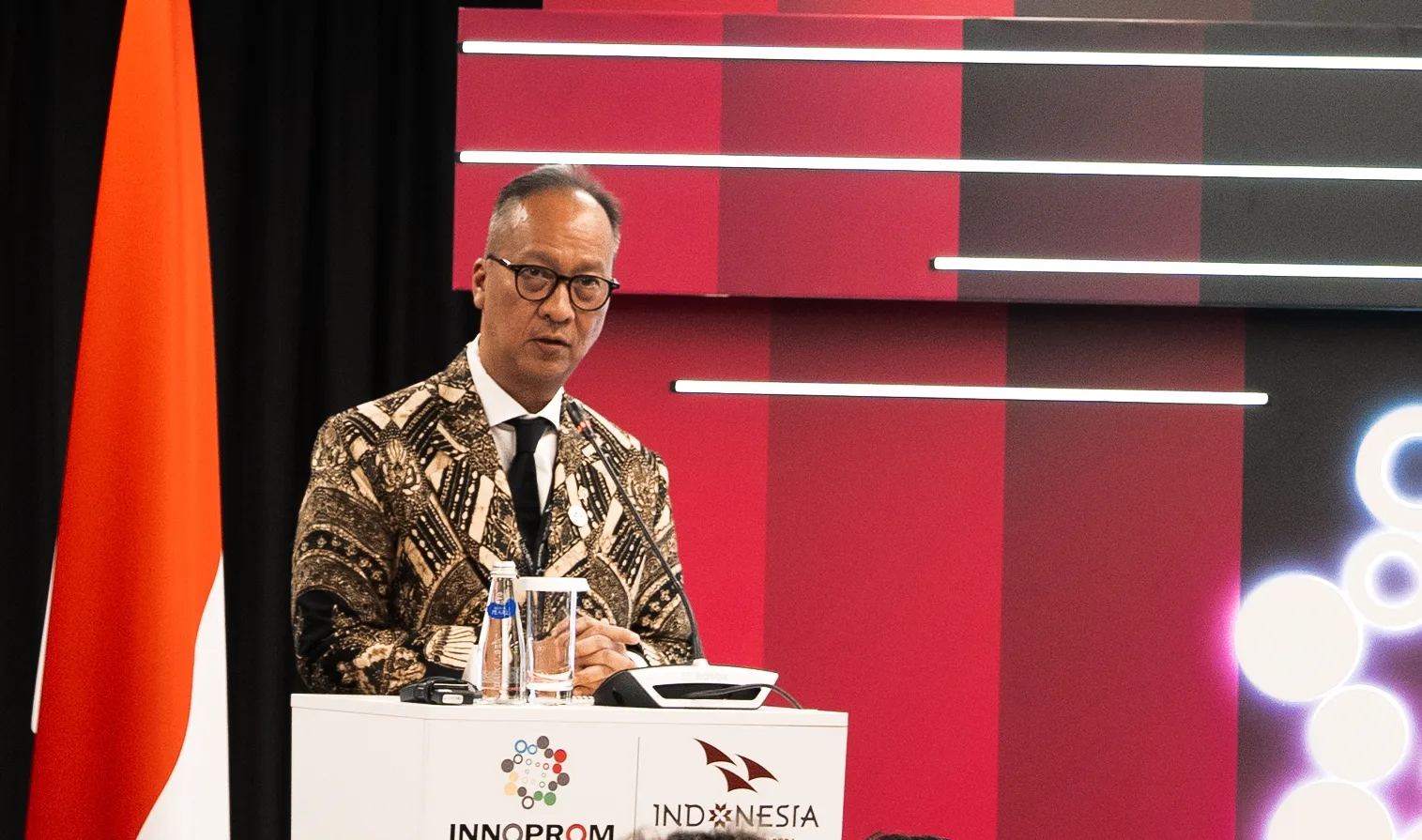
ASIATODAY.ID, YEKATERINBURG — Indonesia is stepping up efforts to attract long-term industrial investment from Eurasia, using its high-profile participation at INNOPROM 2026 to showcase new opportunities in advanced manufacturing, downstream industries, critical minerals, and technology collaboration as global companies continue to diversify supply chains.
As the first Southeast Asian nation to become Official Partner Country at Eurasia’s largest industrial exhibition, Indonesia is positioning itself as a strategic manufacturing hub linking the fast-growing ASEAN market with the broader Eurasian region.
More than 50 Indonesian companies and institutions are participating in the exhibition, presenting investment opportunities across metals, machinery, transport equipment, electronics, chemicals, pharmaceuticals, textiles, agro-processing, industrial estates, and small and medium-sized manufacturing.
The centerpiece of Indonesia’s investment campaign is the New National Industrialization Strategy (SBIN), a long-term roadmap designed to accelerate value-added manufacturing, strengthen industrial competitiveness, expand downstream processing, promote green industrial development, and attract high-quality foreign investment.
Industry Minister Agus Gumiwang Kartasasmita said Indonesia is offering international partners not only one of Asia’s largest domestic markets but also a clear industrial roadmap that supports sustainable long-term investment.
“Through the New National Industrialization Strategy, Indonesia is building a stronger, more modern, and more sustainable industrial base while creating broader opportunities for quality investment, technology transfer, and industrial collaboration,” Agus said on July 8.
The strategy reflects Jakarta’s response to profound changes in the global economy, including the restructuring of supply chains, rapid industrial digitalization, the clean energy transition, and rising global demand for critical minerals essential to electric vehicles and renewable energy technologies.
Indonesia enters the investment drive from a position of growing industrial strength. The country’s manufacturing value added has reached US$265 billion, making it Southeast Asia’s largest manufacturing economy and the world’s 13th largest by manufacturing output. Manufactured products now account for nearly 80 percent of Indonesia’s total exports, underscoring the sector’s expanding contribution to economic growth.
To attract Eurasian investors, Indonesia is highlighting four priority areas for cooperation.
The first focuses on partnerships in industrial machinery, automation systems, petrochemicals, and advanced manufacturing technologies. The second promotes investment in Indonesia’s expanding network of industrial estates supported by regulatory reforms under the new industrial strategy.
The third centers on downstream processing of nickel, bauxite, copper, cobalt, and lithium—critical minerals that are becoming increasingly important for electric vehicle batteries and clean energy supply chains.
The fourth promotes collaboration in agro-processing, food technology, logistics, and value-added agricultural manufacturing, sectors where Indonesia is seeking to combine its abundant natural resources with international technology and expertise.
Indonesia is also using the exhibition to promote its rapidly expanding agro-industrial sector.
Nine Indonesian companies are showcasing products ranging from specialty coffee and processed foods to spirulina, aromatherapy products, cosmetics, furniture, and sustainable pulp and paper products.
The agro-industrial sector contributed 52.37 percent of Indonesia’s non-oil manufacturing GDP during the first quarter of 2026, equivalent to 9.12 percent of national GDP. It generated US$18.92 billion in exports, produced a US$13.78 billion trade surplus, and supports approximately 10 million jobs nationwide.
Officials also see significant opportunities to deepen industrial cooperation with Russia by combining Indonesia’s strength in agricultural resources and tropical commodities with Russia’s expertise in precision agriculture, biotechnology, food processing, agricultural machinery, and logistics.
Prospects for deeper economic engagement have also been strengthened by the conclusion of the Indonesia–Eurasian Economic Union Free Trade Agreement (I-EAEU FTA) in late 2025. The agreement grants preferential tariff treatment for more than 90 percent of tariff lines, expanding market access for Indonesian manufactured products across the Eurasian Economic Union.
Indonesia’s participation at INNOPROM reflects a broader shift in the country’s economic diplomacy—from promoting exports toward attracting strategic investment, expanding technology partnerships, and integrating more deeply into global manufacturing value chains.
As companies continue to diversify production beyond traditional manufacturing centers, Jakarta is positioning itself as a long-term industrial partner for Eurasia—leveraging its abundant natural resources, expanding manufacturing base, and growing domestic market to attract investment that supports the country’s next phase of industrial transformation. (AT Network)
Follow Us at Google News, WA Channel, and LinkedIn