
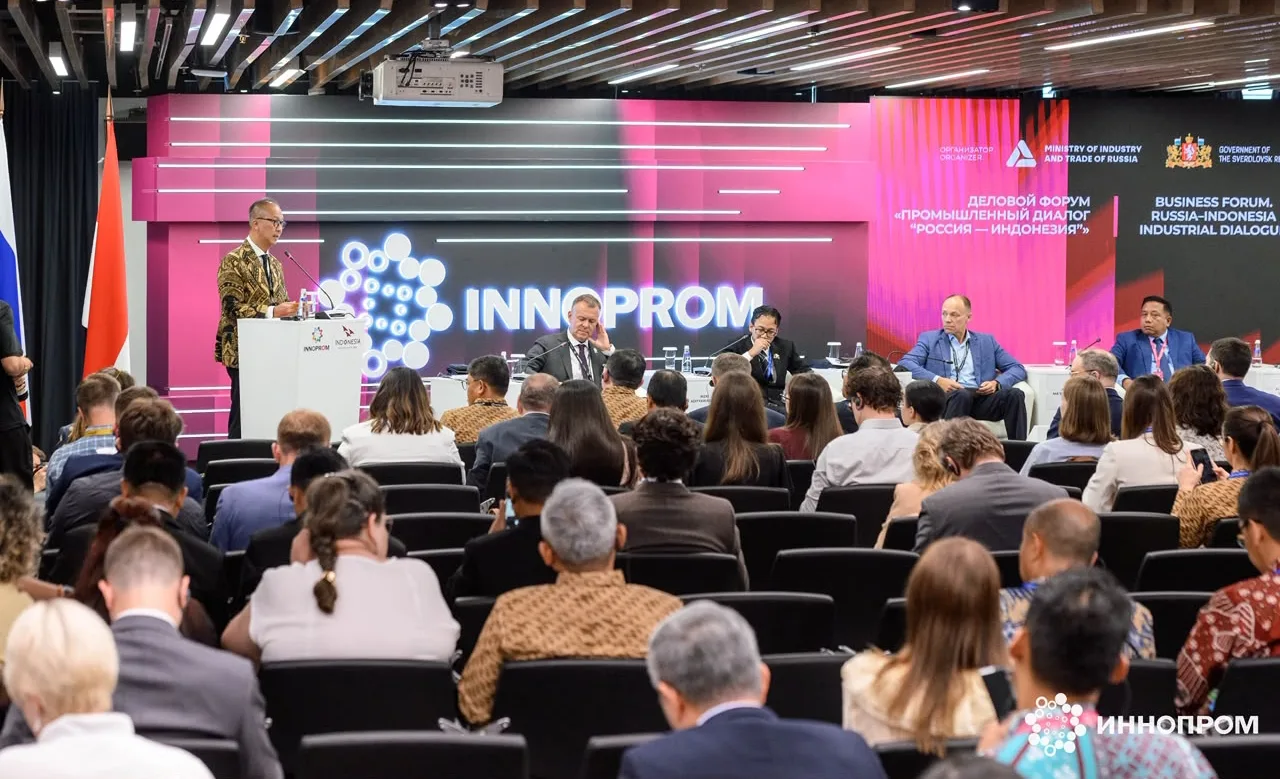
ASIATODAY.ID, EKATERINBURG — Indonesia has strengthened its industrial diplomacy in Eurasia after securing 13 strategic agreements with government institutions, industrial associations, and business partners during its participation in Russia’s major industrial forum.
The agreements mark a significant step in Indonesia’s efforts to expand investment cooperation, accelerate technology transfer, strengthen global supply chains, and open wider market access for national industries.
Indonesian Minister of Industry Agus Gumiwang Kartasasmita said the achievement reflected growing international confidence in Indonesia’s industrial capabilities and its potential as a strategic partner in the Eurasian market.
“Indonesia’s participation has strengthened the position of our national industry in the Eurasian market. This is evident from the strong interest of industrial players who want to establish cooperation with Indonesian companies,” Agus said.
The cooperation was developed through a series of bilateral meetings involving representatives from Armenia, Kazakhstan, Kyrgyzstan, Azerbaijan, Tajikistan, Chelyabinsk Region, Kirov Region, and Sverdlovsk Region.
The 13 agreements cover strategic sectors including manufacturing, machinery, heavy equipment, automotive, metallurgy, chemical industries, mineral processing, industrial estates, halal industries, workforce development, and industrial technology cooperation.
Several business-to-business agreements were also signed involving Indonesian industrial associations and companies, including the Indonesian Shipbuilding and Offshore Association (IPERINDO), PT PCM Kabel Indonesia, PT Athira Maritim Indonesia, and the Indonesian Ship Components Industry Association (PIKKI) with Russia’s United Industrial Corporation AK Bars.
Other agreements involved PT Minang Jordanindo and CHETRA LLC, as well as cooperation between the Indonesian Industrial Estate Association (HKI) and the Association of Clusters, Technology Parks and Special Economic Zones of the Russian Federation.
Palm Oil Innovation Strengthens Energy Cooperation
Beyond manufacturing partnerships, Indonesia also promoted its sustainable energy transformation through cooperation in palm oil-based bioenergy.
At the Indonesia-Russia Business Forum themed “Palm Oil and the Future of Sustainable Energy,” Indonesia showcased its industrial innovation and commitment to supporting the global energy transition.
Agus said Indonesia’s palm oil industry has significant potential to become part of the global renewable energy solution through innovation, downstream processing, and international collaboration.
“Through innovation, downstream development, and international cooperation, we want to make the palm oil industry not only an economic driver but also part of the solution for energy security and sustainable industrial development,” he said.
The forum brought together more than 100 industrial leaders, government representatives, investors, and business stakeholders from Indonesia, Russia, and the Eurasian region.
Indonesia highlighted its experience as the world’s largest palm oil producer and introduced its B50 biodiesel policy, which began implementation in July 2026.
The policy requires diesel fuel to contain 50 percent biodiesel derived from palm oil, aiming to reduce dependence on imported fossil fuels, strengthen national energy security, and lower carbon emissions.
Indonesia also presented its sustainability agenda, including smallholder plantation rejuvenation, industrial workforce development, research and innovation, and the strengthening of the Indonesian Sustainable Palm Oil (ISPO) certification system to improve competitiveness in global markets.
Tri Supondy, Director General of Industrial Resilience, Regional Development, and International Industrial Access at Indonesia’s Ministry of Industry, said the global forum demonstrated that Indonesia’s palm oil industry has evolved beyond being merely an export commodity.
“Indonesia is not only moving toward cleaner and more sustainable energy, but also continuing to innovate through its leading industrial products,” he said.
Building Indonesia’s Industrial Future in Eurasia
The series of agreements reinforces Indonesia’s strategy to use industrial diplomacy as a tool to attract investment, strengthen manufacturing competitiveness, and expand international partnerships.
The Indonesian government sees cooperation with Russia and Eurasian countries as a strategic opportunity to connect national industries with global value chains while promoting high-value manufacturing and technology-based industries.
The cooperation also supports broader economic engagement between Indonesia and the Eurasian Economic Union (EAEU), particularly in trade expansion, industrial collaboration, and market access.
Director General Tri Supondy said the agreements demonstrated that Indonesian industries are increasingly trusted by international partners.
“The cooperation established through this platform is expected to create more opportunities for investment, trade, and industrial collaboration that will strengthen Indonesia’s manufacturing competitiveness,” he said.
Indonesia’s industrial outreach in Russia signals a broader ambition: positioning the country not only as a major producer of commodities, but as a competitive manufacturing hub and innovation partner in the global economy.
Through stronger industrial cooperation, sustainable energy development, and technology partnerships, Indonesia aims to accelerate its transformation toward a high-value economy and support its long-term vision of becoming a leading industrial nation by 2045. (AT Network)
Follow Us at Google News, Instagram, WA Channel, and LinkedIn