
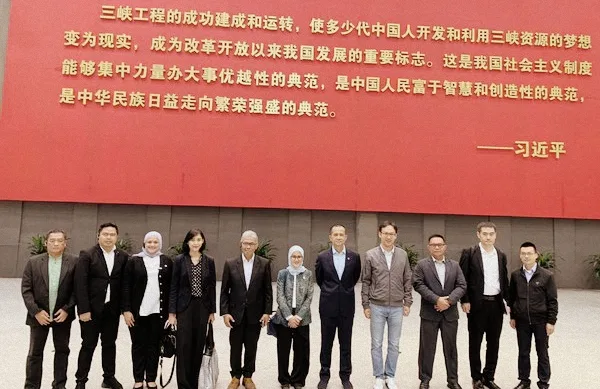
ASIATODAY.ID, JAKARTA – The Indonesian government is studying how China successfully relocated 1.3 million people from urban areas to rural settlements as part of the country’s massive resettlement project linked to the Three Gorges Dam.
The program, implemented in Yichang City, Hubei Province, has become a model of how relocation can transform communities and drive long-term rural prosperity.
After more than three decades, Yichang’s resettled areas have evolved into thriving transmigration villages, supported by strong agriculture, small-scale industries, and tourism sectors.
Indonesia’s Minister of Transmigration, M. Iftitah Sulaiman Suryanagara, said the visit to Yichang provided valuable lessons for Indonesia’s efforts to modernize its own transmigration program.
“We learned a lot from how China relocated around 1.3 million residents in a well-organized and humane way. Earlier today, we visited several relocation villages and met with local leaders. Initially, many people were worried about jobs and quality of life after moving,” Iftitah said on Tuesday, October 14, 2025.
Sustainable Relocation Brings Eightfold Increase in Welfare
The minister’s delegation visited Xu Jia Chong Village in Yichang on Monday, October 13.
According to Iftitah, the Chinese government overcame early challenges by providing comprehensive training, technical support, and continuous mentoring to help residents rebuild their livelihoods.
As a result, the welfare of relocated citizens has improved up to eight times higher than before the move. Agriculture — especially citrus and tea farming — has become the economic backbone of the area, while household industries and handicrafts are now reaching international markets.
“This is exactly what we want to learn. Agricultural growth and local industrialization can turn relocation zones into productive, self-reliant communities,” Iftitah added.
From Relocation to Transformation
The Yichang experience shows that relocation is not just about moving people, but about transforming their social and economic structures. With the right planning, relocated communities can escape poverty and achieve sustainable development based on local strengths.
Indonesia plans to adopt this model through cooperation with the Chinese government, focusing on developing resettlement zones affected by national infrastructure projects.
“We no longer want relocation to mean displacement. It must ensure that local people truly benefit from development. Transmigration programs should keep communities close to economic activities so that growth remains sustainable,” Iftitah emphasized.
Applying China’s Model to Papua and Eastern Indonesia
The Ministry of Transmigration is preparing to apply the Yichang model in Papua and Eastern Indonesia, regions with vast agricultural potential and growing infrastructure investment.
The government will promote partnerships among foreign investors, state-owned enterprises, local governments, and communities to build self-sustaining rural economies.
“Every development plan must be based on accurate data and research. We will identify opportunities that best fit Indonesia’s context,” Iftitah concluded.
By studying China’s success in relocating 1.3 million people and turning them into prosperous rural communities, Indonesia aims to design a modern transmigration system that promotes inclusive growth, economic independence, and sustainable regional development. (AT Network)
Follow Us at Google News and WA Channel