
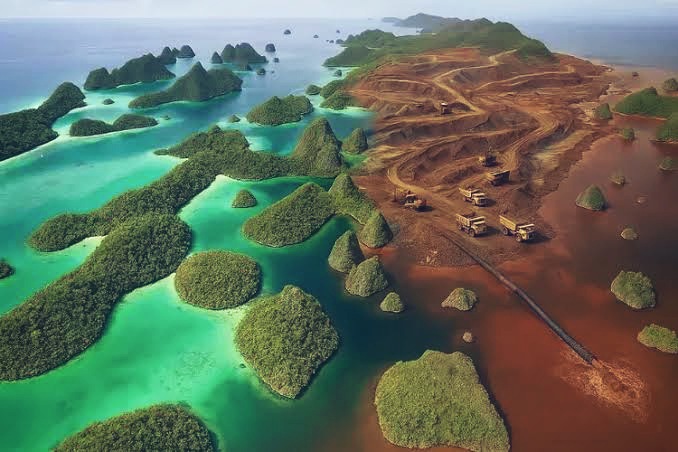
ASIATODAY.ID, JAKARTA – The Indonesian government is once again under fire after granting permission for nickel mining operations to resume in Raja Ampat, West Papua. The decision is widely seen as proof of the state’s failure to protect one of the world’s most important marine conservation areas, home to 75 percent of the planet’s coral reef species.
Just three months after President Prabowo Subianto ordered the revocation of four mining permits (IUP) in June 2025, PT Gag Nikel—a subsidiary of state-owned PT Aneka Tambang Tbk (Antam)—was allowed to restart operations by Energy and Mineral Resources Minister Bahlil Lahadalia.
The move sparked strong criticism from various parties, including former Indonesian Minister of Maritime Affairs and Fisheries Susi Pudjiastuti, who took to social media on Saturday, Sept 13, 2025, urging President Prabowo to halt nickel mining activities that threaten Raja Ampat’s fragile ecosystems.
Nickel Mining Resumes on Gag Island
PT Gag Nikel resumed operations on September 3, 2025, after receiving a new license from the Ministry of Energy and Mineral Resources. The company manages a concession covering 13,136 hectares on Gag Island.
Tri Winarno, Director General of Minerals and Coal at the ministry, defended the decision, stating that PT Gag had been awarded a Green PROPER rating, a government certification for compliance in environmental management and community development.
“Green means the company fully complies with environmental governance and contributes to community empowerment,” Tri explained on Sunday, September 14, 2025.
Environment Minister Faisol Hanif Nurofiq echoed this, insisting that the environmental impacts of PT Gag’s operations could be mitigated. He claimed that environmental audits had been conducted to ensure mining activities would not harm the ecosystem.
Environmental Activists Push Back
Environmental groups, however, strongly rejected the government’s justification. Greenpeace Indonesia described the decision to reopen mining in Raja Ampat as a blatant disregard for the region’s biodiversity.
Arie Rompas, Head of Greenpeace Indonesia’s Forest Campaign Team, argued that the government’s action violated Law No. 1 of 2014 on Coastal Zone and Small Islands Management.
“Granting mining permits in a region that is home to 75 percent of the world’s coral reef species is nothing but greed—putting corporate profit and short-term extraction above environmental protection and human rights,” Rompas said.
Threat to a Global Tourism Icon
Raja Ampat is world-renowned as a marine tourism paradise, famed for its pristine coral reefs, rich biodiversity, and unparalleled natural beauty. Nickel mining, critics warn, will not only damage these ecosystems but also undermine the livelihoods of local communities who rely heavily on fisheries and eco-tourism.
Public concern has mounted as PT Gag Nikel was allowed to resume operations less than three months after a government-ordered suspension. The rapid turnaround has fueled accusations that the state is failing to act consistently in protecting Raja Ampat from extractive industries.
Growing Public Pressure
Pressure on President Prabowo to take a firm stance continues to build. Susi Pudjiastuti, along with environmental activists, has demanded that PT Gag Nikel’s operating license be permanently revoked in order to safeguard Raja Ampat as a global ecological treasure.
So far, the Indonesian government is seen as failing to balance economic interests with its responsibility to preserve Raja Ampat, one of the richest marine biodiversity hotspots on Earth. (AT Network)
Follow Us at Google News and WA Channel