
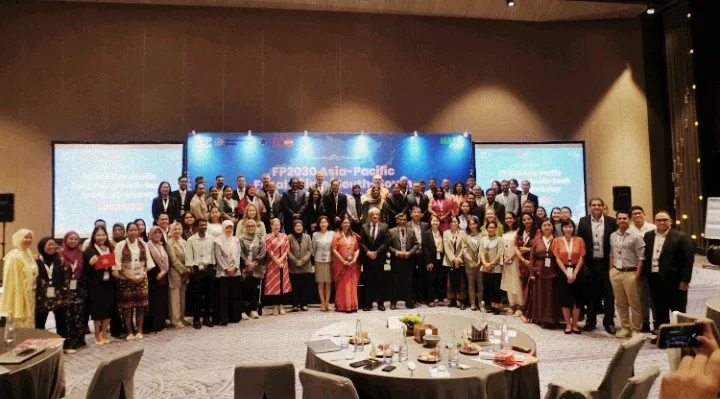
ASIATODAY.ID, BALI – More than 70 representatives from governments, civil society, youth organizations, donors, and development partners are meeting in Bali, Indonesia, for the FP2030 Asia-Pacific Focal Points/South-South Learning Workshop from 8-10 October 2025.
Hosted by the FP2030 Asia and the Pacific Regional Hub, the Ministry of Population and Family Development (Kemendukbangga/BKKBN), Ministry of the State Secretariat, and UNFPA Indonesia, the three-day gathering aims to strengthen collaboration and accelerate progress toward voluntary, rights-based family planning.
At the opening of the event, the Secretary of the Ministry of Population and Family Development/Principal Secretary of the National Population and Family Planning Board (Kemendukbangga/BKKBN), Prof. Budi Setiyono, Ph.D, expressed his gratitude and appreciation for the selection of Indonesia as the host country.
“Over the past five decades, Indonesia has made remarkable progress in population management,” he said. Prof. Budi also emphasized that the Indonesian government is strongly committed to integrating family planning services into maternal and child health systems, while demonstrating Indonesia’s leadership role at the regional level in the field of family planning through South-South and Triangular Cooperation (SSTC) to accelerate the achievement of Sustainable Development Goals (SDGs) and the International Conference on Population Development (ICPD) Programme of Action (PoA).
Asia and the Pacific, home to nearly 60 percent of the global population, still face significant reproductive health challenges. Of the 214 million women worldwide with an unmet need for family planning, 140 million live in this region. Each year, 21 million pregnancies occur among girls aged 15-19, 43 percent of which are unintended.
“The ability to plan pregnancies, including the choice of contraceptive methods, is a fundamental human right. Every woman has the right to decide when to have children and how many children she wants,” said UNFPA Indonesia Representative Hassan Mohtashami in his remarks.
“Through FP2030, we strengthen our collective efforts to provide women with the information and services they need to make informed decisions about their fertility,” he continued.
“UNFPA continues to support the global family planning efforts through the FP2030 commitment.”
The FP2030 workshop in Bali brings together 13 country delegations, including ten governments that have already made FP2030 commitments, which are Bangladesh, Fiji, India, Indonesia, Kyrgyz Republic, Lao PDR, Nepal, Pakistan, Philippines, and Vietnam, along with Thailand, Cambodia, and Timor-Leste, who are in various stages of developing their commitments.
“This workshop comes at a critical time. Countries across our region are undergoing rapid demographic shifts with rising pronatalist rhetoric, but women and young people continue to face barriers to exercising their reproductive rights. By working together, we can reshape the narrative on family planning to one centered on choice, rights, and wellbeing and key to achieving health and development goals,” said Sumita Banerjee, Managing Director of FP2030 Asia-Pacific.
By convening representatives from government, civil society, youth networks, donors, and development partners, the meeting creates a space for knowledge exchange and peer-to-peer learning.
Sessions will address partnerships and South-South cooperation, shaping public narratives in the face of demographic transitions, domestic resource mobilization, addressing adolescent pregnancy, and the adoption of High Impact Practices in family planning.
The gathering also integrates the Made Possible by Family Planning campaign, highlighting the transformative role of family planning in empowering women, strengthening communities, and advancing sustainable development.
Through these discussions and exchanges, the workshop is expected to generate actionable plans that will drive progress on FP2030 commitments and reinforce the collective vision of ensuring that every individual in Asia and the Pacific can decide freely and voluntarily whether, when, and how many children to have. (AT Network)
Follow Us at Google News and WA Channel