
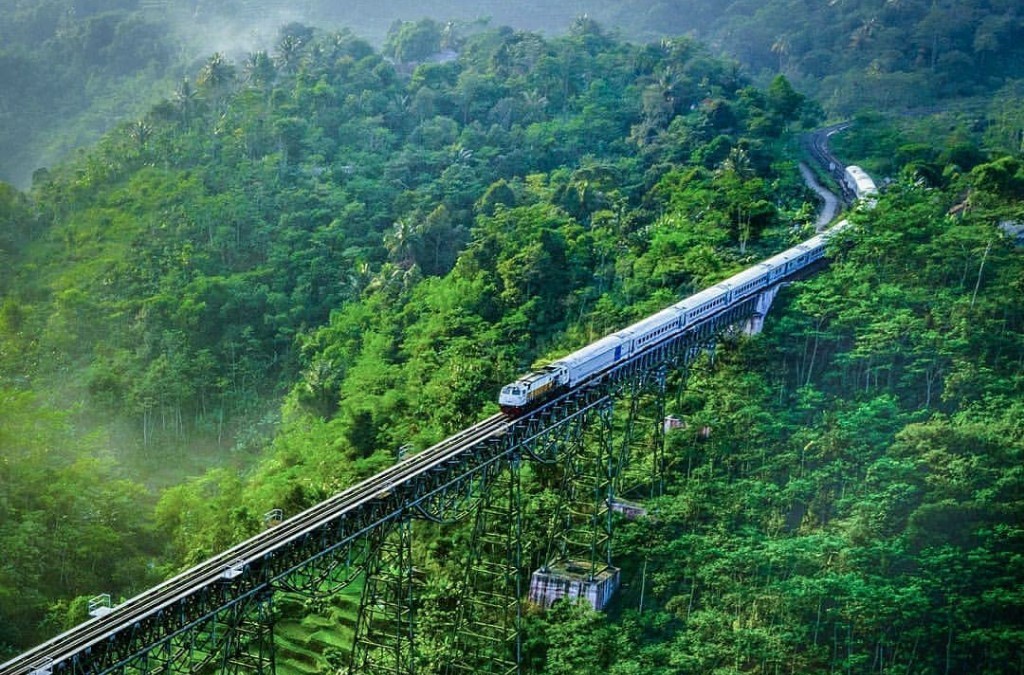
ASIATODAY.ID, JAKARTA – The Ministry of Energy and Mineral Resources marked a new chapter in Indonesia’s energy transition by launching the first trial of using B40 biodiesel in trains.
This trial was carried out at Lempuyangan Station, Yogyakarta, Monday, July 22 2024 using the Bogowonto train connecting Yogyakarta – Pasar Senen.
B40, a mixture of 60% diesel and 40% biofuel from palm oil, is expected to be a strategic solution to reduce diesel consumption and exhaust emissions.
“Today is the kick off for the first time we put it into the railway (sector) for B40,” said the Director General of New, Renewable Energy and Energy Conservation, Ministry of Energy and Mineral Resources, Eniya Listiani Dewi.
According to him, this limited performance test aims to test the durability of the Bogowonto Railway generator set for 1,200 hours. With an estimated time for one round trip train from Bogowonto from Lempuyangan to Pasar Senen of 22 hours, it is estimated that it will take 50 round trips, or around two months, to achieve this result.
“We hope that all use tests can be completed this December so that full use of B40 can be carried out in 2025,” said Eniya.
Through the B40 program, the government continues to increase the adoption of palm oil-based biodiesel in various types of vehicles. After the use of B40 in the car industry four years ago, the next trials in 2024 will focus on agricultural machinery and the railway industry. Next there will be the mining and heavy equipment industry, as well as shipping equipment and power plants, which will start in the near future in Balikpapan, East Kalimantan. Overall, it is estimated that 16 million kiloliters of B40 will be needed.
Eniya is also optimistic that the use of B40 can further increase the country’s foreign exchange savings from reducing diesel imports compared to the previous biodiesel, namely B35. Increasing the use of biodiesel will also further reduce carbon emissions in Indonesia.
Eniya said, in 2023, foreign exchange savings from using B35 in the automotive and non-automotive sectors will reach IDR 122 trillion. This year it is estimated that the figure will also be the same.
“If we switch to B40 next year, savings could reach around US$9 billion,” he said.
The reduction in carbon dioxide (C02) is targeted to reach 42.5 million tons from the estimated use of 16 million kiloliters (kl) of B40 in 2025. This is greater than the use of B35 which reached 12.23 million kl in 2023 and is estimated to reach 13 million kl in 2023. end of 2024.
Vice President of Logistics PT KAI, Suryawan Putra Hia said, PT KAI currently uses 300 million liters of B35 fuel. During use, he said that the train engine’s performance had no problems. Therefore, he is optimistic that the transition from B35 to B40 will go smoothly, considering that the specifications are almost the same.
“So far (the use of biodiesel for train fuel) is no issue. Later, perhaps B100 will be the most challenging and we are optimistic that B40 will not have a significant impact on engines,” he said.
On the other hand, Head of the Oil and Gas Testing Center, Mustafid Gunawan, said that train use tests were carried out for locomotive engine fuel and train generator engines. The locomotive engine use test was carried out on a goods train on the Jakarta-Surabaya route, while the generator test was carried out on the Bogowonto train on the Lempuyangan-Pasar Senen route.
“Locomotive engine testing has started on July 3 2024 and will be completed in December 2024. The generator test will be carried out for 1,200 hours starting today until November 2024,” he explained.
To carry out use tests, PT KAI built blending and fuel filling facilities in five locations, namely Cipinang (Jakarta), Arjawinangun (Cirebon), Cepu (Blora), Lempuyangan (Yogyakarta), and Pasar Turi (Surabaya). (AT Network)
Follow Us at Google News and WA Channel