
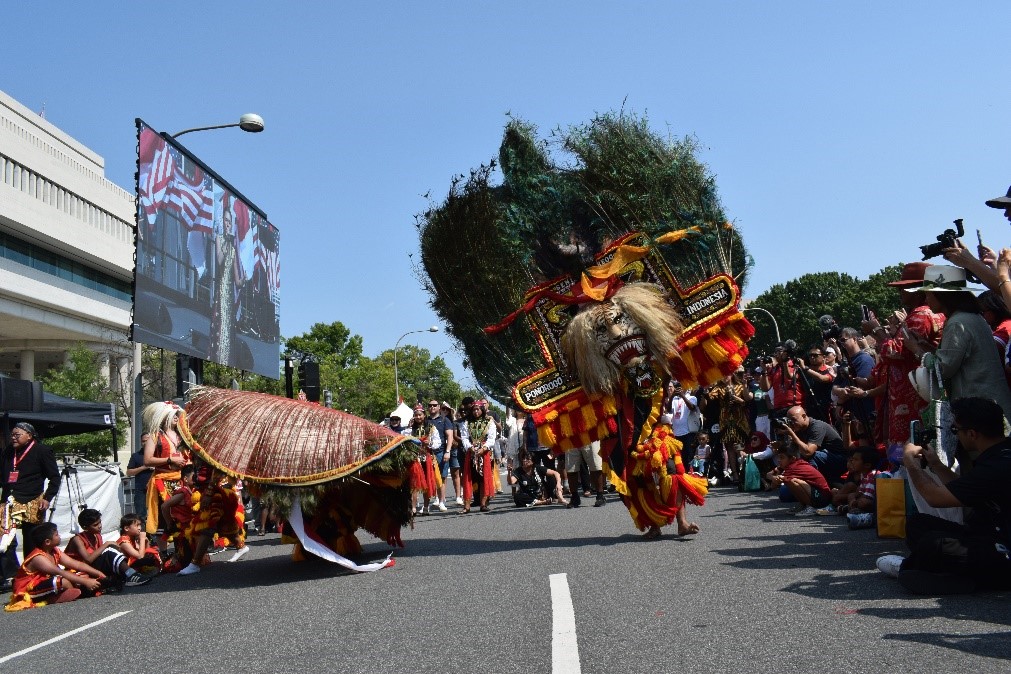
ASIATODAY.ID, PONOROGO – The Ponorogo Regency Government, East Java, is holding simultaneous reog performances throughout the world to celebrate the designation of Ponorogo Reog art as a UNESCO Intangible Cultural Heritage, Sunday, December 22 2024.
The Regent of Ponorogo, Sugiri Sancoko, said that reog events are not only held in Indonesia, but are also carried out by reog groups in a number of countries on the continents of Asia, America, Australia and Africa.
“This performance was also held by reog groups from various countries, such as the United States, Australia, South Africa, South Korea, Japan and Malaysia,” said Sugiri.
Even though there is a time difference, he continued, his party intensively communicated and coordinated to align the event so that it appeared on the same day and date via streaming.
In Ponorogo, as many as 30 reog groups performed in front of Paseban, Ponorogo City Square.
Reog Ponorogo was officially recognized as a WBTB on 3 December 2024 at the 19th Session of the UNESCO Intergovernmental Committee for the Protection of Intangible Cultural Heritage in Asunción, Paraguay.
This performance was special with the presence of the only women’s reog group Sardulo Nareswari from Sawoo Village, Sawoo District.
This group consists of 50 members, all of them women, which proves that the role of women in the art of reog is no longer limited to being jathil dancers.
One of the barong women, Intan Ayu Paramitasari, expressed her pride in being able to contribute to preserving traditional art which has become world heritage.
Even though he faced a tough challenge lifting the reog mask, he managed to dance the typical pembarong movement with strong determination.
“I’m very proud to be a producer in reog. Reog was born in Ponorogo, and we will continue to protect it so that reog is no longer claimed by other countries,” said Intan.
Intan also hopes that UNESCO’s recognition will further motivate the younger generation, both men and women, to preserve Reog Ponorogo art.
“Hopefully there will be more women’s reog groups in Ponorogo and reog can go global,” he said.
Ponorogo Regent Sugiri Sancoko emphasized that the recognition of reog as an Intangible Cultural Heritage is not the end of the struggle, but rather the beginning of the responsibility to preserve it.
He invited all elements of society to carry out cultural conservation and regeneration to ensure the sustainability of reog art and support the local economy.
“Conservation is important, but regeneration must also be carried out so that cultural transmission occurs. In this way, we hope that reog can shape the nation’s character while improving Ponorogo’s economy,” he said. (ANT)
Follow Us at Google News and WA Channel