
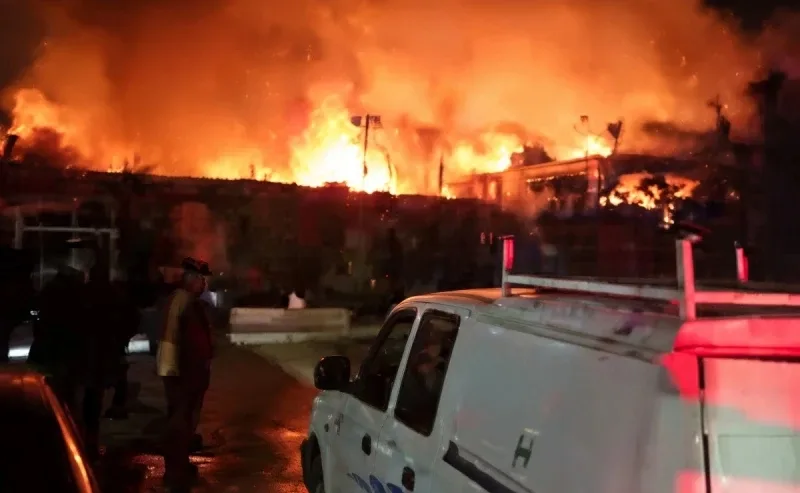
ASIATODAY.ID, TEL AVIV — Tensions in the Middle East surged dramatically after Iran launched a wave of ballistic missile strikes targeting the heart of Tel Aviv, Israel’s economic and financial center.
Powerful explosions rocked the city as air-defense systems scrambled to intercept incoming projectiles, sending residents rushing to shelters while fires and debris were reported in several areas.
The attacks were confirmed by Iran’s Islamic Revolutionary Guard Corps (IRGC), which said the strike was part of the 21st wave of “Operation True Promise 4.” According to Tehran, the operation is retaliation for joint U.S. and Israeli military strikes against Iranian targets on February 28, 2026.
In a statement carried by Iranian state media, the IRGC said it launched several Kheibar Shekan ballistic missiles toward Tel Aviv while also deploying combat drones aimed at strategic sites in the city.
“Kheibar missiles were fired toward Tel Aviv as part of the 21st wave of Operation True Promise 4,” the IRGC said in its official statement.
Explosions Shake Tel Aviv
Witnesses and international media reported at least two nearly simultaneous waves of explosions across Tel Aviv and surrounding areas. Trails of rockets were seen streaking across the night sky as Israel’s air-defense systems attempted to intercept the incoming missiles.
Emergency responders from Magen David Adom (MDA) were dispatched to several locations after reports of falling projectiles in central Israel. Initial footage released by emergency services showed damage to residential areas, with trees knocked down and debris scattered across courtyards and streets.
Despite the intensity of the blasts, Israeli authorities said there were no immediate reports of fatalities, though assessments of structural damage were still underway.
Police confirmed that multiple impact sites were being investigated and urged residents to remain in protected areas as a precaution against possible follow-up attacks.
Regional Strikes Across the Gulf
The missile assault on Israel came amid a broader escalation across the Gulf region.
Earlier the same day, Iranian missiles reportedly struck a major oil refinery belonging to Bapco Energies in Bahrain, triggering a fire at the facility located on the island of Sitra. Bahraini authorities said the blaze was quickly contained and no casualties were reported.
The strikes are part of a widening regional confrontation that erupted after U.S. and Israeli forces carried out attacks on Iranian infrastructure in recent days.
Diplomatic sources also reported that several Western embassy staff in Riyadh, Saudi Arabia, were ordered to shelter in place following security threats linked to the escalating conflict.
Kheibar Missile: Iran’s Strategic Weapon
The attack on Tel Aviv reportedly involved the Kheibar Shekan, one of Iran’s most advanced ballistic missiles.
First unveiled in 2022, the solid-fuel missile is roughly 11.4 meters long and has an estimated range of up to 1,450 kilometers, placing much of the Middle East within its strike radius.
Military analysts say the missile features several advanced capabilities:
– Satellite-guided navigation for improved targeting accuracy
– A 550-kilogram high-explosive warhead
– Terminal maneuverability, allowing it to evade interception
– Speeds reaching Mach 2 to Mach 3 during its final approach
These features are believed to make the missile difficult for air-defense systems such as Patriot or David’s Sling to intercept effectively.
The missile’s relatively compact design also allows it to be launched from mobile platforms, including disguised transport vehicles, increasing the element of surprise in combat scenarios.
Middle East on the Brink
The missile barrage on Tel Aviv marks one of the most serious escalations in the ongoing confrontation between Iran, Israel, and the United States in recent years.
Over the past several days, the region has witnessed a rapid succession of airstrikes, drone attacks, and missile launches involving multiple regional actors.
Iran has vowed it will not halt its military response until the United States and Israel stop their operations against Iranian targets.
Meanwhile, international observers warn that the situation could spiral into a wider regional war, potentially drawing in additional countries and disrupting global energy markets.
As of Friday evening, security forces in Tel Aviv remained on high alert, with air-raid sirens periodically sounding across parts of the city amid fears of further missile strikes. (AT Network)
Follow Us at Google News and WA Channel