
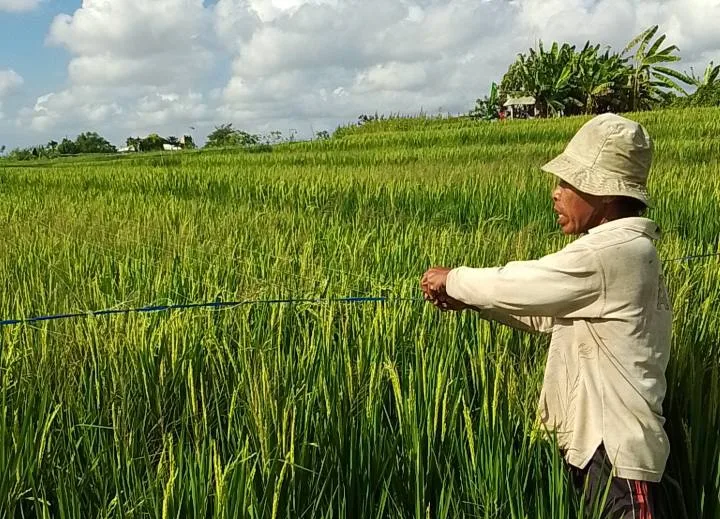
The optimism emerging from the executive branch is commendable, especially after Agriculture Minister Andi Amran Sulaiman announced an ambitious national rice production target of 34.77 million tons by 2026. This figure is not merely a statistical projection, but a political statement signaling the country’s strong commitment to strengthening food sovereignty and ending dependence on imports. The claim that a production surplus will guarantee year-round food availability, on the surface, provides a collective sense of security regarding the nation’s food security.
However, behind this narrative of success built on achieving quantity targets lies a strategic concern that is often overlooked. We are witnessing the strengthening of the “Rice Trap” paradigm, a framework that single-mindedly positions rice as the primary barometer of food self-sufficiency. This structural and political attachment to a single commodity is a fundamental flaw that has the potential to weaken, rather than strengthen, the nation’s future food security position.
This obsession with food monoculture creates the illusion of security. Rice, ecologically, is a costly crop—requiring massive technical irrigation, intensive fertilizer and water inputs, and special treatment to achieve optimal production. When rice production targets are pushed to their maximum limits, policies encourage suboptimal land exploitation, forcing the establishment of new rice fields in agronomically suboptimal areas, simply to meet volume targets. This creates ecological inefficiency and accelerates environmental degradation.
The fragility of this single-minded strategy is directly confronted with the reality of the climate crisis. Global phenomena like El Niño and La Niña are no longer rare cycles, but rather permanent variables that must be accounted for. If climate disruptions strike rice production centers, our near-total dependence on this commodity puts the country in a highly risky position. Millions of tons of production could be lost in a single growing season due to drought or flooding, and by then, ambitious targets will be shattered without a robust alternative carbohydrate safety net.
It’s ironic that, amid our dependence on rice, we are neglecting a treasure trove of ecologically resilient local food diversity. Indonesia is blessed with tubers like taro, cassava, and sago, which are remarkably resilient to marginal soil and water shortages. These commodities are truly pillars, capable of acting as safety valves when national rice production is under pressure. However, due to the lack of price guarantees or adequate industrial infrastructure, these supporting commodities have been relegated to inferior food or simply hedge crops.
Therefore, the 2026 self-sufficiency target must be accompanied by a paradigm shift. Food sovereignty cannot be measured solely by rice volume, but rather by the extent to which a country is able to activate and modernize its full carbohydrate potential. If national food policy remains shackled by rice hegemony, the food security we aspire to will rest on a single, highly vulnerable foundation, ultimately forcing us to re-open the import tap when drought strikes.
Rice Hegemony and Ecological Fragility
The hegemony of rice in national food policy is not simply a cultural preference, but a costly agronomic bias. Agriculturally, relying on a single monoculture for food for a large archipelago is an inherently fragile strategy. Diversity is a fundamental principle of ecology; when a system is dominated by a single species, it loses its natural resilience to the shocks of pests, disease, and climate change.
This fragility stems from the highly resource-intensive nature of rice. Several studies have shown that rice is a water-intensive crop. It takes 3,000–5,000 liters of water to produce 1 kilogram of rice, which is approximately 2 to 3 times more than producing 1 kilogram of other cereals such as wheat or corn. In the context of the climate crisis, which has triggered prolonged droughts (El Niño), this massive water demand presents a critical vulnerability. Any threat of water deficit immediately translates into the risk of mass crop failure, forcing the country into a reactive and vulnerable position to global price spikes.
The obsession with rice production also triggers systemic ecological inefficiencies, particularly in land allocation. Government funds and efforts are diverted heavily to maintain existing rice paddies, even encouraging the conversion of marginal lands naturally better suited to other crops—such as drylands ideal for sweet potatoes, or swamplands, the natural habitat of sago. This practice destroys local biodiversity and accelerates soil degradation due to the massive use of chemical fertilizers and pesticides to maintain yields amidst environmental pressures.
Paradoxically, to achieve ambitious rice production targets of 34.77 million tons, the government is forced to rely on precision farming practices and high technology, which require significant investments in soil analysis, climate data, and sophisticated irrigation systems. Meanwhile, local commodities like taro and sweet potato, which are naturally adapted to local soil and weather conditions—and therefore require minimal technological inputs and costs—are neglected. This represents the greatest opportunity cost: the potential for resilience already inherent in nature is being squandered to maintain expensive and vulnerable commodities.
This situation is exacerbated by a negative feedback loop. Forced rice production on infertile land requires more chemical fertilizers and pesticides. This dependence on imported fertilizers not only burdens the state subsidy budget but also weakens soil quality and increases the carbon footprint. Instead of achieving sovereignty, we are reinforcing a dual dependency: dependence on a single crop and dependence on foreign chemical inputs.
Therefore, if the government is committed to achieving true food sovereignty, the paradigm must shift from a focus on rice volume to food ecosystem resilience. Resilience can only be achieved through ecological diversification, namely by restoring the strategic function of local foods, which are naturally proven to be more resource-efficient and resilient to climate change. Ignoring the treasure trove of cassava, taro, and sago in favor of rice is not only economically inefficient but also ecologically reckless.
The Mistake of National Food Homogenization
The second strategic weakness lies in the policy error that seeks to homogenize consumption patterns in a country that is genetically and culturally one of the most diverse in the world. Indonesia, historically, has a food civilization based on sago in the eastern region, corn in Nusa Tenggara, and various tubers in Java and Sumatra. However, for decades, food policy has been heavily directed at instilling the stigma that rice is the sole symbol of prosperity and a prerequisite for development.
This phenomenon has created a highly damaging cultural bias. Rice-dominated food policies have gradually eroded local wisdom. Communities in various regions that were previously self-sufficient with sorghum or taro now feel they haven’t eaten if they haven’t consumed rice. Consequently, food policies have indirectly excluded millions of farmers and local non-rice food producers from the economic value chain, forcing them to rely on a supply of commodities foreign to their own lands.
Logistically and economically, this homogenization creates a chasm of inefficiency. A rice-centric food policy requires the mobilization and distribution of rice from production centers (such as Java, South Sumatra, or South Sulawesi) to all corners of the country, including geographically difficult-to-reach areas. Transportation, storage, and subsidy costs to stabilize rice prices in remote areas are prohibitively high.
Imagine the logistical costs of shipping rice to Papua, which actually has the world’s largest natural sago reserves. This represents a significant waste of state funds and a failure of public policy to capitalize on the potential of locally available food crops. Funds spent on subsidies and distribution costs could have been diverted to modernizing the sago processing industry or building storage infrastructure for the tuber in these areas.
The most severe consequence of this food homogenization is the fragility of regional resilience. When the rice supply chain is disrupted, whether by natural disasters, maritime transport disruptions, or declining production in Java, communities in the Eastern Region, whose local food systems have been gradually depleted, will immediately fall into food insecurity. They no longer have the “buffer” traditionally provided by tubers or sago.
Therefore, true food self-sufficiency should not mean the state must grow a single type of food, but rather that the state ensures that each region has strengthened local food sovereignty. Re-recognizing taro, cassava, and sago as national strategic commodities is an essential step to ending the policy error that has made our dinner plates uniform, yet fragile.
Overlooked Treasures (Sweet Potatoes and Taro)
Along with our unbridled ambition to massively produce rice, we have systematically neglected the genetic endowment of local commodities that should serve as pillars of diversification and buffers for food security. Sweet potatoes, taro, and sago, widely distributed across the archipelago, are now in a state of dormant potential—an economic and nutritional force overlooked by policy bias.
This debate concerns not only calorie availability but also nutritional quality and public health. White rice, the staple food, has a relatively high glycemic index (GI), closely correlated with the increasing prevalence of diabetes and metabolic diseases in Indonesia. In contrast, taro, sweet potato, and sago generally have a lower glycemic index and are rich in dietary fiber, vitamins, and minerals. By prioritizing these commodities, the government can simultaneously address the threat of a food crisis and a public health crisis.
Economically and industrially, the potential of tubers extends beyond being a boiled staple food. Cassava, for example, is an essential raw material for downstream industries such as Modified Cassava Flour (Mocaf), starch for pharmaceuticals, bioethanol, and even animal feed. Sago holds significant potential as an organic carbohydrate source and a raw material for the modern food industry. Developing this commodity means building a much more complex and profitable value chain than simply selling unhusked rice.
However, this enormous potential is hampered by the failure of policies to build a stable market ecosystem. Farmers are reluctant to grow taro or sweet potatoes on a commercial scale due to the lack of guaranteed state-mandated prices, the lack of post-harvest processing infrastructure, and the lack of research to develop superior varieties. This lack of support reflects the fact that, in the eyes of decision-makers, tubers are still considered subsistence foods, not strategic industrial commodities.
Thus, the stigma of “inferior food” attached to sweet potatoes and taro is not a reflection of the intrinsic quality of the commodities themselves, but rather a reflection of the state’s failure to provide equal status and political support. Activating this treasure trove requires radical interventions in the form of developing local food-based industrial clusters, establishing benchmark prices that benefit farmers, and educational campaigns that change public perception. Only then can we transform tubers from mere field food to pillars of modern food sovereignty.
Redefining Self-Sufficiency: Towards Carbohydrate Sovereignty
To break free from the “Rice Trap,” Indonesia needs a radical paradigm shift from rice self-sufficiency to carbohydrate sovereignty or resilience-based food security. True sovereignty lies not in the ability to massively produce a single commodity, but rather in the freedom of the state and society to produce a variety of primary food sources that are ecologically and culturally most appropriate to local conditions.
The first step toward this redefinition is aggressive downstreaming of the local food industry. The government must move beyond calls for diversification and begin acting as a market maker. Support should no longer be directed at farmers boiling sweet potatoes and taro, but rather at industries capable of processing tubers into modern, high-value products—such as Modified Cassava Flour (Mocaf), sago noodles, or analog rice. Creating stable industrial demand will automatically encourage farmers to grow these commodities commercially.
Fiscal interventions and research must also be allocated proportionally. The state budget needs to be allocated to strengthen research and development of superior varieties of sweet potato and taro with high yields and disease resistance. Furthermore, the government must establish a Government Purchase Price (HPP) for strategic tubers, providing a financial safety net that assures farmers that their businesses will not collapse during the peak harvest. This price guarantee will restore the dignity of tubers as a primary commodity.
Today, food sovereignty is about returning control to the people. The government must gradually eradicate the stigma that local food is inferior through public education and the integration of sago, taro, and cassava-based menus into institutional food programs (such as those in schools, hospitals, and the military). This is a long-term investment in building a generation that values and consumes food diversity, while breaking the historical chain of dependence on rice.
Therefore, when the Minister of Agriculture sets an ambitious rice production target of 34.77 million tons by 2026, this target should be seen as one component of resilience, not the whole story. True food security must be realized through diverse plates, sustainable agricultural land, and farmers who are proud of their country’s full carbohydrate potential. Only with diversity can Indonesia ensure that when one food source is disrupted by the climate crisis or disease, other sources are ready to provide a buffer.
Therefore, when the Minister of Agriculture sets an ambitious rice production target of 34.77 million tons by 2026, this target should be seen as one component of resilience, not the whole story. True food security must be realized through diverse plates, sustainable agricultural land, and farmers who are proud of their country’s full carbohydrate potential. Only with diversity can Indonesia ensure that when one food source is disrupted by the climate crisis or disease, other sources are ready to provide a buffer.
True food security is not measured by how full Bulog’s warehouses are with rice, but by how diverse the plates of Indonesians are. As long as we remain trapped in the “Rice Trap,” food self-sufficiency is merely a grandiose structure on a shaky foundation. (***)
Follow Us at Google News and WA Channel