
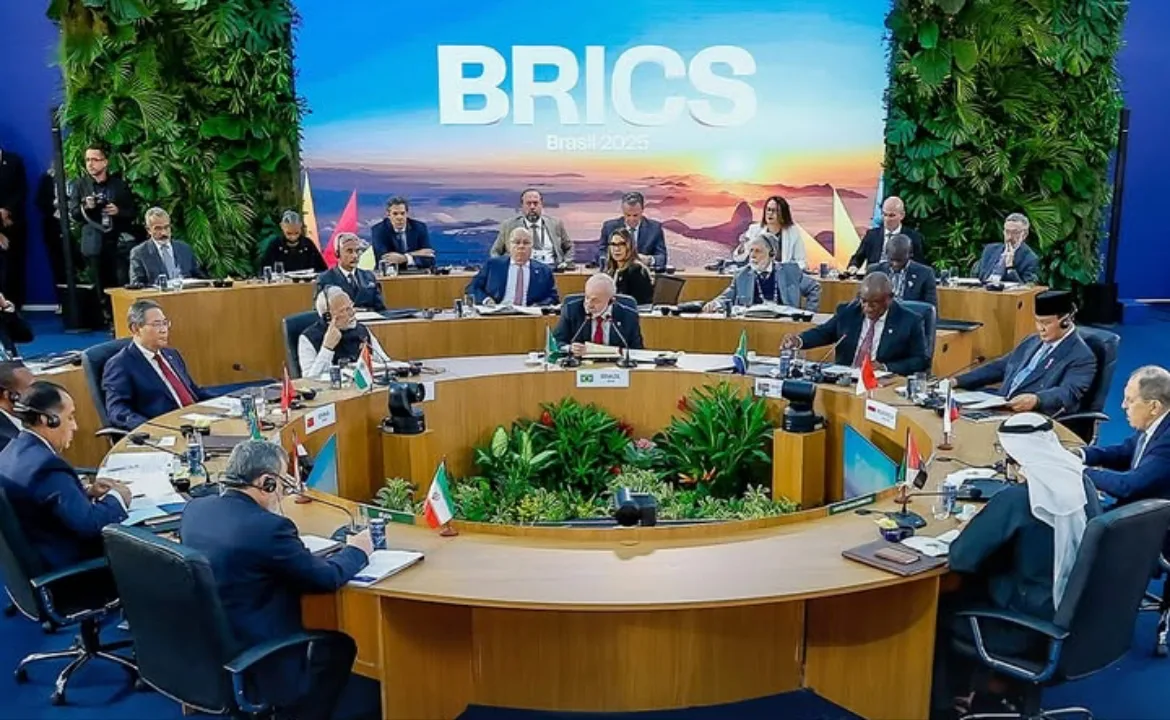
ASIATODAY.ID, RIO DE JANEIRO – BRICS has already outstripped the Western-dominated Group of Seven in terms of combined GDP, Russian President Vladimir Putin has stated.
Speaking via video link at a plenary session of the 17th annual BRICS summit in Rio de Janeiro on Sunday, Putin said that the “BRICS member states not only account for a third of the Earth’s land, and almost half the planet’s population, but also 40% of the global economy.”
BRICS’ “combined GDP measured by purchasing power parity already stands at $77 trillion, that’s according to 2025 IMF data,” he added, noting that “on this metric, BRICS considerably outstrips some other groups, including the Group of Seven.”
The Russian president cited recent IMF data as indicating that the corresponding figure for the G7 is $57 trillion.
He also pointed out that BRICS member states are increasingly relying on their national currencies in inter-bloc trade.
According to the president, “BRICS has deservedly established itself among the key centers of global governance,” with its “global standing and influence rising by the year.” Putin argued that the group represents the “fundamental interests of the global majority.”
Putin hailed “mutual respect” as one of BRICS’ cornerstones, which helps bring together peoples of different cultures and religions, and makes the group attractive to developing nations. According to the Russian president, “the unipolar system of international relations, which has been serving the interests of the so-called ‘golden billion’,” is fast unravelling, giving way to a multipolar global economic system.
Speaking during the St. Petersburg International Economic Forum last month, Putin similarly claimed that the fading world order is deeply neo-colonial in nature. He also spoke of a major transformation taking shape in the global economy.
Around the same time, Kremlin spokesperson Dmitry Peskov said that Russia does not consider the G7, of which it was a member between 1998 and 2014, to be a viable format, “because global trends indicate that the G7’s share in global affairs and the global economy will be inexorably shrinking.”
Founded primarily as an economic group in 2006, BRICS initially included Brazil, Russia, India, and China, with South Africa joining in 2010. Over the past year, Egypt, Ethiopia, the United Arab Emirates, and Indonesia have also become full members.
At the group’s summit in the Russian city of Kazan last year, BRICS approved a new ‘partner country’ status in response to a growing membership interest shown by more than 30 countries.
Modi calls on BRICS nations to condemn terrorism
Terrorism has become the “most serious challenge” for humanity, Indian Prime Minister Narendra Modi said while addressing the BRICS summit in Rio de Janeiro, Brazil, on Sunday. He called on the group to condemn terrorism and show no hesitation in sanctioning terrorists.
Referring to the deadly terrorist attack in Pahalgam, Kashmir, in which 26 people lost their lives, Modi described it as a “direct attack on the soul, identity, and dignity of India.”
“This attack was a blow not only to India but to all of humanity,” he said, thanking the friendly countries “who stood with us, who expressed support and condolences.”
“Condemning terrorism should be our ‘principle,’ not just a ‘convenience,’” Modi emphasized. “For personal or political gain, giving silent consent to terrorism – supporting terror or terrorists – should not be acceptable under any circumstances.”
The BRICS leaders on Sunday condemned the Pahalgam attack and echoed India’s position on adopting a “zero tolerance” approach toward terrorism and rejecting double standards in countering it.
“We reaffirm our commitment to combating terrorism in all its forms and manifestations, including the cross-border movement of terrorists, terrorism financing, and safe havens. We urge the adoption of zero tolerance for terrorism and reject double standards in countering it,” the declaration stated. The document also welcomed ongoing counter-terrorism cooperation among BRICS nations.
India has previously blamed Pakistan for supporting cross-border terrorism and has linked the Pahalgam attack to Islamabad, triggering an unprecedented diplomatic and military standoff in May this year.
Pakistan has denied the allegations, claiming it is itself a “victim of terrorism.” Pakistani Defense Minister Khawaja Asif admitted that Islamabad had done “the dirty work” for Western powers – particularly the US and the UK – by training and arming terrorists for three decades. He added, however, that this “was a mistake” and that Pakistan has “suffered for that.”
There must be absolutely no hesitation in imposing sanctions against terrorists. We cannot weigh victims of terrorism and its supporters on the same scale. Any silent support or approval to terrorism for personal or political interests must be unacceptable.
— Narendra Modi (@narendramodi) July 6, 2025
While addressing the summit’s opening session, Modi also stressed the urgent need for comprehensive reforms in global institutions to address the marginalization of the Global South.
“The Global South has often faced double standards. Whether it’s about development, the distribution of resources, or security-related matters, the interests of the Global South have not been given due importance. On topics like climate finance, sustainable development, and technology access, the Global South has often received nothing more than token gestures,” he stated.
India is set to host the next BRICS summit in 2026, according to the joint statement. (RT)
Follow Us at Google News and WA Channel