
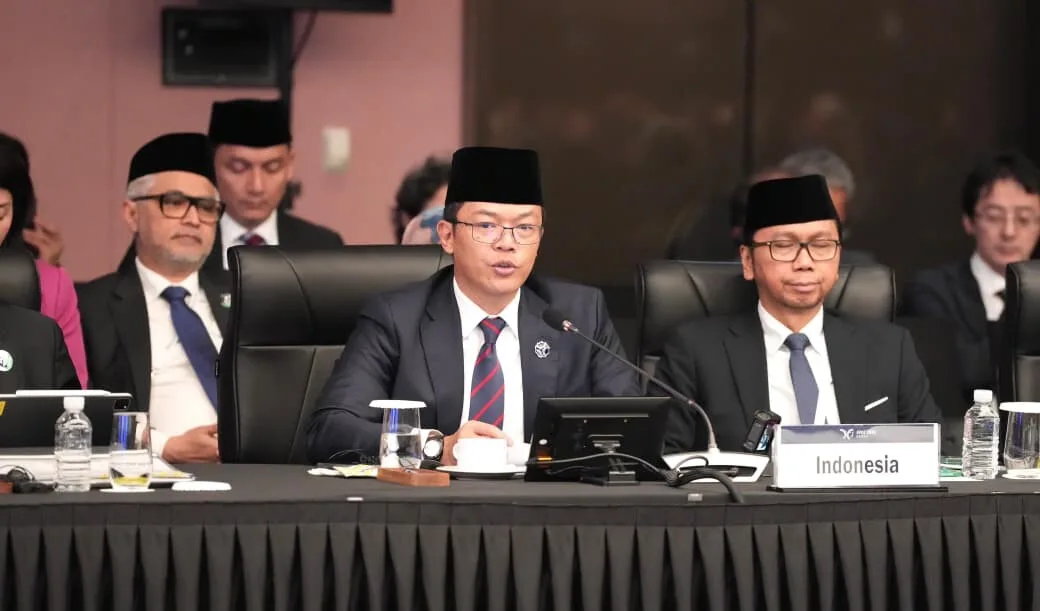
ASIATODAY.ID, GYEONGJU — Indonesian Foreign Minister Sugiono emphasized the urgent need to bridge the digital divide in the Asia-Pacific region to ensure that digital transformation is inclusive, sustainable, and equitable.
Minister Sugiono highlighted that the Asia-Pacific region remains a global engine of growth and innovation, but the benefits of technological revolutions, demographic transitions, and the rise of the creative economy have not been evenly distributed.
“With our collective economic strength, demographic scale, and technological capacity, APEC must lead in promoting human-centered innovation—where technology empowers people rather than replaces them,” Sugiono stated at the 2025 APEC Ministerial Meeting (AMM) in Gyeongju, October 30, 2025.
He underlined that digital progress remains uneven, with nearly half of the region still lacking adequate internet access. This disparity poses a critical challenge, particularly for countries with young populations such as Indonesia.
“While some economies are facing aging populations, Indonesia has a demographic advantage, with more than 60 percent of its population under the age of 40. To turn this potential into real economic power, digital connectivity must be the key,” he added.
Indonesia urged APEC members to make narrowing the digital divide a collective priority, through:
Investment in digital infrastructure,
Capacity building and digital literacy, and
Empowering women and MSMEs in the digital economy.
Minister Sugiono also emphasized the role of the creative economy as a strategic driver for inclusive and sustainable growth. In Indonesia, this sector contributes around USD 90 billion to the national economy and supports over 26.5 million jobs.
Concluding his remarks, Minister Sugiono reaffirmed Indonesia’s commitment to advancing digital cooperation across the Asia-Pacific.
“Indonesia is ready to help build an innovative, inclusive, and prosperous Asia-Pacific—where people remain at the center of progress, and technology serves as a tool for shared prosperity rather than a source of inequality,” he concluded. (AT Network)
Follow Us at Google News and WA Channel