
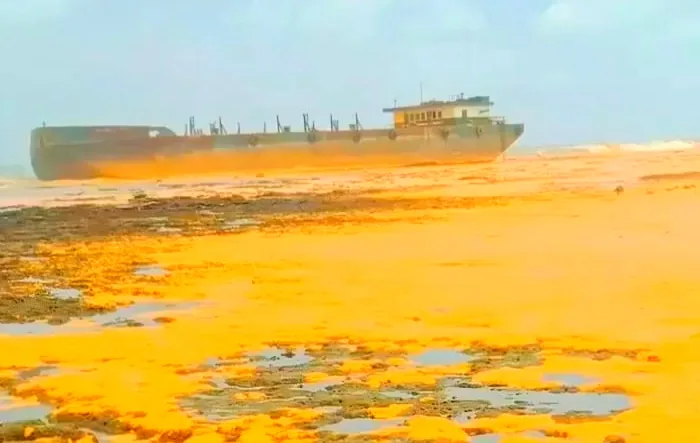
ASIATODAY.ID, SUMENEP — An environmental crisis is unfolding in eastern Indonesia after tens of tons of crude palm oil (CPO) spilled from a grounded barge contaminated the waters of Gili Iyang, one of the world’s most oxygen-rich islands, and spread to neighboring islands across the Madura Sea.
The spill originated from a barge operated by PT Indo Ocean Marine, which ran aground on coral reefs off the northern coast of Gili Iyang, Sumenep Regency, East Java.
What began as localized marine pollution has now escalated into a regional environmental emergency, with contamination detected as far as Sepudi Island and Raas Island.
Pollution Spreads Beyond Ground Zero
According to Anwar Syahroni Yusuf, Head of the Sumenep Environmental Agency, monitoring data and field reports confirm that palm oil contamination has extended well beyond the initial spill site.
“Based on the data we have collected, the crude palm oil has already contaminated waters around Sepudi Island and Raas Island,” Syahroni said on Thursday, January 29, 2026.
He added that the findings have been formally reported to the East Java Provincial Environmental Agency and Indonesia’s Ministry of Environment to enable coordinated, cross-regional response measures.
A Rare Global Ecological Asset at Risk
Gili Iyang is internationally known for its exceptionally high natural oxygen levels, measured at approximately 20.9 percent, significantly above the global average. The island has long been promoted as a health tourism destination and a unique ecological zone.
Environmental observers warn that palm oil residues coating coral reefs, mangroves, and shallow seabeds could suffocate marine ecosystems and undermine the island’s oxygen-producing capacity.
“This is not just an oil spill; it is contamination of a rare ecological asset,” said an environmental researcher familiar with the region.
“Once palm oil settles into marine habitats, recovery can take years.”
Government Focus on Data, Cleanup Awaiting Direction
At the district level, authorities say their role remains focused on environmental assessment and reporting, while cleanup operations and enforcement measures fall under provincial and national jurisdiction.
“For now, we are concentrating on data collection and reporting,” Syahroni said.
“Technical response measures in the field will follow directives from the ministry and the provincial environmental agency.”
As of this week, officials have not confirmed whether additional islands beyond Sepudi and Raas have been affected.
‘A Regional Ecological Emergency’
Indonesian Senator AA LaNyalla Mahmud Mattalitti described the incident as a regional ecological emergency demanding immediate and decisive government action.
“This is not merely a maritime accident. Gili Iyang is a rare global ecological asset. When such an ecosystem is polluted, the consequences extend far beyond local boundaries,” LaNyalla said on Friday, January 30, 2026.
Four Critical Alarms
LaNyalla outlined four urgent alarms triggered by the disaster.
First, pollution threatens oxygen-producing ecosystems. Palm oil residues coating mangroves and coral reefs risk suffocating natural oxygen generation processes.
Second, pollution undermines livelihoods and food security. Reports of dead fish, crabs, and shellfish near Banraas Village indicate severe disruption of the marine food chain.
“I urge residents not to consume seafood from polluted waters until official safety assurances are issued,” he said.
Third, strict legal accountability is unavoidable. Under Indonesia’s Environmental Protection and Management Law, the polluter bears full responsibility for environmental damage.
“PT Indo Ocean Marine must immediately evacuate the vessel, clean up the pollution, and restore the contaminated marine environment,” LaNyalla emphasized.
Fourth, bureaucratic inertia must not delay environmental emergency response, as pollution continues to spread with ocean currents.
Vessel Still Grounded on Coral Reefs
Field observations show that the barge remains grounded on coral reefs off northern Gili Iyang. While visible oil slicks near the vessel have reportedly diminished, authorities believe residual palm oil has been carried eastward by sea currents, continuing to contaminate surrounding waters.
The barge was transporting approximately 3,000 kiloliters of crude palm oil when it encountered strong winds, high waves, and heavy rainfall on the night of January 21, 2026, causing it to drift and strike the reef. The impact damaged the vessel’s hull, triggering the spill.
Legal Accountability and Public Warning
Environmental law experts note that under Indonesia’s Environmental Protection and Management Law, the operator bears full responsibility for pollution, cleanup, and ecological restoration.
Local residents have been urged to avoid consuming seafood from potentially contaminated waters until safety assessments are completed.
Authorities continue to monitor the spread of contamination as calls grow for swift evacuation of the vessel, comprehensive cleanup, and transparent enforcement action against those responsible. (AT Network)
Follow Us at Google News and WA Channel