
ASIATODAY.ID, JAKARTA – Digital violence against women is emerging as a growing threat across Southeast Asia, with new data revealing the scale of the problem in Indonesia.
According to Indonesia’s 2024 National Survey on Women’s Life Experiences (SPHPN), around 1 in 13 women in Indonesia — or 7.5 percent — have experienced digital violence by a non-partner during their lifetime.
The findings underscore the rapid rise of technology-facilitated abuse, which experts warn is becoming one of the most pervasive forms of gender-based violence in the digital age. Globally, studies estimate that between 16 percent and 58 percent of women have faced some form of online violence.
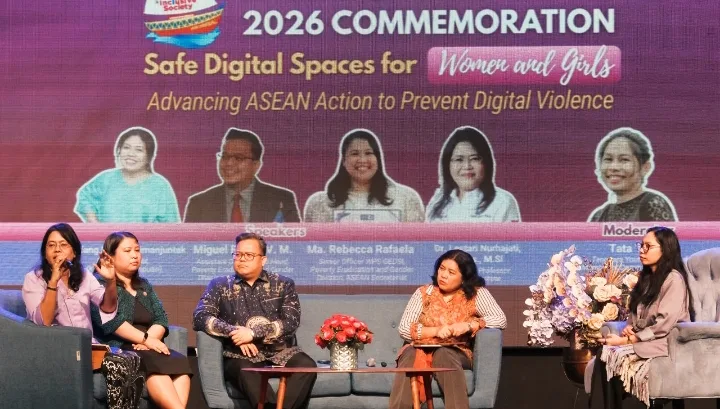
Against this backdrop, the Embassy of the Republic of the Philippines in Jakarta, the United Nations Population Fund (UNFPA) Indonesia, and the London School of Public Relations Communication and Business (LSPR Institute) held a high-level commemoration of International Women’s Day (IWD) 2026 under the theme:
“Safe Digital Spaces for Women and Girls: Advancing ASEAN Action to Prevent Digital Violence.”
The event, held in Jakarta on March 10, 2026, included a film screening and a panel discussion highlighting the urgency of cross-border collaboration to combat digital violence in the ASEAN region.
Growing Threat of Technology-Facilitated Gender Violence
Philippine Ambassador to Indonesia Christopher B. Montero highlighted the importance of stronger collaboration at bilateral, regional, and global levels to address technology-facilitated gender-based violence.
He noted that the discussion was particularly timely as the Philippines currently holds the ASEAN Chairmanship for 2026.
“This event provides a timely opportunity to elevate grounded lessons from both the Philippines and Indonesia as leaders in advancing the gender and development agenda in ASEAN,” Montero said.
Despite years of progress in promoting Gender and Development (GAD) initiatives, he acknowledged that challenges remain, particularly in translating policies into meaningful change at the grassroots level.
Women’s Rights Must Extend to Digital Spaces
Hassan Mohtashami, UNFPA Representative in Indonesia, emphasized that violence against women and girls remains one of the most widespread human rights violations worldwide.
He warned that the rapid expansion of digital technologies has created new forms of abuse that require urgent action.
“The rapidly expanding digital manifestations of violence against women demand urgent, survivor-centred responses,” Mohtashami said.
He stressed that ensuring safe digital spaces goes beyond legal frameworks and requires comprehensive protection systems and accessible justice for survivors.
Rising Cases Among Young Women
Dr. (H.C) Prita Kemal Gani, Founder and CEO of LSPR Institute, said digital violence is rising rapidly, particularly among young women who are highly active in online spaces.
She called for stronger public awareness and coordinated responses from governments, civil society, and academic institutions.
“Online abuse is part of a broader continuum of violence that requires coordinated prevention and response,” Gani said.
“Fotome” Film Highlights Digital Abuse
The event also featured the screening of “Fotome,” a short film produced under the UNiTE 2025 campaign and directed by Indonesian filmmaker Vera Isnaini from Pontianak.
The film explores the psychological and social impact of digital violence on women and served as the starting point for a high-level panel discussion.
The panel included:
– Sondang Frishka Simanjuntak, Commissioner of Indonesia’s National Commission on Violence against Women (Komnas Perempuan)
– Miguel Rafael V. Musngi, Assistant Director and Head of the Poverty Eradication and Gender Division at the ASEAN Secretariat
– Ma. Rebecca Rafaela R. Baylosis, Senior Officer for WPS-GEDSI at the ASEAN Secretariat
– Dr. Lestari Nurhajati, Associate Professor at LSPR Communication and Business Institute
The discussion was moderated by Tata Yunita, founder of Tenggara Youth and a member of UNFPA’s Community of Practice of youth content creators.
Panelists emphasized the need for: stronger cross-country dialogue within ASEAN, legal reforms to address digital violence, accessible reporting systems for victims, better support mechanisms for survivors.
Pushing ASEAN Toward Coordinated Action
The event forms part of a broader regional initiative aimed at strengthening ASEAN’s campaign framework for preventing gender-based violence and promoting sustained action across Southeast Asia.
As internet use and social media penetration continue to rise in the region, experts say ensuring safe digital environments for women and girls must become a priority for ASEAN governments and institutions. (AT Network)
Follow Us at Google News and WA Channel