
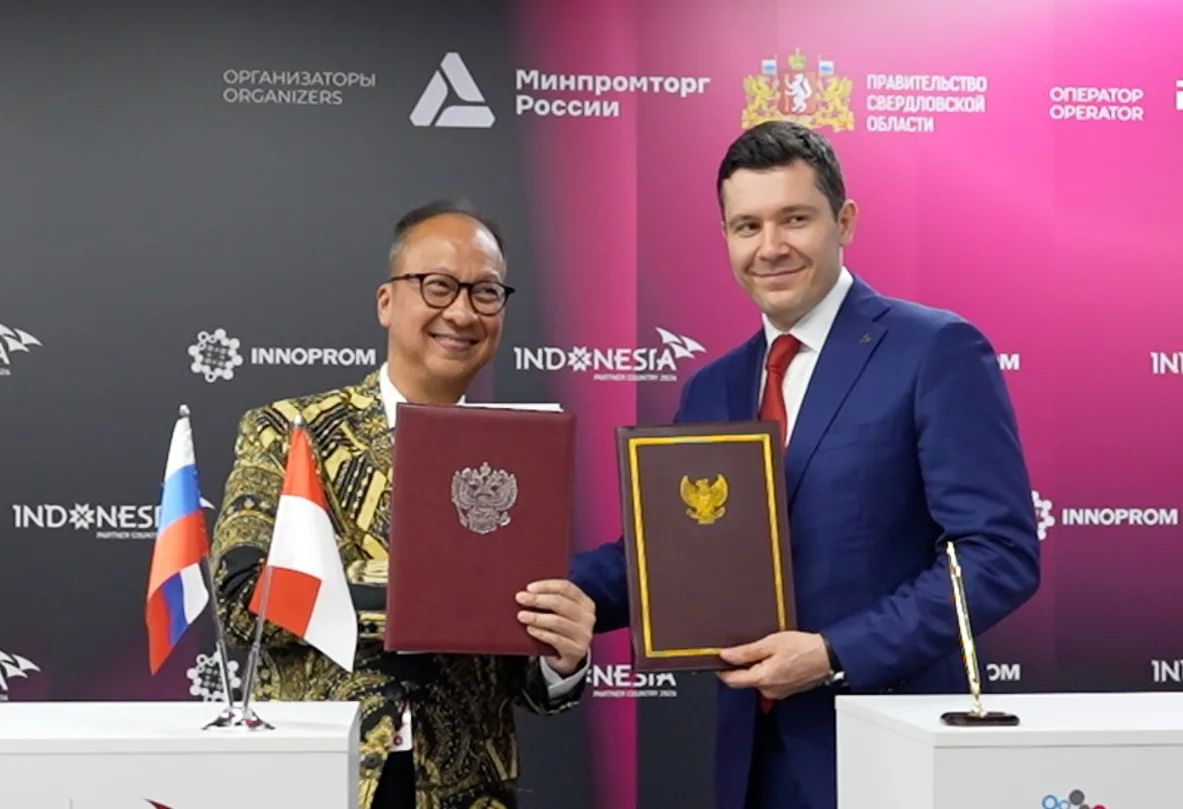
ASIATODAY.ID, YEKATERINBURG – Indonesia is accelerating its global industrial expansion by strengthening strategic partnerships across Eurasia, securing seven new industrial cooperation agreements aimed at advancing technology collaboration, investment opportunities, manufacturing partnerships, and supply chain integration.
The agreements were announced during Indonesia’s participation as the Official Partner Country at INNOPROM 2026, held in Yekaterinburg, Russia, from 6–9 July 2026, marking a significant milestone in Indonesia’s ambition to position itself as a high-value manufacturing partner in the global economy.
Indonesian Minister of Industry Agus Gumiwang Kartasasmita said Indonesia’s participation reflects a clear industrial strategy focused on accelerating downstream industries, strengthening advanced manufacturing capabilities, and expanding access to international markets.
“Indonesia is bringing a clear industrial agenda, from critical minerals and advanced manufacturing to energy, food security, and industrial zones,” Agus said during the Russia–Indonesia Industrial Dialogue in Yekaterinburg.
He emphasized that Indonesia is ready to deepen technology cooperation with Russia while integrating national manufacturing capabilities into the Eurasian market.
Expanding Indonesia–Russia Industrial Cooperation
The new agreements mark a further step in the growing economic relationship between Indonesia and Russia.
Bilateral trade between the two countries reached US$4.8 billion in 2025, growing 5.4 percent compared with the previous year. Indonesia’s exports to Russia increased 7.5 percent to approximately US$1.8 billion, supported by shipments of rubber, coffee, cocoa, tea, footwear, electronic components, and chemical products.
Meanwhile, Indonesia imports strategic products from Russia, including fertilizers, iron and steel products, cereals, organic chemicals, and aviation-related goods.
The industrial dialogue at INNOPROM 2026 focused on three key areas: joint industrial projects, investment opportunities for industrial companies in Indonesia and Russia, and mechanisms to support exporters.
Indonesia views the cooperation as an opportunity to build long-term industrial partnerships while strengthening resilience in global supply chains.
Moving Beyond Commodities Through Advanced Manufacturing
Indonesia showcased its growing industrial capabilities through participation from the metal, machinery, transportation equipment, and electronics (ILMATE) sectors.
The Indonesian delegation presented various innovations, including artificial intelligence (AI), virtual reality, RFID technology, maritime industries, ship components, drone technology, solar energy solutions, industrial machinery, and smart manufacturing systems.
A total of 19 companies and industrial institutions represented Indonesia across sectors such as digital technology, steel and metal industries, shipbuilding, renewable energy, industrial equipment, and smart farming.
Director General of Metal, Machinery, Transportation Equipment and Electronics Industry at Indonesia’s Ministry of Industry, Setia Diarta, said the participation demonstrates that Indonesian industries are increasingly competitive in global markets.
“Indonesia is showing international partners that its industries are capable of producing innovative, technology-based, and high-value manufacturing solutions,” he said.
One notable milestone was the Non-Disclosure Agreement (NDA) between PT PAL Indonesia and Rosatom signed in April 2026, opening opportunities for cooperation between Indonesia’s maritime industry and global technology partners.
From Batik to Drones: Indonesia Highlights Creative Manufacturing
Alongside advanced industries, Indonesia also promoted its creative manufacturing strengths through the Specialty Manufacturing & Consumer Goods Pavilion.
The showcase featured batik and batik-making technology, geospatial survey services, drone technology, specialty coffee, home decoration products, fashion, and textile industries.
The products reflected Indonesia’s ability to combine cultural heritage, innovation, and modern manufacturing standards to compete internationally.
Director General of Small, Medium and Miscellaneous Industries at the Ministry of Industry, Reni Yanita, said Indonesian products possess unique advantages through the combination of cultural identity, craftsmanship, and innovation.
“Indonesian products carry distinctive value through cultural heritage, skilled craftsmanship, and continuous innovation aligned with global market standards,” she said.
I-EAEU FTA Creates New Export Opportunities
Indonesia sees Eurasia as a strategic market for expanding manufactured exports, particularly following the implementation of the Indonesia–Eurasian Economic Union Free Trade Agreement (I-EAEU FTA).
The agreement provides preferential tariffs covering around 90.5 percent of tariff lines, creating wider opportunities for Indonesian products, including textiles, furniture, handicrafts, and other manufactured goods.
The Indonesian government expects the agreement to accelerate export growth, attract investment, encourage technology transfer, and strengthen industrial supply chains between Indonesia and Eurasian economies.
Indonesia’s New Chapter in Global Industrial Diplomacy
Indonesia’s participation as the Official Partner Country at INNOPROM 2026 represents a broader strategy to diversify export markets, strengthen industrial diplomacy, and build sustainable partnerships amid changing global economic dynamics.
The seven newly signed MoUs complement previous cooperation agreements established since December 2025 in shipbuilding and industrial studies.
Through stronger collaboration with Russia, the Eurasian Economic Union (EAEU), and global industrial partners, Indonesia aims to establish itself as a reliable manufacturing hub capable of delivering innovation, technology, and sustainable industrial solutions.
The move reflects Indonesia’s transformation from a supplier of raw materials into an emerging industrial power with growing capabilities in advanced manufacturing and global supply chain participation.
As opportunities in Eurasia continue to expand, Indonesia expects stronger exports, increased investment flows, deeper technology partnerships, and broader recognition as a trusted industrial partner in the global economy. (AT Network)
Follow Us at Google News, Instagram, WA Channel, and LinkedIn