
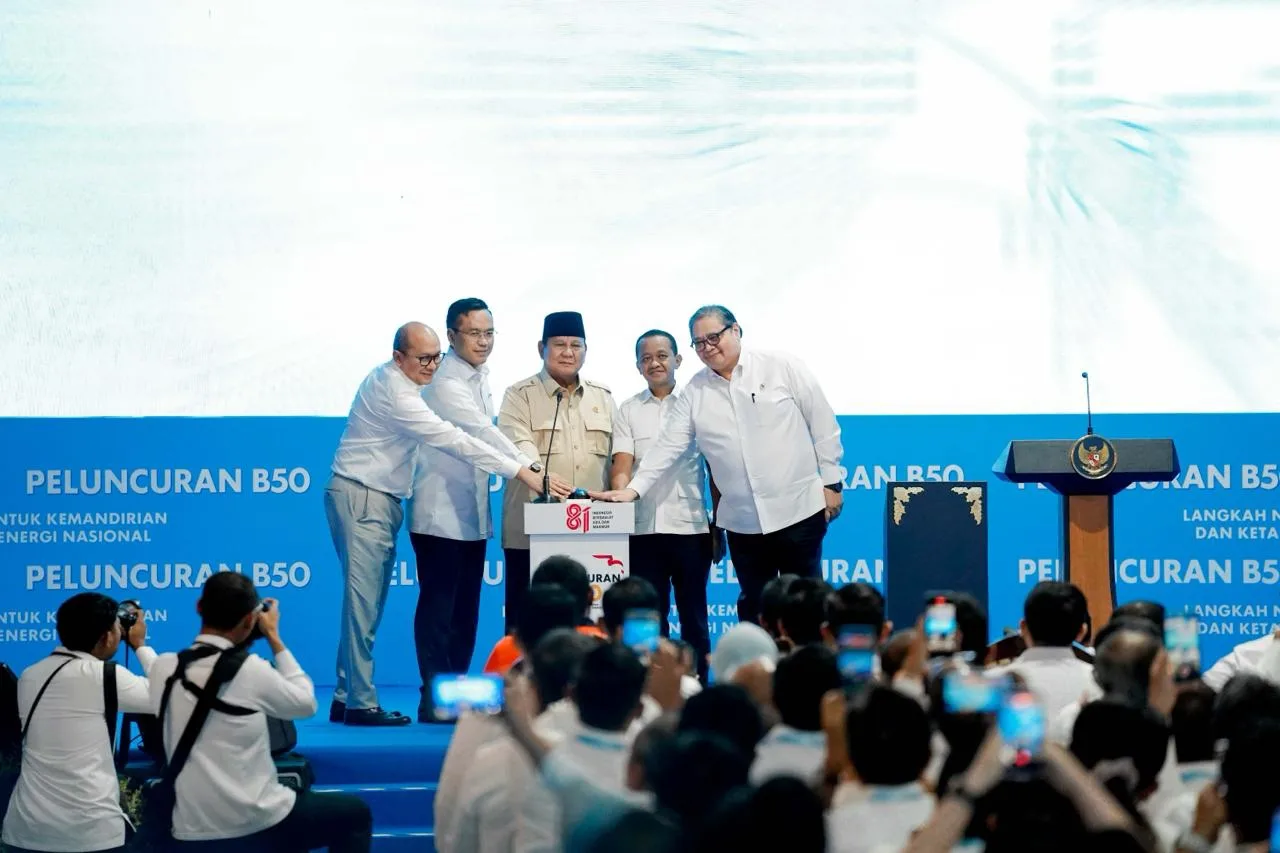
ASIATODAY.ID, JAKARTA — Indonesia has officially launched its nationwide B50 Biodiesel Mandate, marking a major step toward strengthening energy security, reducing dependence on imported fossil fuels, and expanding the use of renewable energy. The policy also supports the government’s strategy to increase the domestic value of Indonesia’s abundant palm oil resources through downstream industrial development.
President Prabowo Subianto, accompanied by Minister of Energy and Mineral Resources Bahlil Lahadalia, inaugurated the program in Karawang, West Java, on Thursday. By increasing the mandatory biodiesel blend in diesel fuel from 40 percent to 50 percent, Indonesia now operates one of the world’s highest mandatory biodiesel blending programs.
The launch comes as governments around the world seek to diversify energy supplies, strengthen resilience against geopolitical uncertainty, and accelerate the transition to lower-carbon energy systems.
“The launch of the B50 Mandate is not merely the introduction of another policy. It is a historic milestone that demonstrates Indonesia’s commitment to strengthening national energy independence, resilience, and sovereignty,” Bahlil said.
As the world’s largest producer of crude palm oil (CPO), Indonesia regards biodiesel as a strategic component of its energy policy, enabling the country to convert its natural-resource advantage into higher-value industrial products while reducing reliance on imported petroleum fuels.
According to the Ministry of Energy and Mineral Resources, the B50 program is expected to deliver significant economic benefits. Annual foreign exchange savings are projected to increase from IDR133.3 trillion under the B40 program to approximately IDR170 trillion, primarily through lower diesel imports.
The policy is also projected to increase the added value of Indonesia’s palm oil industry from IDR20.92 trillion to IDR23.49 trillion, while creating around 2.1 million jobs across agriculture, biofuel production, logistics, transportation, and related industries.
Nationwide implementation will require 16.7–18 million kiloliters of biodiesel annually, supported by demand for 15.2–16.3 million metric tons of crude palm oil, further strengthening Indonesia’s downstream processing industry and expanding domestic demand for palm oil.
Beyond its economic impact, the B50 mandate is expected to reduce carbon dioxide emissions by 44.46 million tons annually, exceeding the emissions reductions achieved under the previous B40 program. The initiative also supports Indonesia’s broader efforts to expand renewable energy while maintaining reliable and affordable fuel supplies.
Before the nationwide rollout, the government conducted extensive technical testing involving passenger vehicles, commercial transportation, mining equipment, agricultural machinery, railway locomotives, marine vessels, and electricity generation facilities. The government said the fuel met national quality specifications as well as vehicle manufacturers’ technical standards, confirming its readiness for large-scale commercial deployment.
Pilot implementation was also completed in East Kutai, Semarang, Yogyakarta’s Lempuyangan Railway Station, Cirebon, and PT Pertamina Patra Niaga’s fuel installation in Surabaya.
President Prabowo said Indonesia’s natural resources should increasingly be processed domestically to generate greater economic value and strengthen national resilience.
“Indonesia’s natural wealth should no longer leave this country without creating added value for our own people. We must process our resources, master the technology, build our industries, and make them the foundation of our energy sovereignty,” the President said.
Indonesia’s biodiesel program has expanded steadily over nearly two decades, progressing from B2.5 in 2008 to B10 (2013), B15 (2015), B20 (2018), B30 (2020), B35 (2023), B40 (2025), and now B50. Each phase has been accompanied by stronger regulations, expanded production capacity, improved fuel quality standards, upgraded distribution infrastructure, and broader industry participation.
With the nationwide rollout of B50, Indonesia is entering a new phase of its renewable energy strategy. The government expects the program to strengthen energy security, reduce fuel imports, expand domestic value creation, support the palm oil industry, create new employment opportunities, and contribute to the country’s long-term economic and environmental objectives. (AT Network)
Follow Us at Google News, Instagram, WA Channel, and LinkedIn