
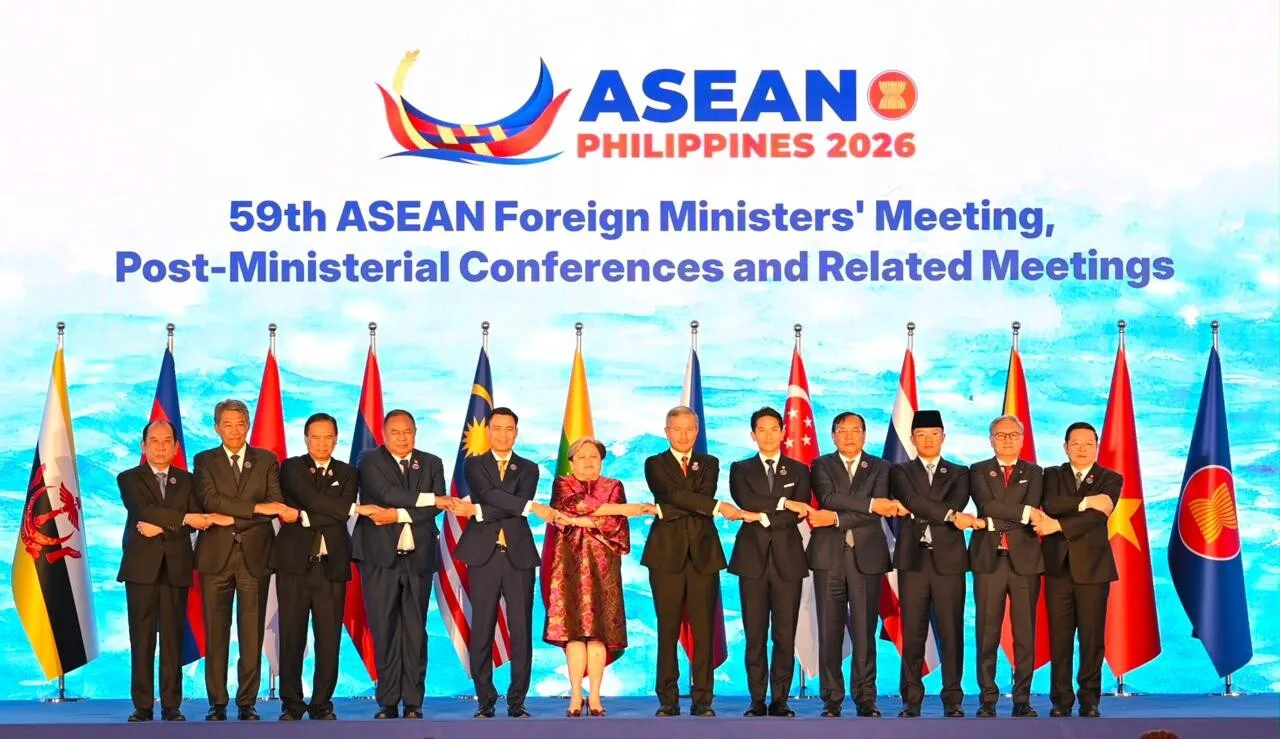
ASIATODAY.ID, MANILA — As geopolitical rivalry intensifies, economic uncertainty deepens, and regional challenges become increasingly complex, ASEAN faces a defining test: whether its high-level meetings and strategic partnerships can move beyond statements and deliver concrete results for the people of Southeast Asia.
The 59th ASEAN Foreign Ministers’ Meeting (AMM) and related Post Ministerial Conferences (PMC) in Manila have placed a fundamental question at the center of regional diplomacy: can ASEAN transform decades of dialogue, agreements, and partnerships into meaningful action that strengthens peace, stability, and prosperity?
ASEAN foreign ministers emphasized that the bloc’s credibility will no longer be measured by the number of declarations produced, but by its ability to deliver tangible outcomes — from preventing conflict and strengthening economic resilience to protecting the interests of its people.
“ASEAN has proven that this organization can continue to grow. The more challenging question now is whether ASEAN can fulfill its promises,” Indonesian Foreign Minister Sugiono said during the meeting.
He stressed that the future of the region depends on maintaining a rules-based order.
“A region governed by law will always be stronger than a region governed by power,” Sugiono said, highlighting the urgency of preventing escalation in one of the world’s most contested strategic areas.
South China Sea: ASEAN’s Credibility Test
The South China Sea remains one of ASEAN’s most serious strategic challenges as competition among major powers continues to reshape the regional security landscape.
ASEAN reiterated the need for an effective and substantive Code of Conduct in the South China Sea based on international law, particularly the United Nations Convention on the Law of the Sea (UNCLOS) 1982.
After more than two decades of negotiations, ASEAN faces growing expectations to ensure that the process produces a meaningful framework capable of reducing risks of confrontation and maintaining regional stability.
For ASEAN, the challenge is clear: preserving peace requires more than diplomatic statements — it requires credible mechanisms and consistent implementation.
From Commitments to Economic Resilience
Beyond security concerns, ASEAN is confronting a new era of economic uncertainty marked by supply chain disruptions, energy volatility, food insecurity, and intensifying technological competition.
The Manila meetings highlighted the need for stronger regional cooperation to secure critical supplies, strengthen industrial networks, accelerate digital transformation, and prepare ASEAN economies for future global shocks.
The success of ASEAN cooperation will increasingly depend on whether regional initiatives can create practical benefits for businesses, workers, and communities across Southeast Asia.
Strategic Partnerships Must Deliver More
ASEAN is also seeking to ensure that its partnerships with major global powers produce concrete outcomes rather than remain limited to diplomatic engagement.
With the United States, ASEAN is strengthening cooperation in trade, supply chains, digital transformation, and cybersecurity.
The ASEAN-US partnership remains a major economic pillar, with trade reaching US$552.8 billion and investment totaling US$28.56 billion in 2025.
As strategic competition grows in the Indo-Pacific, ASEAN seeks to maintain an open and inclusive regional architecture while ensuring partnerships contribute directly to economic stability and security.
With Canada, ASEAN is advancing cooperation on food security, energy resilience, and economic integration, including efforts to accelerate the ASEAN-Canada Free Trade Agreement (ACAFTA).
With India, ASEAN is expanding cooperation in maritime security, connectivity, healthcare resilience, and economic integration under the ASEAN–India Year of Maritime Cooperation.
The partnership is expected to deliver practical cooperation in maritime safety, port connectivity, disaster response, blue economy development, healthcare systems, and regional supply security.
ASEAN’s Moment of Accountability
As ASEAN approaches its 60th anniversary in 2027, the regional bloc stands at a critical turning point.
Its challenge is no longer simply maintaining dialogue or building partnerships, but proving that these platforms can generate real solutions in an increasingly uncertain world.
With its central role in the Indo-Pacific, ASEAN must balance strategic autonomy with deeper cooperation with external partners while ensuring that regional diplomacy translates into measurable benefits.
The Manila meetings under the Philippines’ ASEAN Chairmanship with the theme “Navigating Our Future, Together” deliver a clear message:
ASEAN’s future relevance will depend not only on the strength of its partnerships, but on its ability to turn promises into performance and declarations into action. (Midwan)
Follow Us at Google News, Instagram and LinkedIn