
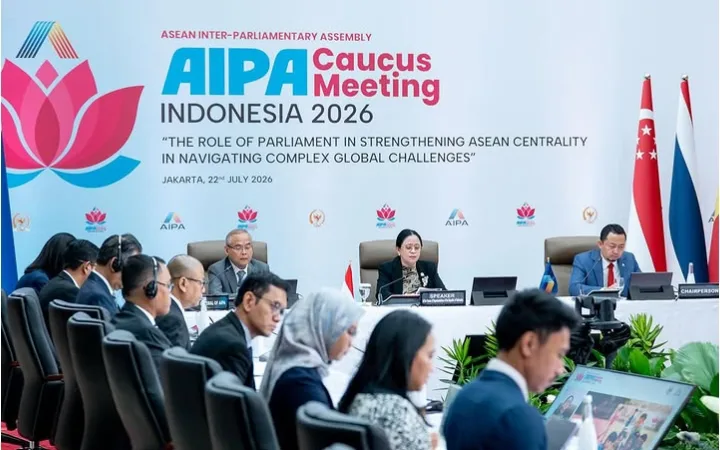
ASIATODAY.ID, JAKARTA – As Southeast Asia faces a rapidly changing geopolitical landscape, Indonesia is urging ASEAN parliaments to move beyond declarations and strengthen ASEAN centrality by ensuring that regional commitments are translated into concrete policies that deliver peace, stability, and prosperity for the region.
The call was made during the 17th Meeting of the ASEAN Inter-Parliamentary Assembly (AIPA) Caucus in Jakarta, where lawmakers from ASEAN member states discussed the role of parliamentary diplomacy in addressing increasingly complex global challenges, from geopolitical competition and regional security risks to economic uncertainty, climate change, and technological disruption.
The forum underscored that ASEAN’s credibility will not only depend on the agreements it adopts, but also on its ability to implement those commitments effectively at the national level.
Chairman of Indonesia’s House of Representatives’ Inter-Parliamentary Cooperation Agency (BKSAP) Syahrul Aidi Maazat emphasized that AIPA resolutions must deliver tangible outcomes rather than remain political statements.
“Resolutions must not stop as documents. They must be translated into legislation, budgeting, and oversight mechanisms that create real benefits for more than 700 million people across ASEAN,” Syahrul said.
He added that the AIPA Caucus serves as a strategic mechanism to monitor the implementation of resolutions adopted at AIPA General Assemblies while encouraging member states to exchange best practices.
AIPA’s Role in Preserving Regional Peace
Peace and stability emerged as key priorities during the meeting as ASEAN navigates a more challenging security environment.
Growing geopolitical competition and heightened tensions in the South China Sea have reinforced the need for ASEAN to strengthen dialogue, preventive diplomacy, and peaceful dispute settlement mechanisms.
Vice Chairman of BKSAP Muhammad Husein Fadlulloh said sustainable peace requires more than the absence of conflict. It must be supported by strong institutions, inclusive governance, respect for international law, and broad participation from governments, parliaments, civil society, and communities.
Meanwhile, BKSAP Vice Chairman Bramantyo Suwondo called for stronger implementation of the Treaty of Amity and Cooperation in Southeast Asia (TAC) as an important foundation for maintaining regional stability.
“ASEAN needs stronger mechanisms to ensure conflicts can be resolved effectively while continuing to uphold the principles of non-intervention, consultation, and dialogue,” Bramantyo said.
He stressed that a peaceful and stable Southeast Asia remains a key foundation for investment, economic growth, and deeper international cooperation.
50 Years of TAC and the Future of ASEAN Stability
The 17th AIPA Caucus also marked the 50th anniversary of the Treaty of Amity and Cooperation (TAC), a historic agreement that has shaped ASEAN’s peace architecture for five decades.
Speaker of Indonesia’s House of Representatives Puan Maharani highlighted that the ASEAN Way — built on dialogue, consensus, and peaceful settlement of disputes — remains one of ASEAN’s greatest strengths.
“ASEAN Way has become a key strength supporting ASEAN centrality and maintaining regional stability,” Puan said.
She emphasized that parliaments have a critical role in ensuring ASEAN principles remain relevant amid a more fragmented and uncertain global order.
Turning Commitments into Results
A major focus of the AIPA Caucus was strengthening the implementation of regional resolutions.
The AIPA Secretariat reported that around 52 percent of resolutions adopted during the 46th AIPA General Assembly have been fully implemented, while other commitments remain under progress.
Vice Chairman of BKSAP Irine Yusiana Roba Putri explained that Indonesia has integrated AIPA resolutions into national policies covering economic transformation, digital development, green economy, renewable energy, women empowerment, and youth participation.
“Indonesia believes parliamentary cooperation remains essential in translating regional commitments into tangible benefits for ASEAN communities,” Irine said.
ASEAN’s Next Challenge: Security, Technology and Growth
Beyond traditional security issues, the AIPA Caucus also addressed emerging challenges that will shape ASEAN’s future, including artificial intelligence governance, cybersecurity, climate change, and sustainable economic development.
Indonesia encouraged ASEAN members to strengthen cooperation in developing compatible frameworks for artificial intelligence and cybersecurity to prevent cross-border digital threats.
The meeting reaffirmed that ASEAN’s future will depend not only on unity, but also on its ability to convert political commitments into effective action.
As geopolitical uncertainties continue to rise, parliamentary diplomacy is becoming an increasingly important pillar in protecting ASEAN centrality, regional stability, and the vision of a peaceful, inclusive, and prosperous ASEAN Community. (AT Network)
Follow Us at Google News, Instagram and LinkedIn