
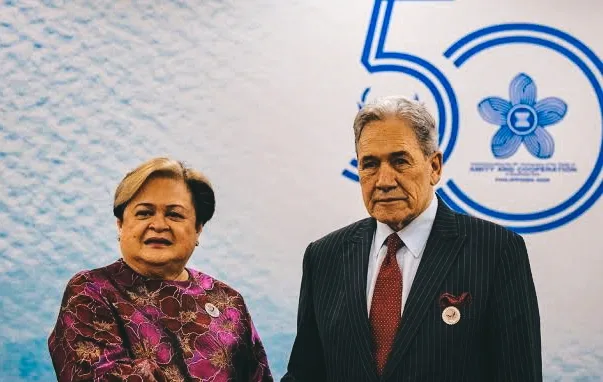
ASIATODAY.ID, MANILA — New Zealand and the Philippines have entered a new era of strategic cooperation after elevating their six-decade diplomatic relationship into a Comprehensive Partnership, strengthening collaboration in defence, maritime security, trade, education and regional stability.
The agreement was formalised by New Zealand Foreign Minister Winston Peters and Philippine Foreign Secretary Ma. Theresa P. Lazaro during a bilateral meeting in Manila, marking the 60th anniversary of diplomatic relations between the two countries.
“New Zealand and the Philippines are close friends and trusted partners on the world stage – and today we turn this friendship into concrete action,” Peters said.
“Elevating our relationship to a Comprehensive Partnership signals the importance we place on working together to support a stable, rules-based Indo-Pacific.”
The partnership establishes four major pillars of cooperation: political engagement; defence, security and maritime cooperation; trade and economic ties; and people-to-people connections.
Strengthening Indo-Pacific Security
The new partnership comes as the Indo-Pacific faces growing strategic challenges, including heightened tensions in maritime areas such as the South China Sea.
New Zealand and the Philippines reaffirmed their commitment to maintaining peace, stability and freedom of navigation through dialogue, diplomacy and respect for international law, including the 1982 United Nations Convention on the Law of the Sea (UNCLOS).
Both sides emphasised that UNCLOS remains the legal framework governing activities in oceans and seas, while supporting the peaceful resolution of disputes.
The two countries also welcomed the expansion of defence cooperation, including military exchanges, joint exercises, training programmes and the implementation of the Status of Visiting Forces Agreement signed in 2025.
Driving Trade and Economic Growth
The Comprehensive Partnership is also designed to accelerate economic cooperation between the two nations.
New Zealand and the Philippines highlighted their shared ambition to increase bilateral trade by 50 percent by 2030, supported by the establishment of a Joint Economic Commission to advance investment and commercial opportunities.
The two sides also welcomed preparatory discussions on the Philippines’ potential accession to the Comprehensive and Progressive Agreement for Trans-Pacific Partnership (CPTPP).
With a population of around 113 million people, the Philippines remains one of Southeast Asia’s fastest-growing economies and a key emerging market in the region.
Education, Energy and Human Connections
The partnership expands cooperation in education, skills development and sustainable energy.
New Zealand and the Philippines signed a Memorandum of Cooperation in Education to strengthen collaboration between universities, technical institutions and workforce development programmes.
They also renewed cooperation on geothermal energy, reinforcing shared commitments to clean energy and climate resilience.
People-to-people relations remain a cornerstone of bilateral ties, with both countries recognising the important contribution of the Filipino community in New Zealand.
Future cooperation will focus on human resource development, cultural exchanges and stronger connectivity.
Supporting ASEAN and Regional Cooperation
The new partnership carries broader significance as the Philippines prepares to assume the ASEAN Chairmanship in 2026.
New Zealand and the Philippines reaffirmed support for ASEAN centrality and the ASEAN Outlook on the Indo-Pacific, while encouraging stronger cooperation between ASEAN and the Pacific Islands Forum.
Both nations pledged to work together in addressing regional challenges, including economic resilience, climate change, peace and security.
A New Chapter for Two Trusted Partners
The two foreign ministers described the Comprehensive Partnership as a new chapter built on trust, shared values and commitment to a rules-based international order.
The agreement reflects a broader effort by New Zealand and the Philippines to strengthen cooperation at a time when regional stability and strategic partnerships are becoming increasingly important for the future of the Indo-Pacific. (AT Network)
Follow Us at Google News, Instagram and LinkedIn