
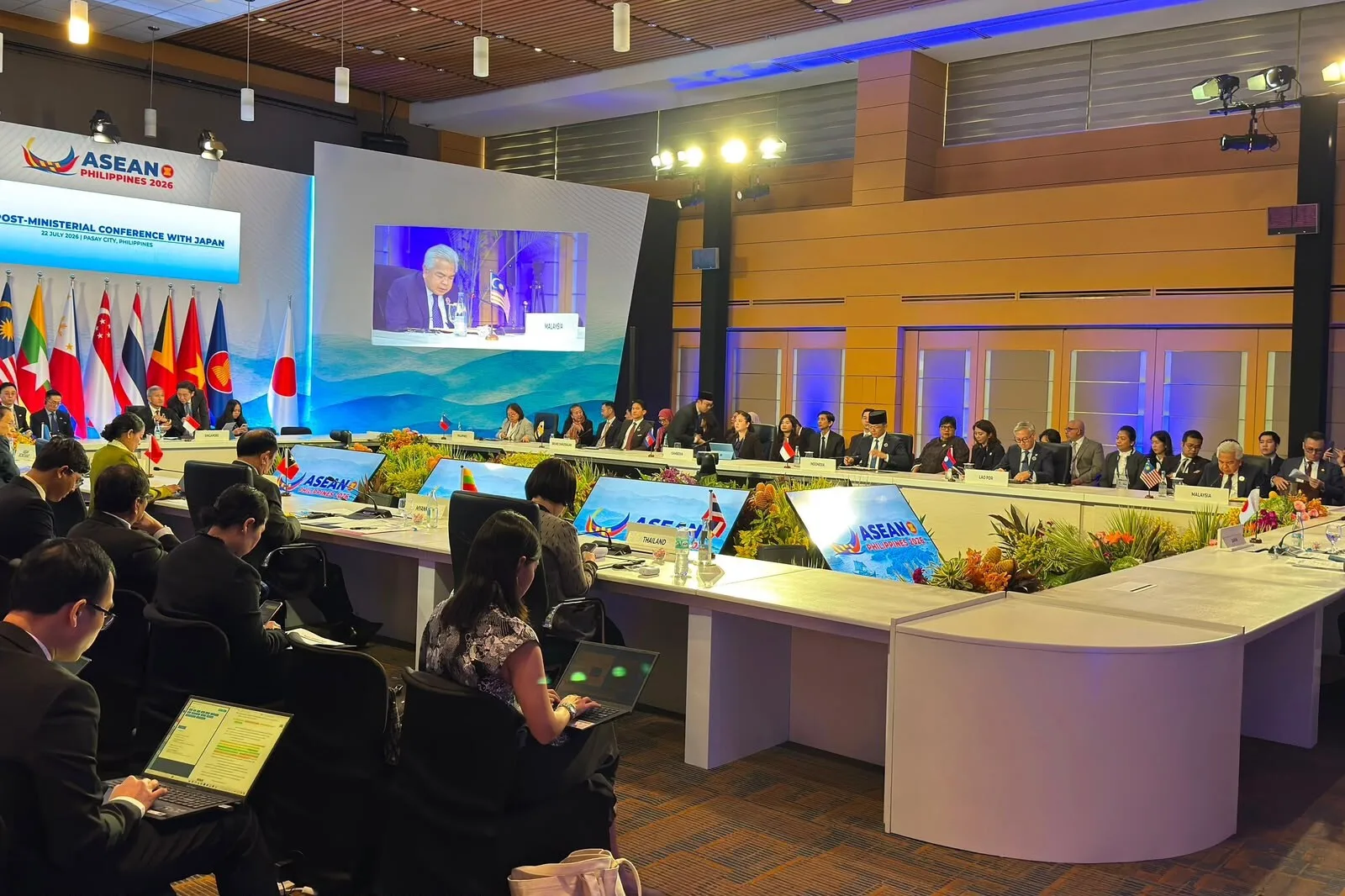
ASIATODAY.ID, MANILA – ASEAN has strengthened its position as a key platform for global cooperation after a series of high-level ministerial meetings in Manila delivered a new agenda with five major partners — the European Union, United Kingdom, Japan, China, and Russia.
The ASEAN Post Ministerial Conferences (PMC) highlighted the region’s growing role in connecting major economies while addressing shared challenges ranging from economic uncertainty and energy transition to supply chain resilience, digital threats, food security, and regional stability.
The meetings demonstrated ASEAN’s effort to maintain strategic balance and expand practical cooperation with global partners amid shifting geopolitical dynamics.
Indonesia emphasized that ASEAN partnerships must generate concrete benefits for societies, strengthen economic resilience, and support an open and inclusive regional order.
“ASEAN and its partners share responsibility to strengthen stability, promote peace, and create prosperity for our people,” Indonesian Foreign Minister Sugiono said.
ASEAN–EU: New Momentum for Trade and Clean Energy Cooperation
ASEAN and the European Union are moving to deepen economic engagement through stronger trade and investment cooperation.
Indonesia encouraged efforts to build greater momentum toward ASEAN–EU trade integration by leveraging existing bilateral agreements between the EU and ASEAN member states.
Energy transition emerged as another major priority, with ASEAN seeking greater European support in renewable energy investment, technology transfer, and capacity building.
The cooperation aims to accelerate clean energy development while maintaining energy security, affordability, and reliable supply across the region.
The partnership will reach a historic milestone in 2027 as ASEAN and the European Union commemorate 50 years of dialogue relations.
ASEAN–UK: Tackling Digital Threats and Building Green Growth
ASEAN and the United Kingdom expanded cooperation on emerging challenges, particularly cross-border cybercrime and online financial fraud.
The two sides emphasized stronger collaboration in financial intelligence, law enforcement, and mechanisms to protect citizens from increasingly sophisticated digital crimes.
Green transition also became a key agenda, with ASEAN and the UK seeking to ensure that clean energy development creates wider social and economic benefits.
Human capital development through education, skills training, and people-to-people exchanges remains an important foundation of the partnership.
ASEAN–Japan: Advancing Infrastructure, Energy and Maritime Security
Japan continues to play a strategic role in ASEAN’s development through cooperation in infrastructure, technology, clean energy, and maritime security.
Indonesia highlighted the importance of secure and open sea lanes as vital foundations for global trade, energy flows, food security, and regional connectivity.
ASEAN and Japan also advanced cooperation through initiatives such as the Asia Zero Emission Community (AZEC) while utilizing regional economic frameworks including RCEP to strengthen investment and sustainable growth.
ASEAN–China: Transforming Economic Power into Shared Prosperity
ASEAN–China relations remain one of the largest economic partnerships in Asia.
Trade between ASEAN and China reached US$772.4 billion in 2024, reflecting deep economic integration and interconnected supply chains.
ASEAN emphasized that the scale of economic cooperation must translate into broader benefits through stronger industries, expanded business opportunities, and inclusive growth.
The implementation of the ASEAN–China Free Trade Area (ACFTA) 3.0 and continued utilization of RCEP are expected to further strengthen regional economic connectivity.
Beyond trade, ASEAN continues to promote dialogue and stability through ASEAN centrality and respect for international law, including efforts to advance an effective Code of Conduct (COC) in the South China Sea.
ASEAN–Russia: Securing Energy, Food and Health Resilience
ASEAN and Russia focused on strengthening cooperation in strategic sectors including energy resilience, food security, and healthcare preparedness.
Energy cooperation was highlighted as an important foundation for regional stability, while agricultural cooperation remains relevant for maintaining reliable food supplies.
The two sides also emphasized capacity building and cooperation in healthcare to strengthen preparedness for future challenges.
ASEAN’s Growing Role as Global Connector
The Manila meetings underline ASEAN’s expanding influence as a bridge connecting major global economies.
From Europe and the United Kingdom to Japan, China, and Russia, ASEAN’s partnerships are increasingly focused on practical solutions: stronger economies, cleaner energy, secure supply chains, and long-term regional stability.
As global uncertainty continues to reshape international relations, ASEAN is positioning itself not only as the center of Asia’s economic growth but also as a critical force for dialogue, cooperation, and peace. (Midwan)
Follow Us at Google News, Instagram and LinkedIn