
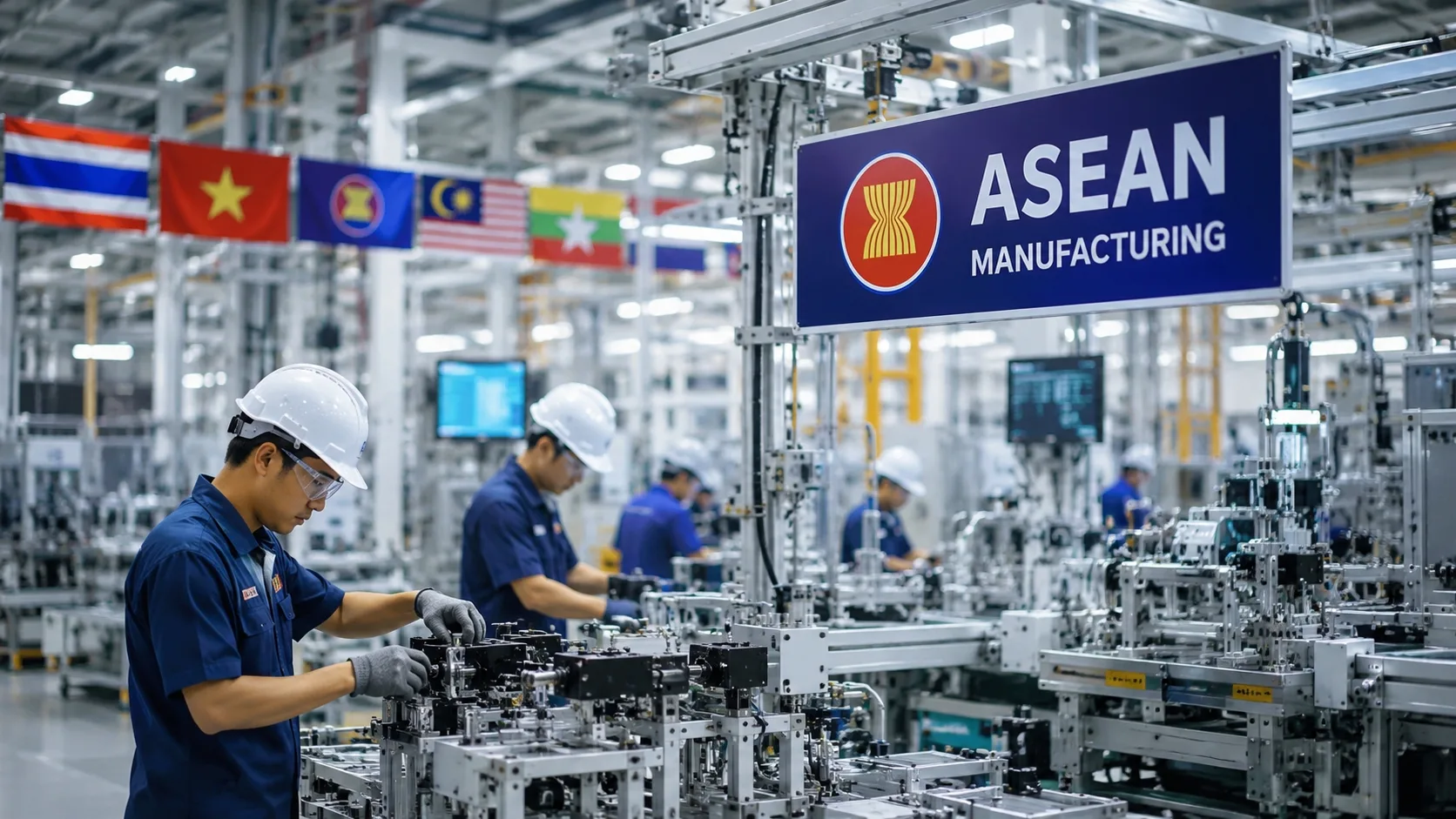
ASIATODAY.ID, JAKARTA — Southeast Asia’s manufacturing sector maintained its growth momentum in June 2026, with most major ASEAN economies remaining in expansion despite persistent global economic uncertainty. Indonesia, however, emerged as an outlier, with independent and government indicators offering contrasting assessments of the country’s manufacturing performance.
According to the latest S&P Global Purchasing Managers’ Index (PMI), the ASEAN Manufacturing PMI stood at 50.5 in June, easing from 51.5 in May but remaining above the 50-point threshold that separates expansion from contraction.
Thailand led the region with a PMI of 53.6, followed by Vietnam (51.8), the Philippines (50.9), and Malaysia (50.7), highlighting the resilience of manufacturing activity across much of Southeast Asia despite geopolitical tensions, elevated borrowing costs, and slowing global trade.
Indonesia moved in the opposite direction. Its manufacturing PMI fell to 46.9, down from 50.0 in May, returning to contraction territory as weakening domestic demand and slowing export orders weighed on factory activity.
S&P Global said new orders declined for the first time in three months and at the fastest pace in a year, while export orders recorded their steepest fall since August 2021, reflecting softer overseas demand and weakening price competitiveness.
“The health of Indonesia’s manufacturing sector deteriorated for the second time in the past three months, ending the first half of 2026 on a weaker footing,” said Usamah Bhatti, Economist at S&P Global Market Intelligence on July 1, 2026.
Government Sees Manufacturing Remaining Resilient
The weaker PMI reading contrasts with Indonesia’s Industrial Confidence Index (IKI), which remained in expansion territory at 52.90 in June, according to the Ministry of Industry.
The ministry acknowledged that manufacturers continue to face pressure from higher imported raw material costs, a weaker rupiah, rising energy prices, electricity disruptions in several industrial areas, and higher industrial gas prices.
However, officials argued that resilient domestic consumption, stronger non-oil and gas exports, and government spending through strategic programs—including the Free Nutritious Meals initiative, the Red-and-White Village Cooperatives program, the B50 biodiesel mandate, and fisheries development projects—would continue to support manufacturing activity in the coming months.
The ministry also expects lower regasified LNG prices for industrial users to improve cost competitiveness and strengthen manufacturing performance.
Different Measures Reflect Different Perspectives
The divergence between the PMI and the IKI largely reflects differences in methodology and scope rather than conflicting economic realities.
The PMI, compiled by S&P Global, measures changes in manufacturing activity based on monthly surveys of purchasing managers and is widely regarded by global investors as a leading indicator of industrial performance.
The IKI, meanwhile, measures business confidence among domestic manufacturers and is used by the Indonesian government to assess current industrial conditions and business expectations.
Taken together, the two indicators suggest that Indonesia’s manufacturing sector is facing mounting short-term pressure from weaker demand and rising production costs, while business confidence remains supported by domestic market fundamentals and government policy.
As ASEAN strengthens its role as a global manufacturing hub amid shifting supply chains, investors will be watching whether Indonesia can translate that confidence into a sustained recovery in factory activity and maintain its competitiveness against rapidly advancing regional peers. (AT Network)
Follow Us at Google News, WA Channel, and LinkedIn