
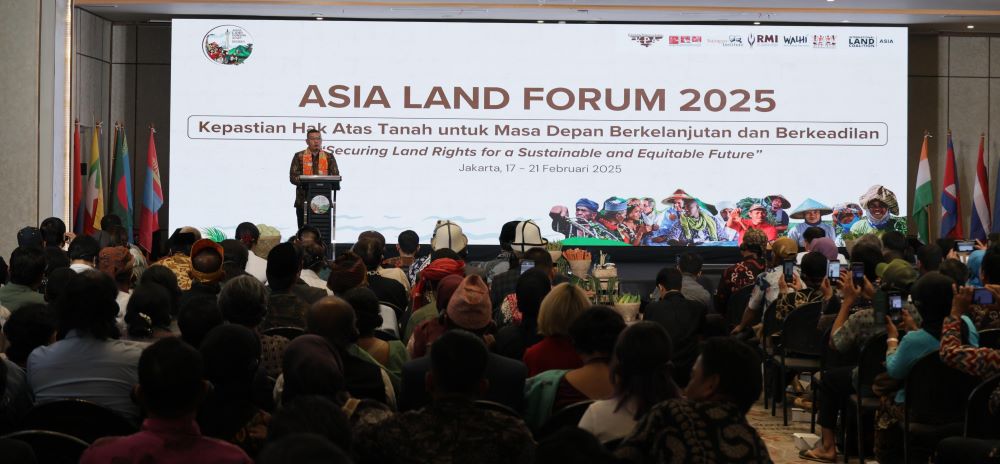
ASIATODAY.ID, JAKARTA – Land is a limited resource that is increasingly difficult to obtain amidst Asia’s growing population.
Cross-sector collaboration is needed to resolve various challenges in land management and Agrarian Reform, in order to achieve a sustainable and just future.
“Land is a limited resource, and this reality is in stark contrast to the growing population and increasing demand for land for various purposes,” said Deputy Minister of Agrarian Affairs and Spatial Planning/Deputy Head of the Indonesian National Land Agency, Ossy Dermawan, when he was the Key Speaker at the 2025 Asia Land Forum with the theme “Securing Land Rights for a Sustainable and Equitable Future” which took place at Mercure Jakarta Batavia, Wednesday, 19 February 2025.
Indonesia, with a land area of around 190 million hectares, faces challenges in managing land fairly and equitably.
“The forest area is around 120 million hectares, while around 70 million hectares are under the authority of our ministry. Of this area, almost 56 million hectares or 80 percent have been registered and certified,” he explained.
However, according to him, the Indonesian government is facing problems of unequal land ownership, overlapping management and agrarian conflicts.
“These issues require urgent resolution from the Indonesian government with the support of various stakeholders, including civil society organizations,” added Ossy Dermawan.
Furthermore, he expressed the government’s commitment to solving this problem through the Agrarian Reform program.
“Through the Agrarian Reform program, we can ensure certainty of land rights, redistribution of land, and management of access through partnerships with the community,” he said.
One of the main steps in Agrarian Reform is the One Map Policy which is being promoted by the government. This policy aims to harmonize maps between ministries and sectors to minimize overlapping land uses that often occur.
“Synchronizing maps between sectors will support the implementation of Agrarian Reform and minimize the potential for conflict and overlapping land use,” he said.
In addition, he emphasized the importance of collaboration between government, civil society organizations and other stakeholders.
“The government in collaboration with civil society organizations has achieved significant progress in completing priority Agrarian Reform locations. For example, of the 70 targeted locations, 15,725 plots in 26 locations have been successfully completed,” he added.
Ossy also reminded that the success of Agrarian Reform does not only depend on policies and regulations, but also on community participation.
“Community involvement is very important to accelerate the resolution of agrarian problems, and the collaboration of all parties will ensure that the benefits of agrarian reform are felt directly by the community,” he concluded.
The Asia Land Forum 2025 is an important forum for sharing ideas and solutions related to land management in Asia, with the hope of creating a more just, sustainable and prosperous future for all.
As a concrete step forward, a Joint Statement was signed by representatives from the government and civil society organizations, as a form of commitment to joint action in implementing Agrarian Reform, village development and people’s cooperatives to achieve food sovereignty and poverty alleviation. (AT Network)
Follow Us at Google News and WA Channel