
ASIATODAY.ID, JAKARTA – A Canadian-linked gold mining operation is once again under fire in Indonesia. On Sangihe Island, North Sulawesi, a legally protected small island near the Philippine border, PT Tambang Mas Sangihe (TMS) is accused of continuing gold mining activities despite losing its case at Indonesia’s Supreme Court and having its production permit revoked. Environmental groups and local communities warn that the state’s silence risks legitimizing environmental plunder.
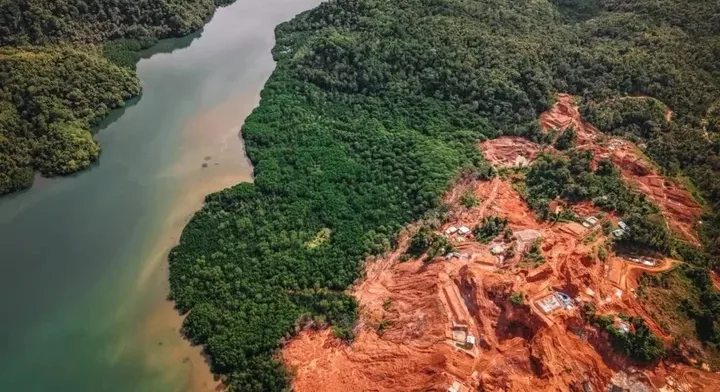
The civil society coalition Save Sangihe Island (SSI) says environmental destruction in the southern part of the island has reached an alarming level. Hills in Bowone and Binebas villages have reportedly been torn apart, forests cleared, and mining waste is suspected of polluting coastal waters—threatening marine ecosystems and the livelihoods of local fishers.
Environmental Devastation Laid Bare
Through images shared on social media platform X, SSI revealed the current condition of Sangihe Island. The photos show fractured hillsides, exposed red soil, vanished vegetation, and mining scars cutting deep into the landscape.
“This is Sangihe Island today. The people’s victory at the Supreme Court in 2022 has become meaningless,” SSI wrote quoted on Monday, December 29, 2025.
The group stressed that Sangihe is a small island that is legally and ecologically unfit for mining, yet continues to be exploited by a gold mining company linked to Canada—allegedly with tacit government backing.
The damage, SSI said, extends beyond land. Mining waste is believed to have reached the sea, contaminating coastal waters that serve as the backbone of local fishing communities.
“The situation is already this severe. The waste is evident, the sea is polluted, and yet this activity continues to receive government support,” SSI stated.
Mining Continues Despite Supreme Court Ruling
Legally, PT TMS is no longer entitled to operate. In December 2022, Indonesia’s Supreme Court rejected the cassation appeal filed by the Ministry of Energy and Mineral Resources and PT TMS, upholding the community’s legal victory. In 2023, the government formally revoked the company’s production operation permit.
However, activists allege that mining activities have continued through subcontracting schemes involving local companies, including CV Mahamu Hebat Sejahtera and PT Putra Rimpulaeng Persada—a maneuver widely criticized as an attempt to circumvent Indonesian law and maintain illegal gold extraction.
Local residents insist their island is far more valuable than gold.
A Small Island with Global Ecological Value
Sangihe Island holds exceptional ecological importance. It lies within the Coral Triangle, the world’s richest marine biodiversity hotspot, and serves as a global migratory route for birds, a habitat for rare marine species, and a nursery ground for tuna.
The region is recognized as an Important Bird and Biodiversity Area (IBA) and a Key Biodiversity Area (KBA), and has been designated an Ecologically or Biologically Significant Area (EBSA) under the Convention on Biological Diversity (CBD).
In 2024, Indonesia also launched its 30×45 Marine Conservation Vision, placing the Sangihe Islands among priority areas for expanding marine protected zones to 30 percent by 2045.
“We Refuse to Die Slowly”
For the people of Sangihe and SSI, the struggle against gold mining is a matter of survival.
“We refuse to die. We refuse to be killed slowly. This is not only about Sangihe, but about everyone suffering deadly disasters caused by environmental destruction,” SSI declared.
The group also expressed solidarity with communities in other parts of Indonesia, including Sumatra and Papua, which have experienced ecological disasters linked to excessive natural resource exploitation under the banner of investment.
Indonesia Urged Not to Remain Silent
As environmental damage worsens, communities are calling on the Indonesian state to enforce the law, shut down all illegal gold mining activities, and protect Sangihe as a constitutionally safeguarded small island.
Failure to act, activists warn, would not only sacrifice Sangihe Island, but also undermine Indonesia’s legal credibility and environmental commitments on the global stage. (AT Network)
Follow Us at Google News and WA Channel