
ASIATODAY.ID, WASHINGTON – The rivalry between the United States and China has officially reached the world’s most remote frontier.
For the first time in six years, Washington has conducted direct inspections of Chinese research stations in Antarctica, a move widely seen as a strategic escalation and a clear signal that the South Pole is becoming a new theater of great-power confrontation.
The inspection comes amid rising global tensions between the two superpowers, following disputes in the Arctic, the South China Sea, Taiwan, and Greenland.
Antarctica—long considered a neutral zone dedicated to science—now appears to be sliding into the orbit of geopolitical competition.
A U.S. State Department official described the mission as essential to national security.
“The United States is exercising its right to inspect in order to protect our national security by verifying that all activities in Antarctica comply with the Antarctic Treaty and its Environmental Protocol, including prohibitions on military use and mining,” the official told Newsweek on Saturday, January 31, 2026.
Washington Suspects Covert Militarization by Beijing
U.S. concerns focus on China’s five Antarctic research stations, which Washington believes may serve dual purposes—civilian scientific research and covert military operations.
Alexander B. Gray, former White House official and ex–National Security Council chief of staff, warned that Antarctica could be quietly transforming into a strategic military outpost for Beijing.
“We have strong reasons to believe that some Chinese bases in Antarctica are being militarized, involving undeclared PLA personnel and possibly intelligence operatives. If confirmed, this would be a direct violation of the Antarctic Treaty and a serious threat to global security,” Gray said.
Defense analysts note that Antarctica’s strategic value lies in satellite tracking, space monitoring, communications interception, and long-term positioning for global power projection.
China Pushes Back, Accuses U.S. of Politicizing Antarctica
Beijing swiftly rejected the allegations. Chinese Embassy spokesperson Liu Pengyu denied any military agenda, accusing Washington of turning a peaceful region into a geopolitical battlefield.
“China has always ensured that its Antarctic activities are peaceful and fully consistent with the Antarctic Treaty System. Peace, stability, and sustainable development in the polar regions serve the common interests of all humanity,” Liu said in a written statement.
Despite Beijing’s denials, reports from international media suggest China is planning to construct a sixth Antarctic station, further intensifying Western concerns over its expanding footprint.
Antarctica Emerges as a New Strategic Front
The U.S. inspection delegation—comprising officials from the State Department, the National Science Foundation (NSF), and the Department of Defense—visited Antarctica between January 16 and 20, 2026, with logistical support from Australia and New Zealand.
The team inspected several key stations, including:
– Zhongshan Station (China)
– Davis and Law Stations (Australia)
– Bharati Station (India)
– Progress Station (Russia)
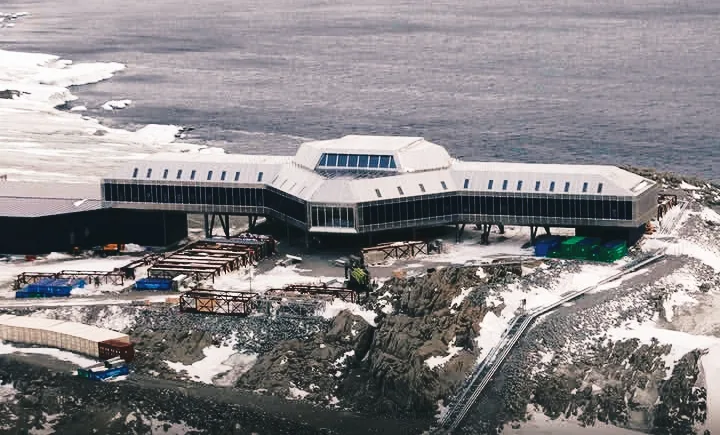
China’s newest facility, Qinling Station, officially opened in 2024, is viewed by analysts as a symbol of Beijing’s long-term strategic ambitions in the region.
Currently, both the U.S. and China operate three permanent stations in Antarctica. However, the U.S. maintains three additional seasonal stations, while China has only two—an imbalance that could fuel further competition and expansion.
From Scientific Sanctuary to Cold War Battleground?
The Antarctic Treaty Secretariat in Buenos Aires declined to comment on individual national programs but reiterated that Antarctica is legally reserved for peaceful and scientific purposes only.
Yet diplomatic rhetoric and military suspicions tell a different story.
Findings from the U.S. inspection will be presented at the Antarctic Treaty Consultative Meeting in Hiroshima, Japan, in May 2026, a forum now expected to become a battleground of diplomatic pressure rather than purely scientific dialogue.
One conclusion is increasingly hard to ignore: Antarctica is no longer geopolitically neutral.
The frozen continent is rapidly emerging as a new Cold War front, where the United States and China test power, influence, and the limits of global confrontation—far from the world’s capitals, but dangerously close to a new era of strategic conflict. (AT Network)
Follow Us at Google News and WA Channel