
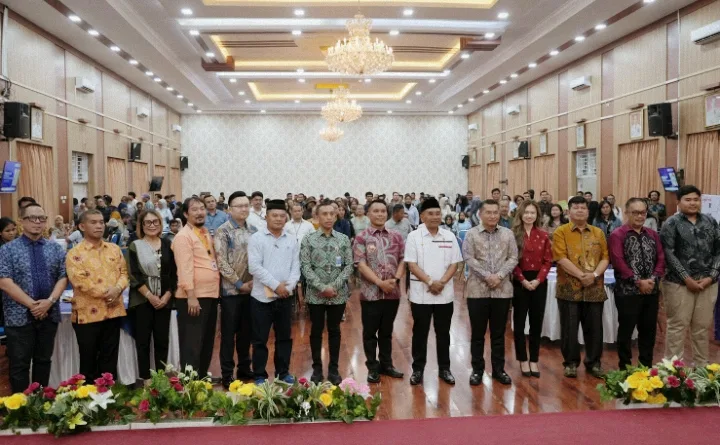
ASIATODAY.ID, SIMALUNGUN – At Balei Harungguan Djabanten Damanik in Simalungun, applause erupted as a new chapter for village cooperatives officially began.
On Saturday, October 4, 2025, a milestone moment unfolded for the 413 Village/Urban Cooperatives Merah Putih (KDKMP) across Simalungun Regency as they embarked on full-scale digitalization through the Simkopdes platform.
Simkopdes—short for Sistem Informasi Koperasi Desa/Kelurahan Merah Putih (Village/Urban Cooperative Information System)—is an initiative led by the Deputy for Institutional Affairs and Cooperative Digitalization at the Ministry of Cooperatives and SMEs.
Deputy Henra Saragih emphasized that cooperative digitalization serves as the foundation for local economic independence.
“Digital transformation through Simkopdes is not merely a system upgrade—it’s an entry point to broader partnerships, financing access, and business networks for KDKMPs,” said Henra Saragih.
Through digitalization, village cooperatives are no longer bound by manual bookkeeping. All cooperative activities—from member transactions to financing applications—can now be conducted online and connected with financial institutions and business partners alike.
Government and Strategic Partner Collaboration
The workshop was attended by Simalungun Regent Anton Achmad Saragih, Vice Regent Benny Gusman Sinaga, and LPDB Regional Head for Sumatra Laode Karsid.
The presence of business partners such as Bank BRI, Bulog, PT Pos Indonesia, KSP Nasari, BPJS Kesehatan, and ID Food reaffirmed the commitment to cross-sector collaboration.
This digitalization effort is not a standalone initiative. The government designed it to ensure that KDKMPs are directly linked with national financing ecosystems and supply chains.
In other words, village cooperatives are evolving into relevant and competitive economic actors in the broader national landscape.
Kana Consumer Cooperative: Powering the “Sweet Cooperative” Movement in Villages
From the private sector, Kana Consumer Cooperative brings a refreshing new approach.
Through its flagship program, “Koperasi Manis” (Sweet Cooperative), the Surabaya-based cooperative aims to elevate village cooperatives beyond their traditional savings-and-loan role into modern retail players.
“We want village cooperatives not only to save or borrow but to sell and grow together. Koperasi Manis provides consigned goods worth IDR 200 million, plus operational support of IDR 2 million for eligible cooperatives,” explained Tresya Wijaya, Executive Chair of Kana Consumer Cooperative.
The business model is simple yet strategic: KDKMPs operate retail outlets supplied directly by Kana Consumer Cooperative. The product range—spanning sugar, soy sauce, garlic, and canned food—is managed through an integrated digital system that ensures transparency and efficiency.
Business Insight: A Proven Collaboration Model
400+ KDKMPs in East Java have joined the Koperasi Manis network.
12 cooperatives have already signed official collaboration contracts.
2026 Target: 700 KDKMPs with an estimated fund circulation of IDR 400 billion.
2030 Projection: 40% of KDKMPs nationwide integrated, generating up to IDR 20 trillion in economic value.
Tresya highlighted that the potential of inter-cooperative business is enormous when supported by robust digital systems.
“This collaboration is not only about distributing goods—it’s about building a sustainable value chain. Village cooperatives can become the backbone of national distribution, and that’s what we aim to achieve,” she said.
Towards a Modern Cooperative Ecosystem
The combination of Simkopdes and Koperasi Manis creates a new formula: digital transformation fused with collaborative business models.
The government provides infrastructure and policy frameworks, while modern cooperatives like Kana bring operational models and market networks to life.
“Digitalization is merely a tool. The ultimate goal is the economic independence of cooperative members,” reaffirmed Henra Saragih.
Amid national economic challenges, this collaboration signals a new direction for Indonesia’s cooperatives—from traditional entities to resilient, professional, and market-adaptive ecosystems ready to compete in the modern economy. (Silvia Andriani)
Follow Us at Google News and WA Channel