
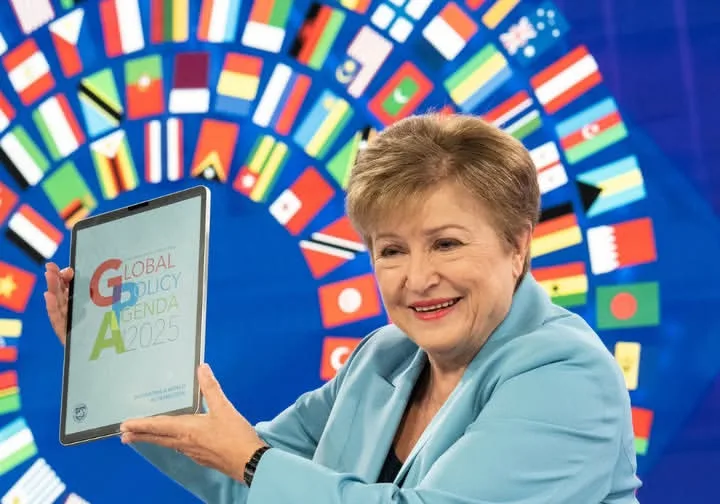
ASIATODAY.ID, GYEONGJU – The International Monetary Fund (IMF) has issued a stark warning to APEC leaders about mounting global debt and growing risks from over-enthusiastic investment in artificial intelligence (AI).
Delivering the IMF’s latest Global Economic Outlook at the APEC 2025 Summit, Managing Director Kristalina Georgieva likened the global economy to a catamaran navigating rough seas — resilient but under pressure.
“The world economy has proven more resilient than many experts predicted, supported by two strong hulls: sound institutions and dynamic private sectors,” Georgieva said on October 30, 2025.
Resilient Growth Amid Uncertainty
The IMF projects global growth at 3.2 percent in 2025 and 3.1 percent in 2026, slightly below the 3.3 percent growth in 2024.
For the APEC region, growth is expected to moderate from 3.7 percent in 2024 to 3.1 percent in 2025 and 2.9 percent in 2026.
Global inflation is forecast to decline further, reaching 4.2 percent in 2025 and 3.7 percent in 2026. In APEC economies, inflation is expected to remain close to 2 percent, particularly subdued among emerging markets.
“Despite shifts in geopolitics, trade, and technology, growth has held up so far. But uncertainty remains high,” Georgieva noted.
Four Policy Priorities for Global Stability
Georgieva identified four critical policy priorities to sustain global stability and promote balanced growth:
1. Restore Fiscal Health
Public debt in APEC economies is projected to surpass 110 percent of GDP in 2026, nearing record highs last seen after World War II. Georgieva urged governments to reverse the trend through prudent spending and structural fiscal reforms.
2. Preserve Financial Stability
While AI-driven innovation is boosting productivity, Georgieva cautioned against “over-enthusiasm followed by abrupt correction” in financial markets. Responsible regulation is vital to balance innovation with long-term stability.
3. Unleash Private Sector Growth
Georgieva called for a regulatory clean-up to remove outdated rules and non-tariff barriers that stifle innovation and cross-border trade. “Red tape is a self-inflicted injury,” she emphasized.
4. Address Global Imbalances
Sustainable recovery requires rebalancing both externally and internally, Georgieva explained. Economies with high savings should increase domestic spending, while those with large fiscal deficits must strengthen savings and reduce consumption-driven growth.
Regional Cooperation: The Path to Shared Prosperity
Highlighting the role of regional integration, Georgieva praised APEC’s growing cooperation as a model for inclusive development. She pointed to the ASEAN Summit in Kuala Lumpur as proof that stronger collaboration can enhance collective resilience.
“The Asia-Pacific region holds vast complementarities and immense potential,” Georgieva said. “By sailing forward together, APEC economies can navigate the waves of uncertainty and build a more stable, prosperous future.”
Navigating the Next Global Chapter
With APEC economies accounting for 61 percent of global GDP, their collective policy direction will define the next phase of global recovery. The IMF’s message is clear: fiscal discipline, balanced AI innovation, and deeper regional cooperation are essential to sustain growth in an uncertain world.
“Sail forward together — it is the key to wise navigation,” Georgieva concluded. (AT Network)
Follow Us at Google News and WA Channel