
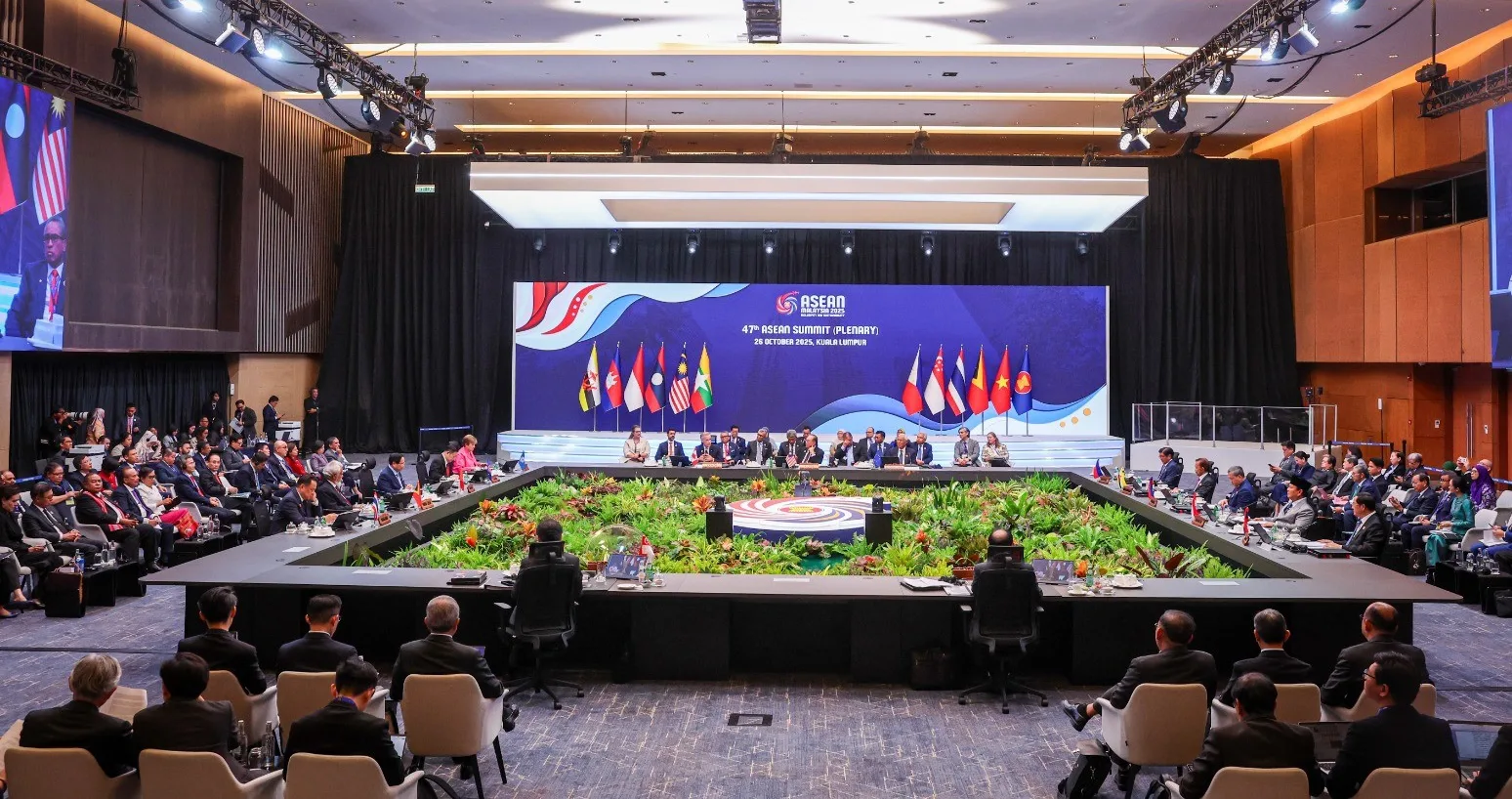
ASIATODAY.ID, KUALA LUMPUR — Nearly 20 world leaders gathered in Malaysia’s capital this week for the 47th ASEAN Summit, a three-day meeting aimed at addressing critical regional and global issues — from the inclusion of Timor Leste as ASEAN’s 11th member to new trade tensions triggered by U.S. tariffs and border peace between Cambodia and Thailand.
Yet, Indonesia reportedly walked away with “no deal”, maintaining its cautious stance amid complex negotiations on trade and energy cooperation.
Here are five major highlights from the ASEAN Summit Malaysia 2025 that are shaping Southeast Asia’s future.
1. Timor Leste Officially Joins ASEAN
The 47th ASEAN Summit marked a historic milestone as Timor Leste officially became the bloc’s 11th member.
The young nation, which gained independence from Indonesia in 2002, joins a regional alliance representing 678 million people and a combined GDP of USD 3.9 trillion.
Key global leaders attending the event include U.S. President Donald Trump, China’s Premier Li Qiang, Japan’s new Prime Minister Sanae Takaichi, South Korea’s President Lee Jae Myung, and Australia’s Prime Minister Anthony Albanese. Their presence underscores ASEAN’s growing geopolitical weight in the Indo-Pacific.
2. Cambodia–Thailand Border Peace Deal Signed
In a landmark moment, Cambodia and Thailand signed a peace pact to end a long-standing and deadly border conflict that reignited in mid-2025, killing dozens and displacing thousands.
The ceremony, presided over by U.S. President Donald Trump and Malaysian Prime Minister Anwar Ibrahim, is seen as a symbolic step toward stability in mainland Southeast Asia.
However, critics remain skeptical. Former Cambodian opposition leader Mu Sochua told Al Jazeera that the agreement risks becoming “a political show rather than a sustainable peace,” warning that economic coercion, not justice, may have driven both sides to the table.
3. U.S. Trade Tariffs Dominate Discussions
Economic tensions overshadowed the summit as President Trump’s “Liberation Day Tariffs” imposed steep import duties ranging from 10% to 40% on ASEAN economies.
While some nations negotiated partial exemptions, Indonesia reportedly declined to sign any trade deal, opting instead to review long-term implications for its domestic industries.
According to Marco Foster, ASEAN Director at Dezan Shira & Associates, “Almost every leader at the summit wanted a private meeting with Trump. Everyone was trying to secure a better tariff deal.”
Meanwhile, China tightened restrictions on rare earth exports, escalating competition in the global high-tech manufacturing sector and forcing ASEAN states to reassess their supply chain resilience.
4. Myanmar Absent, Philippines to Chair ASEAN in 2026
Myanmar’s acting president Min Aung Hlaing skipped the summit amid an ongoing civil war that has ravaged the country since 2021.
As a result, Myanmar will not assume ASEAN’s 2026 chairmanship, with the Philippines stepping in instead.
ASEAN’s Five-Point Consensus on Myanmar — calling for a ceasefire and humanitarian aid — has seen little progress.
ASEAN Parliament for Human Rights Vice Chair Charles Santiago warned that “Myanmar has become a destabilizing factor, spreading weapons, drugs, and refugees across borders.”
5. ASEAN’s Weak Enforcement Under Scrutiny
The summit once again spotlighted a long-standing criticism: ASEAN’s lack of binding enforcement mechanisms.
Unlike the European Union, ASEAN operates under a non-interference principle, allowing members wide autonomy even when collective decisions are made.
Analyst Marco Foster noted, “ASEAN was born from the spirit of independence. It was never designed to limit national sovereignty under any supranational authority.”
While this structure preserves flexibility, it also hinders regional responses to crises like Myanmar’s civil war and Cambodia–Thailand tensions.
Indonesia Holds Firm as ASEAN Faces a Crossroads
The ASEAN Summit Malaysia 2025 showcased diplomacy, ambition, and competing interests among member states and global powers.
Indonesia’s decision to withhold signing a U.S. tariff agreement underscores its strategic patience — prioritizing economic sovereignty over short-term gains.
Yet, as ASEAN expands and grapples with geopolitical pressures, one question looms large: Can Southeast Asia stay united in the face of great-power rivalry and internal division?
(AT Network)
Follow Us at Google News and WA Channel