
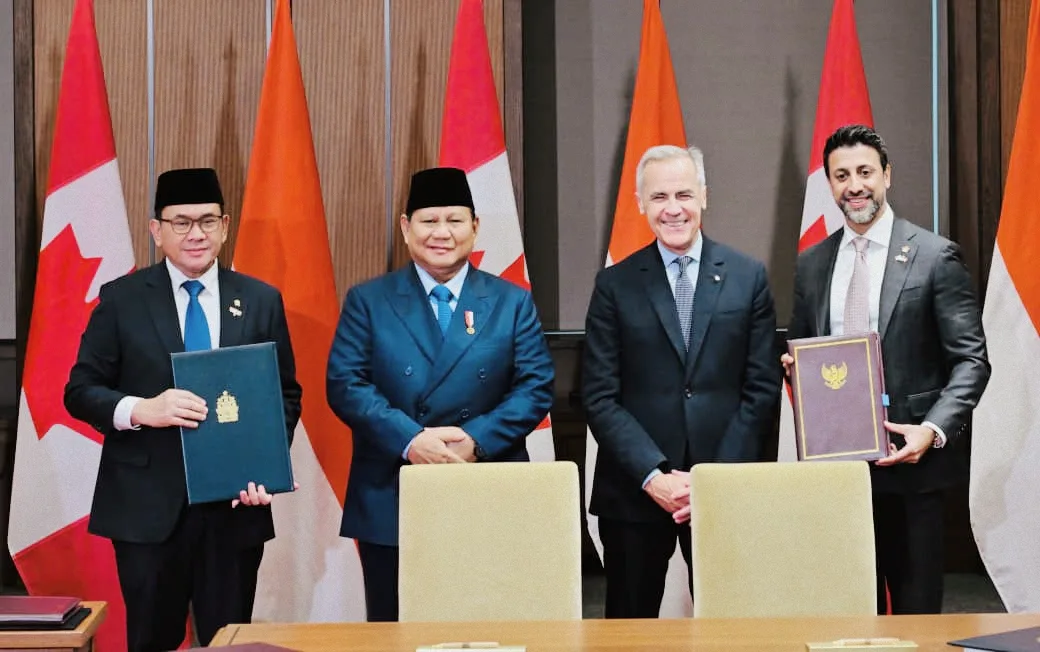
ASIATODAY.ID, JAKARTA – Indonesia has marked a historic milestone on the global stage with the conclusion of two strategic agreements: the Indonesia–European Union Comprehensive Economic Partnership Agreement (IEU–CEPA) and the Indonesia–Canada Comprehensive Economic Partnership Agreement (ICA–CEPA).
These landmark deals reaffirm Indonesia’s commitment to strengthening economic diplomacy while paving the way for expanded market access, investment opportunities, and broader cooperation with key partners in Europe and North America.
The ICA–CEPA was signed in Ottawa on Wednesday, September 24, witnessed by Indonesian President Prabowo Subianto and Canadian Prime Minister Mark Carney.
Meanwhile, the Substantive Agreement of the IEU–CEPA was announced in Bali on Tuesday, September 23, by Indonesia’s Coordinating Minister for Economic Affairs Airlangga Hartarto and European Commission Executive Vice President for Trade and Economic Security Maroš Šefčovič.
“These agreements demonstrate Indonesia’s consistency in safeguarding national interests amid global trade dynamics. Their benefits will be felt directly by businesses and the wider public,” said Haryo Limanseto, spokesperson for the Coordinating Ministry for Economic Affairs, quoted September 30, 2025.
European Union: A Strategic Market for Indonesia
Economist Sunarsip highlighted that the European Union is one of Indonesia’s main trading partners, accounting for around 10% of total exports. Indonesia’s key exports to Europe include mineral resources for the automotive industry, steel, electronics, as well as crude palm oil (CPO) and other vegetable oils used in biofuel, food, and cosmetics.
Through the IEU–CEPA, these leading exports are projected to grow further with broader market access. The deal is also considered a strategic move amid global tariff uncertainties, while providing a buffer for Indonesia’s exports at times when demand from major partners such as China and India weakens.
“The IEU–CEPA will ultimately strengthen Indonesia’s trade surplus and bolster foreign exchange reserves,” Sunarsip explained.
Extending Benefits to MSMEs
University of Indonesia lecturer Firman Kurniawan emphasized the need for follow-up policies to connect large corporations with micro, small, and medium enterprises (MSMEs) so that the benefits of the agreements can be felt across the wider economy.
He also underlined the importance of effective public communication.
“The government must translate the complex substance of these agreements into practical language that is easily understood, so that MSMEs and society at large can truly seize the economic opportunities provided by the IEU–CEPA,” Firman said.
Firman further noted that both traditional and digital media should be involved in dialogues to prevent misinformation and to help the public gain a comprehensive understanding of the agreements’ advantages for Indonesia. (AT Network)
Follow Us at Google News and WA Channel