
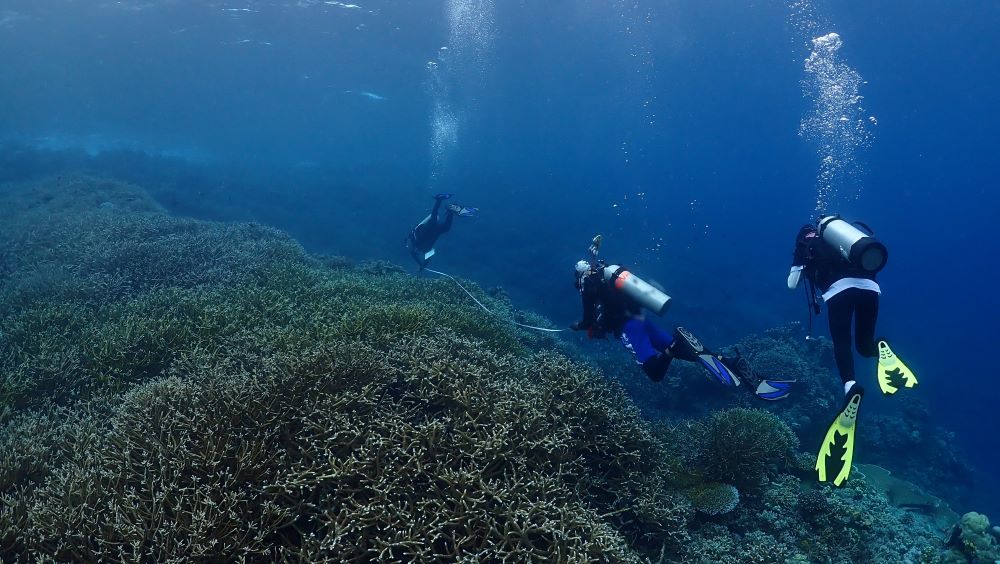
ASIATODAY.ID, JAKARTA – The Indonesian Ministry of Maritime Affairs and Fisheries, through the Kupang National Marine Conservation Area, conducted an assessment of the coral bleaching phenomenon as a follow-up to the National Oceanic and Atmospheric Administration (NOAA) Coral Reef Watch prediction which stated the potential for an early increase in sea water temperature. in 2024.
This assessment was carried out in stages and continuously from January to mid-February 2024 in the Gili Air, Gili Meno and Gili Trawangan (Gili Matra) Island Conservation Areas, the Banda Sea Conservation Area and the Sawu Sea National Park.
Director General of Marine and Marine Space Management, Indonesian Ministry of Maritime Affairs and Fisheries, Victor Gustaaf Manoppo, in his statement in Jakarta, explained that as an organizational unit responsible for marine conservation, his party needs to pay special attention and take quick action to respond to the coral bleaching phenomenon.
Apart from that, collaborative efforts between the government, community and other stakeholders are also very important in efforts to protect and restore coral reefs which are vulnerable to global climate change.
“Assessing the coral bleaching phenomenon needs to be carried out because coral reefs are a very important ecosystem for marine life and humans. Coral reefs are home to a variety of marine species, providing food resources, coastal protection and a source of income for coastal communities. “Meanwhile, coral bleaching can cause extensive ecosystem damage and be detrimental to marine life and human resources that depend on coral ecosystems if mitigation and adaptation measures are not taken,” explained Victor.
In line with this, the Director of Ecosystem and Aquatic Biota Conservation, Firdaus Agung, added that scientists predict coral bleaching events will occur more frequently on a large scale along with increasing sea surface temperatures as a result of climate change. Therefore, Firdaus reminded the need for an integrated response, especially urgent monitoring activities for areas of the coral reef ecosystem that are predicted to experience coral bleaching based on the model developed by NOAA.
“We have designed the area, time and recommendations for types of coral bleaching monitoring activities, as well as monitoring guidelines according to predictions of increasing sea surface temperatures with the main focus being conservation areas. “The results of this monitoring will then be analyzed and disseminated to increase awareness and provide education to the public,” he explained.
Not only that, according to Firdaus, responses in the form of regulations and policies will also be carried out in accordance with the results of the analysis and will be used to develop a coral bleaching monitoring network.
Meanwhile, Head of the Kupang National Marine Protected Area, Imam Fauzi, explained that Coral Bleaching Monitoring activities were carried out using citizen science methods involving community groups and diving operators, including in the Banda Marine Protected Area involving the Banda Luminocean, in the Sawu Sea TNP involving the Yapeka Foundation, in the area Gili Matra Island conservation involves the Gili Indah Ecosystem Foundation, Gili Matra Bersama Foundation, Pokmaswas Gili Matra, as well as diving operators who are members of the Gili Island Diving Alliance and Oceans.
“The results of the rapid assessment show that the average level of live hard coral bleaching in all forms of coral growth in the Gili Matra Island Conservation Area is around <25%, but there are several locations where bleaching has reached 50-75% or even >75%, namely Bounty Wreck (Next to “West of Gili Meno Island) and Sunset Reef (South of Gili Trawangan Island),” he explained.
The condition of Coral Bleaching in the Banda Marine Conservation Area based on a rapid assessment carried out at the Banda Lava Flow and Miniature Sites shows that it is generally around <25%. In this condition, the branching coral is still in the pale stage as a result of exposure to the Coral Bleaching incident. Apart from that, other biota that also experience bleaching are Anemones and Sponges.
Meanwhile, a rapid assessment of coral bleaching in the Sawu Sea TNP carried out at Oesina Beach, Lifuleo Village, Kupang Regency showed that coral bleaching was still very low with an incidence percentage value of <5%.
“The monitoring survey is divided into 3 (three) phases, namely rapid survey, peak bleaching survey and post-bleaching survey. The Coral Bleaching phenomenon still needs to be followed up by conducting a detailed survey of the peak of coral bleaching in the near future. Apart from that, mitigation is also needed by reducing anthropogenic pressure so that corals can survive and recover naturally. “One of them is by increasing awareness and participation of users of coral reef ecosystem services in conservation areas,” concluded Imam. (AT Network)
Check out other news and articles at Google News and WA Channel