
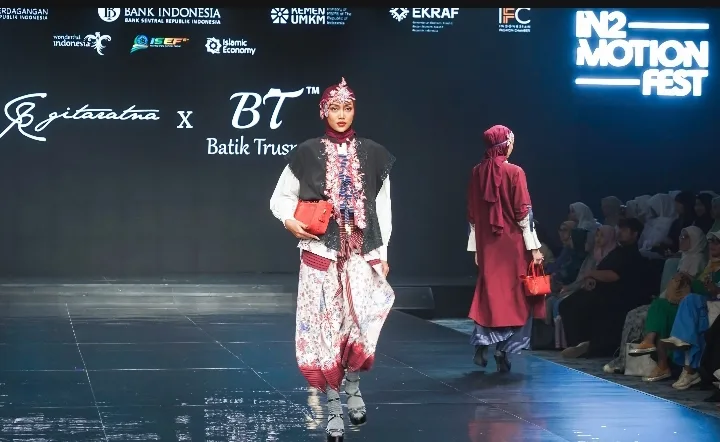
ASIATODAY.ID, JAKARTA — Indonesia’s Muslim fashion industry, better known as modest fashion, has continued to show steady growth in recent years. This positive trend positions Indonesia as one of the emerging leaders in the global modest fashion market.
“With the creativity of our designers, the richness of our natural and cultural heritage, and our large Muslim population, Indonesia has enormous potential to dominate the global Muslim fashion market,” said Minister of Industry Agus Gumiwang Kartasasmita in Jakarta on Friday, October 17, 2025.
To accelerate the development of the national modest fashion industry, the government has been collaborating with various stakeholders to ensure wider benefits and impact.
One of the key strategies has been organizing fashion events and exhibitions that provide local designers and entrepreneurs with platforms to showcase their creations, expand market access, and strengthen the national fashion ecosystem.
Promising Growth in the Global Muslim Fashion Market
Director General of Small, Medium, and Miscellaneous Industries (IKMA), Reni Yanita, noted that the global Islamic economy—including the modest fashion sector—holds tremendous growth potential.
“According to the State of Global Islamic Economy Report (SGIER) 2024/2025, Muslim consumer spending across six key sectors reached USD 2.43 trillion in 2023, and is projected to grow by 5.3 percent to USD 3.36 trillion by 2028,” she said during the opening of the Indonesia International Modest Fashion Festival (IN2MOTIONFEST) 2025 in Jakarta.
The annual event, co-hosted by Bank Indonesia and the Indonesia Fashion Chamber (IFC), carries the theme “One Vision, One Movement: Advancing Indonesia Modest Fashion Through Synergy & Collaboration.” The theme emphasizes the importance of cross-sector collaboration and synergy in elevating Indonesia’s modest fashion industry to the global stage.
Reni expressed appreciation to all parties involved in organizing the festival.
“We are optimistic that this collaboration will accelerate the growth of Indonesia’s Muslim fashion industry while promoting the unique potential of wastra nusantara (Indonesian traditional textiles) to international markets,” she said.
Rising Export Performance
Reni emphasized that Indonesia is not only a potential market but also an emerging producer and key player in the global modest fashion industry.
She called on all stakeholders—including designers, business associations, entrepreneurs, academics, influencers, and e-commerce platforms—to actively contribute to building a sustainable and competitive industry.
According to data from Statistics Indonesia (BPS), in 2024 there were 594,000 small-scale garment manufacturing units employing around 1.2 million workers.
Meanwhile, Indonesia’s modest fashion exports to member countries of the Organization of Islamic Cooperation (OIC) reached USD 990 million in 2023—an 83 percent increase from the previous year’s USD 540 million.
“This achievement places Indonesia seventh among the top exporters to OIC countries, following China, Turkey, and India,” Reni added.
Strengthening Competitiveness and Industrial Ecosystem
To sustain growth, the Ministry of Industry continues to encourage Muslim fashion entrepreneurs to enhance their products’ quality and competitiveness in both domestic and global markets.
“We urge fashion businesses to continuously innovate so they can create value-added products that appeal to international buyers,” said Reni.
Meanwhile, Director of Chemical, Textile, and Handicraft Industries at the Ministry of Industry, Budi Setiawan, stated that the government has prepared a range of initiatives to strengthen the national fashion ecosystem, including the modest fashion sector.
“Our programs include improving human resource competence, enhancing product quality, nurturing new entrepreneurs, providing product and skills certification (including halal certification), offering machinery and equipment assistance, supporting business incubation, and expanding access to promotion and exhibition opportunities,” Budi explained.
He added that collaboration between the government and industry players is crucial to positioning Indonesia as a global fashion hub.
“We hope that small and medium enterprises (SMEs) will seize this opportunity as a stepping stone to move up the value chain and solidify Indonesia’s role as a global center for modest fashion,” Budi concluded. (AT Network)
Follow Us at Google News and WA Channel