
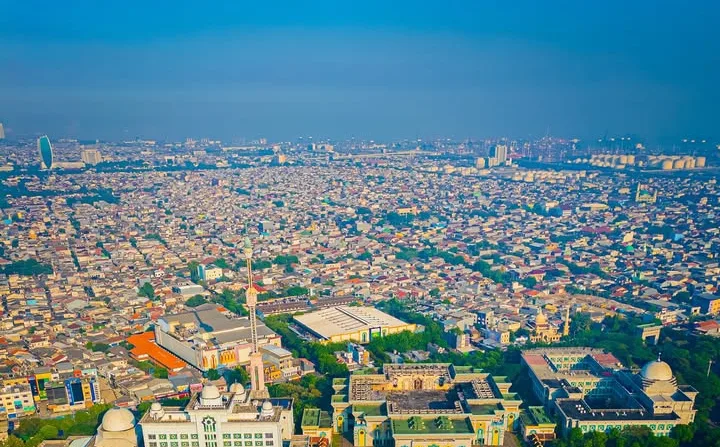
ASIATODAY.ID, JAKARTA — Jakarta, the beating heart of Indonesia’s economy, is standing on the edge of a multidimensional crisis.
Behind the glittering skyline and the ceaseless flow of urban life, two global forces — rapid urbanization and accelerating climate change — are converging, threatening to unravel the city’s economic and social fabric.
Acting Head of the Center for Population Research at the National Research and Innovation Agency (BRIN), Ali Yansyah Abdurrahim, warned that the impacts of climate change have amplified the vulnerability of coastal urban areas, particularly in the capital.
“Climate change has intensified risks in urban regions, especially coastal areas, through more frequent flooding, heat waves, and sea-level rise,” Ali said during the opening of the Workshop on Jakarta’s Socioeconomic Vulnerability Scenarios 2050 Based on Shared-Socioeconomic Pathways (SSP) on Thursday, October 23, 2025 ago.
The workshop, a joint initiative between BRIN and Ludwig Maximilian University (LMU) Munich, Germany, aims to map out Jakarta’s future amid growing pressures from urbanization and climate extremes.
Urbanization: Between Progress and Collapse
Jakarta’s rapid urban growth has long been a double-edged sword. With more than 10 million residents and aging infrastructure, the capital embodies the tension between economic progress and environmental collapse.
“Jakarta represents the intersection of two powerful global currents — fast-paced urbanization and an intensifying climate crisis,” Ali explained.
For years, Indonesia’s climate risk assessments have been hazard-centric, focusing largely on physical threats like floods or storms, while neglecting the social and economic dimensions of vulnerability. Yet, as noted in the IPCC 2014 Report, vulnerability arises from the complex interaction of hazard, exposure, and adaptive capacity.
In short, the climate crisis is not only an environmental issue — it is a social and economic emergency, disproportionately affecting the city’s most marginalized communities.
Jakarta 2050: A City at Risk in a Warming World
Through collaboration with LMU Munich, BRIN is developing Jakarta’s Socioeconomic Vulnerability Scenarios for 2050 using the Shared-Socioeconomic Pathways (SSP) framework. This model integrates data on demography, economy, and climate to forecast the city’s future risk landscape.
Ali emphasized that this research aims not merely to predict risks but to shift the paradigm — from resilience to transformational adaptation.
“We need more than resilience; we need transformation. This is not just about adapting to climate change — it’s about redesigning how our cities and economies function,” he said.
Economic Risks: Floods, Heat, and Inequality
Without decisive action, Jakarta’s economy could face severe consequences. Studies show that:
Annual flood losses could cost up to 2% of the city’s GDP.
Urban heat waves may reduce labor productivity by 12–15% in informal and light manufacturing sectors.
Sea-level rise could submerge up to 40% of North Jakarta by 2050, threatening key industries, ports, and densely populated neighborhoods.
Given that Jakarta contributes over 17% of Indonesia’s national GDP, the city’s vulnerability represents a systemic national risk. A climate shock in Jakarta would ripple through supply chains, fiscal systems, and employment across the country.
From Research to Action: Building a Resilient and Just City
The BRIN–LMU Munich initiative is expected to strengthen evidence-based urban policy and inform future planning documents such as the Regional Climate Adaptation Action Plan (RAD-API). It will also guide the design of climate-resilient and socially inclusive urban policies.
“This discussion deepens our understanding of socioeconomic vulnerabilities in urban areas and paves the way for establishing a Center of Excellence for Urban Socio-Ecological Risk Studies at BRIN,” Ali stated.
He stressed that science-based policymaking is essential for Indonesia to build cities that are not only resilient to climate shocks but also equitable and economically sustainable.
Jakarta at a Crossroads
Jakarta stands at a critical juncture. The unchecked pace of urbanization and the worsening climate crisis have turned the city into one of the most climate-vulnerable megacities in the world.
Without bold transformation, Jakarta could become a cautionary tale — a metropolis that grew too fast yet failed to adapt to a rapidly changing planet.
But with strategic planning and sustained scientific collaboration, Jakarta could still rewrite its narrative — transforming from a fragile capital into a global model of climate adaptation and urban resilience. (AT Network)
Follow Us at Google News and WA Channel