
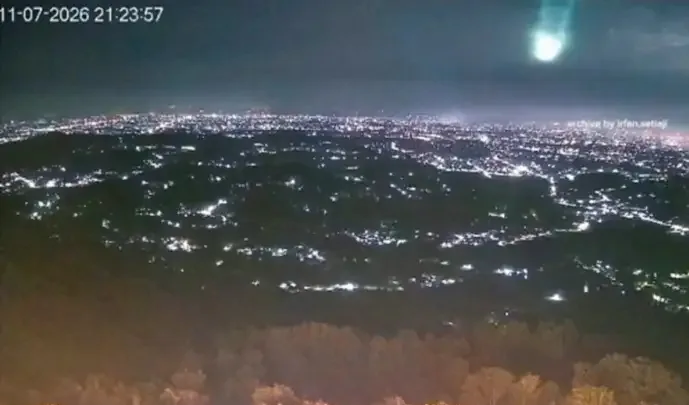
ASIATODAY.ID, JAKARTA — A bright meteor streaked across the night sky over Java on Saturday (July 11), captivating residents across the island after a glowing object was seen moving rapidly through the atmosphere, followed by a loud booming sound reported in several areas.
Indonesia’s National Research and Innovation Agency (BRIN) confirmed that the phenomenon was a large meteor entering Earth’s atmosphere at high speed, dismissing speculation of an explosion or other dangerous event.
BRIN Senior Researcher in Astronomy and Astrophysics Thomas Djamaluddin said the conclusion was based on observations and reports collected from multiple locations across Java.
The meteor was initially detected above the Java Sea before becoming visible from Bekasi at around 9:22:35 p.m. local time. At that stage, the object appeared as a bright white streak while it was still at a relatively high altitude.
“Meteors originate from space rocks that orbit the Sun. When their paths intersect with Earth’s orbit, they enter the atmosphere at extremely high speeds. Friction with the atmosphere heats the surface, causing them to glow,” Thomas explained.
The meteor began producing visible light when it entered the atmosphere at an altitude of approximately 120 kilometers above Earth’s surface. The intense heat triggered ablation, a process in which the surface material of the space rock erodes and creates a bright luminous trail.
Sonic Boom Heard Across Parts of West Java
BRIN’s analysis showed that the meteor traveled southeastward across Java before continuing toward the Indian Ocean region.
As the object entered denser parts of the atmosphere, it became brighter and displayed different colors observed by residents in several locations, including Majalengka, Nagreg, Tasikmalaya, and Yogyakarta.
Residents in Cirebon and Kuningan, West Java, reported hearing a loud boom shortly after the meteor passed. BRIN explained that the sound was caused by a sonic boom, a shock wave produced when an object travels faster than the speed of sound.
“The sound was not caused by an explosion on the ground. The shock wave occurred because the meteor moved at a very high speed through the lower atmosphere and reached observers after a delay,” Thomas said.
The meteor was also reported to have appeared blue in Majalengka and later produced a bright green glow over Yogyakarta.
According to Thomas, these color variations are common in meteor events and are influenced by the chemical composition of the space rock and atmospheric conditions.
The green light is often associated with elements such as magnesium or nickel, which emit distinctive colors when heated to extremely high temperatures during atmospheric entry.
Rare Astronomical Event, No Public Danger
BRIN estimated that the meteor continued moving southeast before losing its energy, with its final trajectory likely ending over the Indian Ocean south of East Java or Bali.
Thomas emphasized that such events are part of natural astronomical processes and do not pose a threat to the public.
Every day, Earth encounters millions of small particles from space, but most burn up completely in the atmosphere. Larger meteors that can be observed across wide areas are far less common, making this event a rare spectacle for people across Java.
“Earth’s atmosphere acts as a natural shield against most objects from space. The public does not need to panic, but understanding the science behind these events is important to prevent misinformation,” Thomas said.
The meteor over Java serves as a reminder of Earth’s continuous interaction with the space environment and highlights the importance of scientific literacy in understanding natural phenomena. (AT Network)
Follow Us at Google News, Instagram, WA Channel, and LinkedIn