
ASIATODAY.ID, AUCKLAND — New Zealand is accelerating its diplomatic outreach across the Pacific and Southeast Asia as geopolitical shifts reshape the Indo-Pacific, strengthening partnerships focused on regional stability, trade, and long-term cooperation.
Foreign Minister Winston Peters hosted a series of high-level meetings with Pacific counterparts in Auckland, reaffirming Wellington’s commitment to closer ties with neighbouring island nations and a stronger regional role.
“In these uncertain geostrategic times in our region, it is more important than ever that we connect with fellow Pacific leaders,” Peters said.
The meetings brought together Niue Prime Minister Dalton Tagelagi, Fiji’s Foreign Affairs and External Trade Minister Sakiasi Ditoka, and Samoa’s Commerce, Industry and Labour Minister Afioga Fata Ryan Schuster.
The discussions highlighted shared priorities, including economic cooperation, trade connectivity, people-to-people links and responses to emerging regional challenges.
New Zealand Deepens Pacific Partnerships
Peters’ meeting with Niue Prime Minister Dalton Tagelagi marked the first in-person engagement between the two leaders since Tagelagi’s re-election in May.
New Zealand reaffirmed its commitment to its constitutional relationship with Niue, built on shared values, close community ties and decades of cooperation.
“New Zealand and Niue’s constitutional relationship remains strong, underpinned by shared values, close people-to-people ties, and a commitment to working together for our mutual benefit,” Peters said.
The Auckland meetings also included Fiji and Samoa, whose representatives attended the Future of Investment and Trade Partnership Ministerial Meeting hosted by New Zealand.
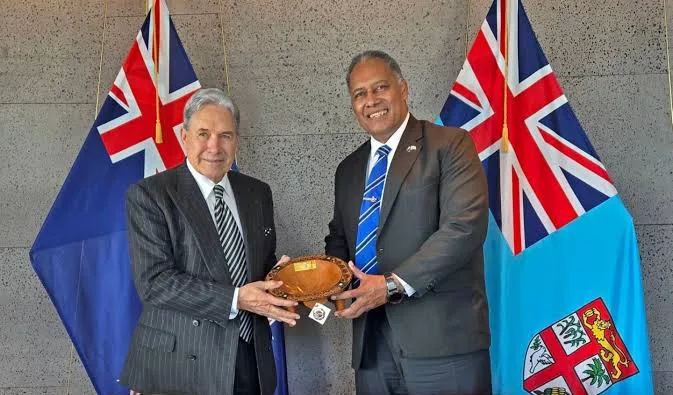
New Zealand and Fiji Renew Strategic Partnership
A key outcome of the diplomatic engagement was the signing of a refreshed Duavata Partnership between New Zealand and Fiji, outlining cooperation priorities for the next five years.
Peters said the agreement reflects the strength of the bilateral relationship and a shared commitment to expanding cooperation across trade, tourism, education, culture, business and community connections.
“New Zealand and Fiji are natural partners, with decades-long ties spanning culture, sport, business, tourism, education, and people-to-people links,” he said.
The two countries also discussed opportunities to strengthen economic integration, including exploratory discussions involving Fiji, New Zealand and Australia under the proposed Ocean of Peace Alliance initiative.
Both sides reaffirmed an ambition to increase two-way trade between New Zealand and Fiji to NZ$2 billion by 2030, highlighting the growing importance of Pacific economic connectivity.
Wellington Expands ASEAN Engagement
Following his Pacific engagements, Foreign Minister Peters will travel to Manila to deepen New Zealand’s relationship with the Philippines and participate in major ASEAN-led diplomatic meetings.
The visit comes as New Zealand and the Philippines mark the 60th anniversary of diplomatic relations, while cooperation between New Zealand and the Association of Southeast Asian Nations (ASEAN) continues to grow.
“Lifting New Zealand’s relationships in Southeast Asia has been a core part of the Government’s Foreign Policy Reset,” Peters said.
With a population of around 700 million people, ASEAN remains a key economic and strategic partner for New Zealand. The regional bloc is New Zealand’s fourth-largest trading partner by value and plays an increasingly important role in trade, energy security, regional stability and economic resilience.
Peters said recent global developments have demonstrated the need for stronger partnerships across the region.
“The past year has underscored how international events can impact New Zealand’s own security and prosperity and reinforced the importance of close partners like ASEAN,” he said.
New Zealand Joins Key Indo-Pacific Forums
During his Manila visit, Peters will participate in several major regional forums, including the ASEAN-New Zealand Foreign Ministers’ Meeting, the East Asia Summit (EAS) Foreign Ministers’ Meeting, and the ASEAN Regional Forum (ARF).
The gatherings bring together Southeast Asian countries and major Indo-Pacific partners, including China, the United States, Japan, India and Australia, to discuss regional security, economic cooperation and stability.
New Zealand’s latest diplomatic initiatives reflect Wellington’s broader strategy to strengthen its role in the Indo-Pacific by maintaining deep Pacific relationships while expanding engagement with Southeast Asia.
As competition and uncertainty continue to influence regional dynamics, New Zealand is positioning partnership, connectivity and cooperation as key pillars of its foreign policy approach.
Foreign Minister Winston Peters departed New Zealand on 20 July and is scheduled to return on 24 July. (AT Network)
Follow Us at Google News, Instagram and LinkedIn