

ASIATODAY.ID, JAKARTA – The UN chief on Thursday issued an urgent call to action to better protect billions around the world exposed to crippling effects of extreme heat, as global temperature rise continues unabated.
The appeal comes against the backdrop of record temperatures and deadly heatwaves – from the United States to Africa’s Sahel and Europe to the Middle East – that have killed several hundred people this summer.
During the Hajj, for instance, scorching heat claimed over 1,300 pilgrim lives.
“Billions of people are facing an extreme heat epidemic – wilting under increasingly deadly heatwaves, with temperatures topping 50 degrees Celsius around the world. That is 122 degrees Fahrenheit – halfway to boiling,” Secretary-General António Guterres said at a press conference at UN Headquarters in New York.
“The message is clear: the heat is on. Extreme heat is having an extreme impact on people and planet. The world must rise to the challenge of rising temperatures.”
Protect the most vulnerable
The UN chief highlighted that while “crippling heat is everywhere”, it does not affect everyone equally.
Those most at risk include the urban poor, pregnant women, children, older persons, those with disabilities, the sick, and the displaced, who often live in substandard housing without access to cooling.
According to UN estimates, heat-related deaths for people over 65 years of age increased by about 85 per cent over the past two decades, while 25 per cent of all children today are exposed to frequent heatwaves and by 2050, that could rise to almost 100 per cent.
“We must respond by massively increasing access to low-carbon cooling, expanding passive cooling – such as natural solutions and urban design and cleaning up cooling technologies while boosting their efficiency,” Mr. Guterres said, calling for scaling up of finances to protect communities from “climate chaos”.
Protect workers
Mr. Guterres also underscored the need to step up protections for workers.
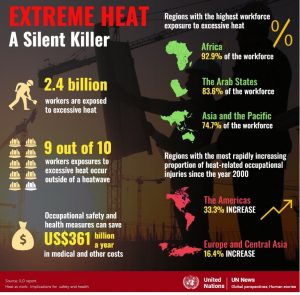
Over 70 per cent of the global workforce, or 2.4 billion people, are at substantial risk of extreme heat, according to new report from the UN International Labour Organization (ILO).
The situation is particularly dire in the Africa and Arab regions, where more than 90 per cent and 80 per cent of workers are exposed, respectively. In Asia and the Pacific – the world’s most populous region – that figure is three in four workers (75 per cent).
In addition, heat stress at work is projected to cost the global economy $2.4 trillion by 2030, up from $280 billion in the mid-1990s.
“We need measures to protect workers, grounded in human rights,” Mr. Guterres stressed.
“And we must ensure that laws and regulations reflect the reality of extreme heat today – and are enforced.”
Boost resilience
He also underscored the need to strengthen resilience of economies and societies, citing impacts such as infrastructure damage, crop failures, and increased pressure on water supplies, health systems, and electricity grids.
Cities are particularly vulnerable, experiencing heating at twice the global average rate.
To address these challenges, Mr. Guterres called for comprehensive and tailored action plans based on scientific data are essential for countries, cities and sectors.
“We need a concerted effort to heatproof economies, critical sectors and the built environment.”
Fight the disease
The UN chief reiterated that it is crucial to recognize the myriad symptoms beyond extreme heat, such as hurricanes, floods, droughts, wildfires and rising sea levels.
The core issue is the reliance on fossil fuels and climate inaction, he stated, stressing that governments, especially G20 nations, the private sector, cities and regions, must urgently adopt climate action plans to limit global temperature rise to 1.5°C.
Alongside, countries must urgently phase-out fossil fuels and end new coal projects.
“They must act as though our future depends on it – because it does.” (UN News)
Follow Us at Google News and WA Channel