
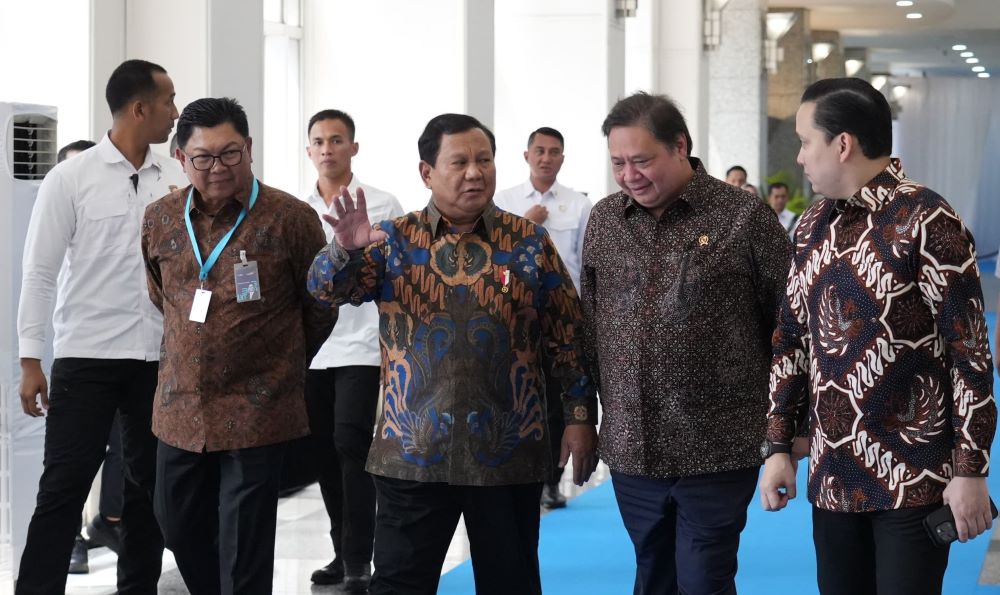
ASIATODAY.ID, JAKARTA – The Government of Indonesia, through the Coordinating Ministry for Economic Affairs, held the National Economic Sarasehan led directly by the President of the Republic of Indonesia, Prabowo Subianto, in Jakarta, April 8, 2025. The event marked a strong reaffirmation of the government’s commitment to building a resilient, self-reliant economy amid the escalating complexity of global economic challenges.
In his keynote address, President Prabowo emphasized the importance of economic sovereignty as the cornerstone in countering global protectionism and uncertainty driven by major world economies.
“The world’s strongest economies are unilaterally imposing high tariffs, creating global instability. That is why I strongly urge: let us build our economy to stand on our own feet,” President Prabowo firmly stated.
Indonesia’s Economic Fundamentals Remain Strong
Coordinating Minister for Economic Affairs, Airlangga Hartarto, highlighted that Indonesia’s macroeconomic fundamentals remain solid, with key indicators reflecting national economic resilience:
- Stable economic growth at 5% (yoy)
- Low inflation at 1.03% (yoy) as of March 2025
- Consumer Confidence Index (CCI) at an optimistic level of 126.4 (Feb 2025)
- Manufacturing PMI in expansion zone at 52.4 (Mar 2025)
- Robust banking sector with credit growth of 10.42% and a capital adequacy ratio (CAR) of 27%
Indonesia also improved its global position in the World Competitiveness Ranking 2024, securing the 27th spot out of 67 countries. Additionally, the country’s Sovereign Credit Rating (SCR) remains one notch above Investment Grade, supported by strong domestic demand and credible fiscal and monetary policies, according to Moody’s.
Strategic Response to Global Economic Risks
Minister Airlangga further noted that 2025 presents significant global risks, including rising geopolitical tensions, intensified protectionism, and tighter monetary policies in developed economies. In response, the Indonesian government has adopted several strategic measures:
- Revitalization of the Trade and Investment Framework Agreement (TIFA) with the United States
- Deregulation of trade policies, including relaxation of Non-Tariff Measures (NTMs) and Domestic Component Level (TKDN) for the ICT sector
- Trade balance adjustment through strategic imports such as soybeans, LPG, LNG, and engineering equipment
- Fiscal and non-fiscal incentives to maintain the competitiveness of Indonesian exports
Key export products such as apparel and footwear are seen as having a significant advantage in penetrating the US market due to lower tariff barriers compared to peers like Vietnam, Bangladesh, and Cambodia.
Medium-Term Policies and Global Market Expansion
To support sustained growth, the government is also implementing medium-term economic strategies, including: job creation through labor-intensive industries, optimization of foreign exchange from natural resource exports, development of a national bullion industry, global market access expansion via multilateral agreements including IEU-CEPA, RCEP, IPEF, and CP-TPP. These initiatives are designed to further solidify Indonesia’s position in 83% of global trade, supporting long-term economic sovereignty.
The National Economic Sarasehan was attended by prominent national figures including the Governor of Bank Indonesia, the Chair of the National Economic Council, several cabinet ministers and deputy ministers, the Chairman of the Financial Services Authority (OJK), the Chairman of the Indonesia Deposit Insurance Corporation (LPS), as well as representatives from business associations, capital market analysts, and labor unions.
This forum demonstrated the power of national collaboration in facing global headwinds and reaffirmed the nation’s determination to ensure Indonesia’s sustainable economic growth through inclusive and self-sufficient development. (AT Network)
Follow Us at Google News and WA Channel