

ASIATODAY.ID, WASHINGTON — Indonesian President Prabowo Subianto concluded his high-profile visit to the United States with a headline-grabbing outcome: 11 Memoranda of Understanding (MoUs) worth a combined US$38.4 billion signed between Indonesian and American companies.
The agreements, unveiled during a high-level business roundtable in Washington, D.C., mark one of the largest economic commitments secured by Indonesia in recent years.
But beyond the impressive numbers, the key question remains: What tangible benefits will Indonesia ultimately gain?
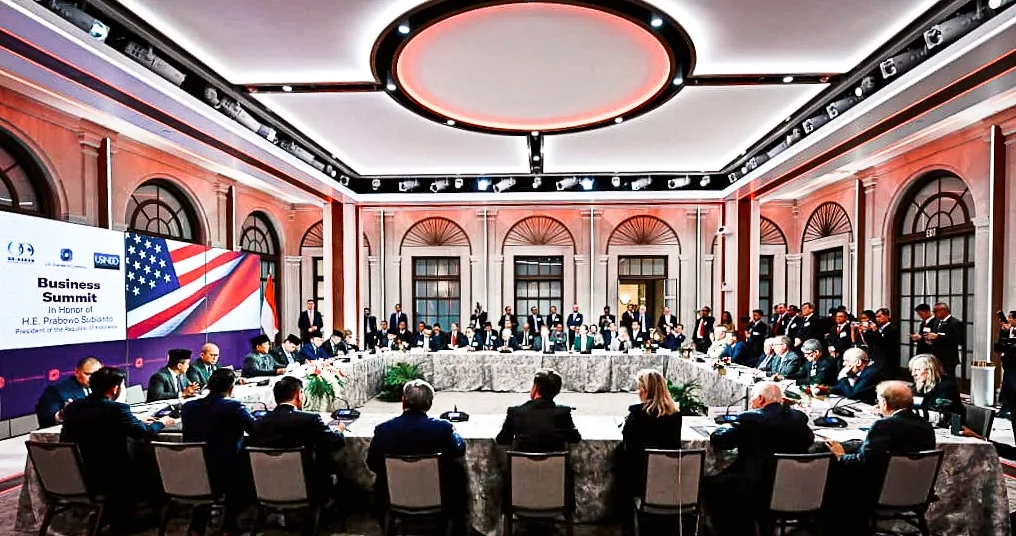
11 Strategic Agreements Across Key Sectors
The MoUs were signed during a Business Summit hosted by the US-ASEAN Business Council at the U.S. Chamber of Commerce on February 18, 2026.
According to Indonesia’s State Secretariat, the agreements demonstrate “concrete collaboration between the public and private sectors of both countries.”
The 11 MoUs Cover:
1. Critical Minerals
Indonesia’s Investment Ministry – Freeport-McMoRan – PT Freeport Indonesia
2. Oilfield Recovery Technology
Pertamina – Halliburton
3. Corn Procurement
PT Cargill Indonesia – PT Arena Agro Andalan – Cargill Inc.
4–5. Cotton Supply Agreements
Busana Apparel Group & Daehan Global – U.S. National Cotton Council
6. Recycled Textile Materials
AGTI – Pan Brothers Tbk – Ravel
7. Furniture Trade Cooperation
ASMINDO – Bingaman and Son Lumber, Inc.
8–9. Semiconductor Partnerships
Galang Bumi Industri (GBI) – Essence
GBI – Tynergy Technology Group
10. Transnational Free Trade Zone Initiative
GBI – Solanna Group LLC
11. Wood Products Collaboration
HIMKI – American Hardwood Export Council
Not all agreements disclose specific financial values, particularly in furniture and trade zone initiatives. However, the combined headline figure of US$38.4 billion significantly exceeds the earlier US$7 billion estimate previously cited by U.S. business representatives.
Why the Jump from $7 Billion to $38.4 Billion?
Earlier discussions reportedly included U.S. agricultural exports to Indonesia — including 1 million tons of soybeans, 1.6 million tons of corn, and 93,000 tons of cotton.
The expanded total now reflects broader strategic sectors, including:
– Critical minerals and downstream mining
– Energy recovery technology
– Semiconductor supply chain development
– Textile and manufacturing partnerships
– Potential extension of PT Freeport Indonesia’s mining operations beyond 2041
This signals a deeper economic alignment, particularly in sectors crucial to global supply chain resilience and industrial policy.
Prabowo’s Core Message: Stability and Legal Certainty
Speaking before American business leaders, President Prabowo emphasized that investment flows depend on governance reform and policy predictability.
“No one wants to invest in uncertainty or instability,” he said.
He acknowledged Indonesia’s structural weaknesses, including governance and corruption challenges, while reaffirming his administration’s commitment to reform, fiscal discipline, and institutional strengthening.
Key economic indicators presented:
– US$53 billion in foreign investment recorded last year
– Stable and improving economic growth trajectory
Prabowo positioned Indonesia as a long-term partner seeking serious investors for modernization and industrialization.
Selling Indonesia’s Transformation Agenda
Beyond trade deals, Prabowo used the Washington forum to promote Indonesia’s domestic transformation programs.
Digital Education Acceleration
– Over 280,000 interactive smart screens distributed to schools nationwide
– Goal: fully digital classrooms across Indonesia before the end of his term
Danantara Sovereign Investment Strategy
The establishment of Danantara, a state asset management body, aims to consolidate state-owned assets and accelerate 18 downstream industrial projects.
Waste-to-Energy Projects
A US$3 billion initiative focused on environmentally sustainable infrastructure.
The message to U.S. corporations was clear: Indonesia is not just a market — it is positioning itself as a production base and strategic hub for the region.
Beyond Economics: Diplomacy and Global Stability
Prabowo’s visit also included a meeting with U.S. President Donald Trump, reportedly in connection with a Peace Board initiative aimed at supporting ceasefire implementation in Gaza.
This underscores Indonesia’s dual-track diplomacy — strengthening economic ties while maintaining an active role in global peace initiatives.
The Big Question: Commitments or Concrete Impact?
While the US$38.4 billion figure is politically and diplomatically significant, implementation will determine the real outcome.
Key factors to watch:
– How quickly projects transition from MoUs to binding contracts
– Realization of investment flows into Indonesia
– Job creation and industrial capacity expansion
– Technology transfer and supply chain integration
If executed effectively, the visit could mark a turning point in Indonesia–U.S. economic relations and reinforce Indonesia’s ambition to become a major industrial power by 2045. (AT Network)
Follow Us at Google News and WA Channel